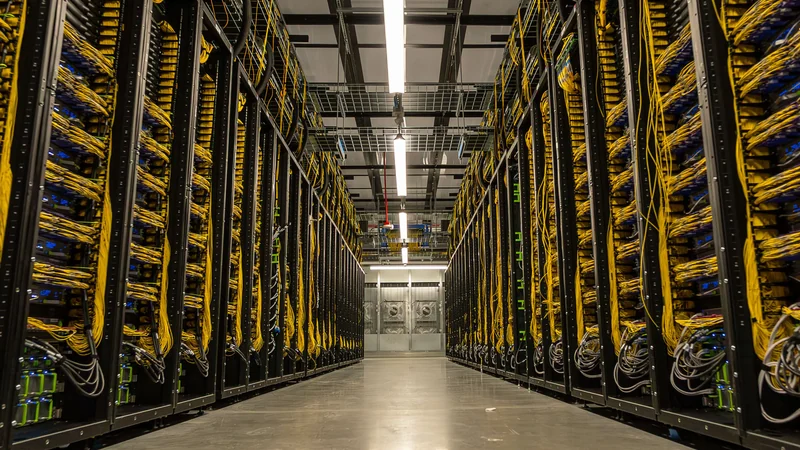
Meta Unveils Open AI Networking Innovations at OCP Summit
At the 2026 Open Compute Project Global Summit, Meta detailed its latest infrastructure breakthroughs designed to support modern AI scale-up, scale-out, and scale-across network environments.
 Radwan AbdulhadiEditor and technology writer

Introduction to Open AI Networking at the OCP Summit
At the 2026 Open Compute Project (OCP) Global Summit, Meta presented comprehensive network architectures and hardware innovations directly supporting its latest generation of AI initiatives. The updates cover end-to-end infrastructure advancements tailored to handle massive machine learning workloads across scale-up, scale-out, and scale-across topologies, which power cutting-edge deployments including the gigawatt-scale Prometheus cluster.
The shared infrastructure breakthroughs arrive as modern artificial intelligence models demand unprecedented coordination between compute facilities and network fabrics. Meta outlined these developments across multiple technical sessions and hardware demonstrations, highlighting ongoing work with industry partners.
Advanced Hardware for Liquid-Cooled Racks and Scale-Out Fabrics
Among the hardware highlights are IcePack and IceCube, representing Meta’s first liquid-cooled network rack configuration featuring 102.4T switch blades. These blades offer 128 by 800G capacities using Broadcom Tomahawk 6C and NVIDIA Spectrum-6 variants while running FBOSS. Alongside hardware integration, Meta detailed its Flattened Planar Fabric designed for scale-out environments, connecting each GPU across eight network planes to improve multi-plane traffic distribution.
Furthermore, Meta presented progress on its Tahan Ethernet scale-up switch built for the MTIA 300 architecture. The hardware roadmap also previewed configurations capable of supporting 72 accelerators per rack on 102.4T silicon alongside evolving Ethernet scale-up specifications.
Standardization and Open-Source Software Initiatives
To address historical fragmentation in network hardware control layers, Meta, Microsoft, and Alibaba jointly introduced OSPA as a new OCP initiative. OSPA aims to standardize the switch platform layer, with the initial v1.0 specification officially submitted to the Open Compute Project to simplify multi-vendor integration and reduce duplicated platform bring-up efforts.
In addition to hardware standards, Meta announced that its specialized RDMA transport protocol built for high-performance AI clusters is being made available to the broader open-source community, fostering collaboration across the AI networking ecosystem.
Connecting Regional Infrastructures and AI Workloads
To connect massive infrastructure footprints across buildings, campuses, and geographic regions, Meta highlighted its petabit-scale super-spine networking solution known as BAG. Operating alongside SRv6 regional backbones managed via FBOSS and SAI, these wide-area architectures are designed to maintain reliable data flow and low latency across the company's largest AI superclusters.
The entire suite of networking innovations serves to anchor demanding computation tasks required by advanced systems such as Muse Wonder and Muse Spark, ensuring that underlying networks scale efficiently alongside expanding GPU pools.
Sources
- Meta EngineeringMeta Networking at the 2026 OCP Global Summit: Open Innovation for Scale-Up, Scale-Out, and Scale-Across AI Networks
Continue chronologically

Related entity coverage
Related stories
Meta Unveils Next-Gen AI Networking at OCP Summit 2026
At the 2026 Open Compute Project Global Summit, Meta showcased open networking innovations including the IcePack liquid-cooled rack and FPF fabric architecture.
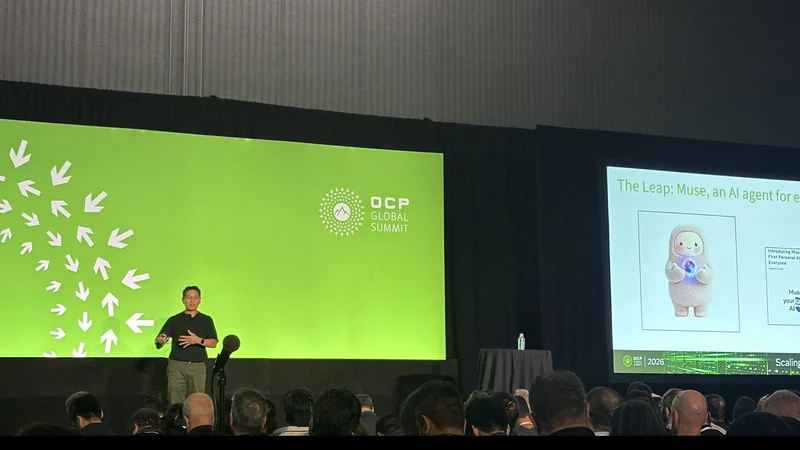
NVIDIA Opens Vera Rubin Architecture to Scale AI Factories
NVIDIA unveiled key rack and compute tray designs for the Vera Rubin architecture at the OCP Global Summit to help scale global AI factories.
Microsoft Unveils Agentic AI Features and Surface Laptop Ultra
Microsoft detailed its agentic AI vision and showcased the Surface Laptop Ultra powered by NVIDIA's RTX Spark chip at a hardware and software event.

Meta Unveils Prometheus Gigawatt-Scale AI Supercluster
Meta completes the first phase of its Prometheus gigawatt-scale supercluster in Ohio, powering frontier models with hundreds of thousands of GPUs.