AWS Introduces Support for Reflection AI's Beam
Amazon Web Services has introduced deployment pathways for Reflection AI's open-weight model, Beam, designed for agentic coding and long-horizon tasks on Amazon SageMaker.
 Radwan AbdulhadiEditor and technology writer

Overview of Reflection Beam
Reflection AI has introduced Beam, an open-weight model tailored for agentic coding and long-horizon tasks such as maintaining code, interpreting results, utilizing tools, and completing complex multi-step workflows. According to the [AWS Machine Learning Blog](https://aws.amazon.com/blogs/machine-learning/introducing-reflection-beam-an-open-weight-model-for-agentic-coding-on-aws/), the release provides developers and researchers with extensive control over the runtime, customization process, and deployment environment.
The model functions as a sparse mixture-of-experts system featuring 501 billion total parameters and 23 billion active parameters, alongside an effective context length of 1 million tokens. Reflection AI distributes Beam's weights through Hugging Face under the Apache 2.0 license, offering BF16, FP8, and NVFP4 checkpoint variants to accommodate various memory footprints and hardware compatibilities.
Deployment Pathways on AWS
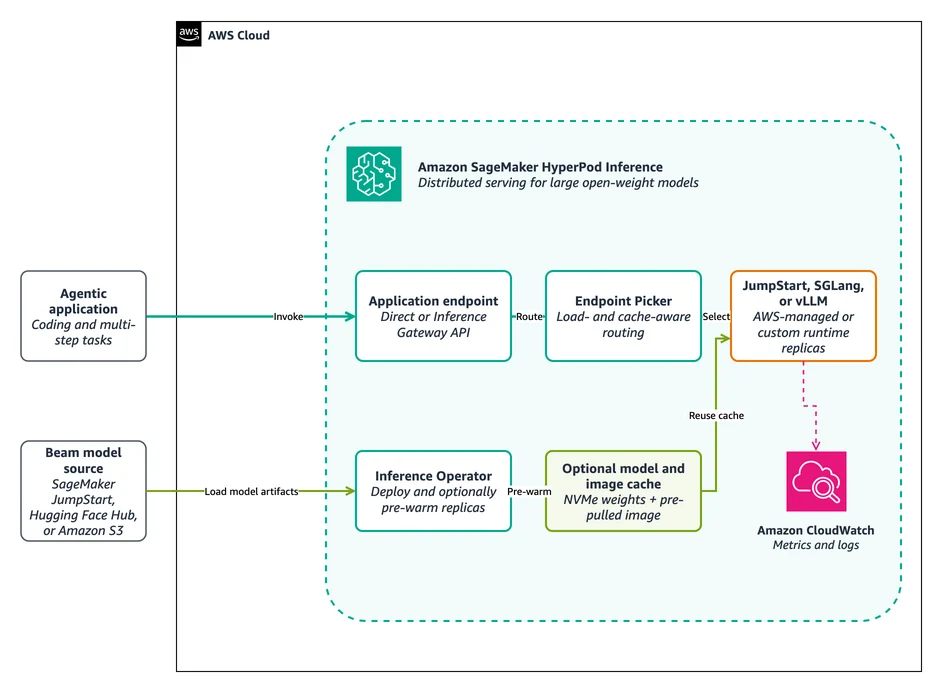
Developers can deploy Beam on AWS utilizing different pathways depending on their control and scaling needs. For a fully managed path, users can start with an Amazon SageMaker JumpStart real-time endpoint. Alternatively, engineers requiring Kubernetes-native control over distributed GPU infrastructure can utilize [Amazon SageMaker HyperPod Inference](https://docs.aws.amazon.com/sagemaker/latest/dg/sagemaker-hyperpod-model-deployment.html) alongside JumpStart, SGLang, or vLLM.
At launch, Beam is available within Amazon SageMaker JumpStart specifically in the US East (N. Virginia) and US East (Ohio) regions. The managed JumpStart real-time path packages the model, container, and endpoint behind a streamlined managed deployment workflow.
Architecture and Hardware Requirements
Beam's large parameter footprint requires multi-GPU deployments. Because BF16 possesses the largest weight-memory requirement, multi-node configurations must account for aggregate GPU memory dedicated to weights and runtime overhead. For FP8 configurations, recommended instances include ml.p5.48xlarge with NVIDIA H100 GPUs or ml.p5e.48xlarge and ml.p5en.48xlarge with H200 GPUs. Meanwhile, NVFP4 variants are designed for ml.p6-b200.48xlarge instances featuring NVIDIA B200 GPUs.
To ensure successful implementation, users are advised to calculate memory usage for weights, KV cache, and runtime overhead for a single replica before validating the estimates via load testing. Teams can choose between on-demand capacity or utilize short-term reservations via a SageMaker training plan.
Getting Started with JumpStart and HyperPod
The initial setup process involves cloning the official sample repository, creating a Python virtual environment, and installing required dependencies. For quick evaluations, developers can execute bounded deployment scripts using variant-aware commands that target specific checkpoints like FP8 or NVFP4.
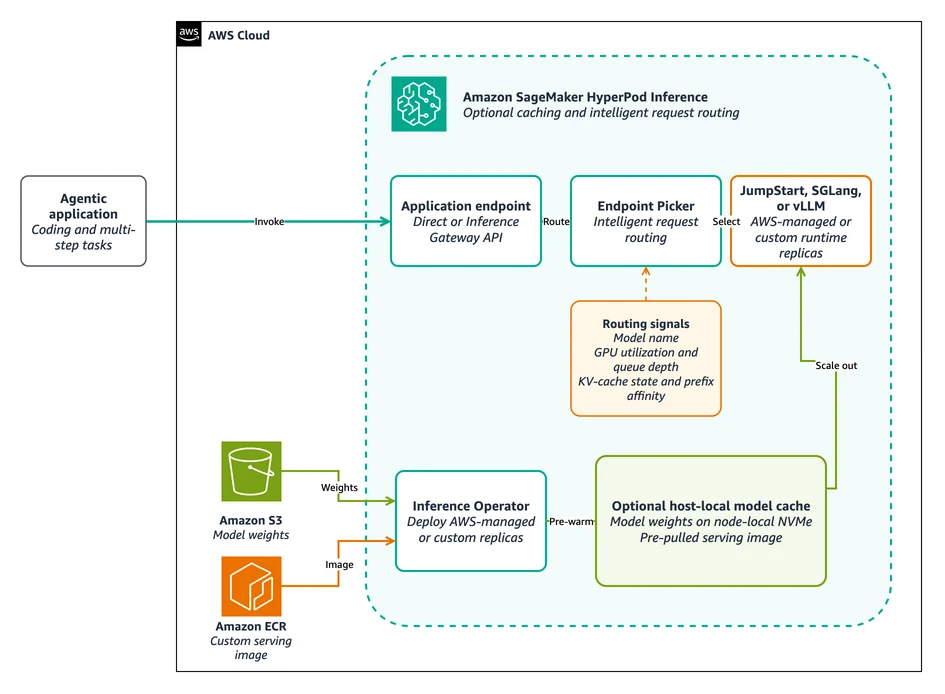
For advanced production scenarios, the HyperPod Inference option allows technical teams to configure customized runtime arguments, quantization parameters, and distributed execution strategies across an Amazon EKS-orchestrated cluster.
Sources
- AWS Machine Learning BlogIntroducing Reflection Beam: an open-weight model for agentic coding on AWS
Continue chronologically
Related entity coverage
Related stories
Reflection Debuts Beam AI Model to Rival Chinese Competitors
Reflection AI unveils Beam, its first open-weight text-only model designed to rival Chinese reasoning benchmarks at a lower compute cost.

Manage SageMaker HyperPod Spaces Directly from Studio
Data scientists and machine learning engineers can now create, configure, start, stop, and open Amazon SageMaker Spaces directly from SageMaker Studio.
Hugging Face Skills Automate SageMaker Model Deployments
Hugging Face and AWS release open-source agent skills, letting coding agents automate production-ready model deployments on Amazon SageMaker AI.
Deploying NVIDIA Nemotron 3.5 Super VL on AWS EKS and SageMaker
Learn how to deploy the NVIDIA Nemotron 3.5 Super VL mixture-of-experts model on Amazon EKS, EKS Auto Mode, and SageMaker HyperPod EKS.