GLM 5.3 Launches on Amazon Bedrock for Coding and Agents
Z.ai has brought its 753B-parameter mixture-of-experts model to Amazon Bedrock, providing enterprise developers with fully managed infrastructure for complex coding and long-horizon agentic workloads.
 Radwan AbdulhadiEditor and technology writer
Introduction to GLM 5.3 on Amazon Bedrock
Complex software engineering and long-running agentic tasks require advanced artificial intelligence models capable of maintaining context across multi-step workflows and hundreds of repository files. To meet these demands without requiring organizations to build and maintain their own inference infrastructure, Z.ai has launched GLM 5.3 on Amazon Bedrock.
Initially published on the Hugging Face Hub, the model is built as a 753B-parameter mixture-of-experts system. Eligible enterprise customers can deploy the model on Amazon Bedrock using fully managed APIs, cross-Region inference, prompt caching, and custom service tiers without managing any underlying hardware.
Core Performance and Capabilities
Building upon the lineage of earlier releases, GLM 5.3 introduces significant performance improvements across software development and security evaluations. According to Z.ai claims, the model delivers competitive results across multiple coding benchmarks including DeepSWE, FrontierSWE, and Terminal Bench 3.0, alongside notable gains over previous iterations.
In addition to software engineering, the model exhibits emergent capabilities in cybersecurity tasks. Z.ai measured a prominent score on the CyberGym benchmark during its official release, positioning the architecture as a strong candidate for defensive security tools and authorized automated penetration testing workflows.
API Integration and Prompt Caching
Developers can invoke GLM 5.3 through standard Amazon Bedrock endpoints or via OpenAI-compatible Responses and Chat Completions APIs. For new applications, the OpenAI-compatible interfaces are recommended because they support an expanded feature set and flexible integration patterns.
To help manage operational expenses during high-volume agentic operations, GLM 5.3 supports both implicit and explicit prompt caching. Because automated agents frequently resend large system instructions or repository contexts over multiple conversation turns, caching helps minimize both input latency and financial costs.
Cross-Region Inference and Service Tiers
Amazon Bedrock supports the model via dedicated cross-Region inference options, including US-specific and global configurations. Users can route requests to a chosen source AWS Region, allowing the platform to dynamically route requests for efficient processing. Additional information regarding routing behavior can be found in the Amazon Bedrock User Guide.
Furthermore, administrators can select among three distinct service tiers depending on workload priorities. Organizations can choose the Flex tier for cost optimization on flexible schedules, the Priority tier for time-sensitive requests, or the Standard tier to maintain a balanced compromise between speed and cost.
Prerequisites and Access Requirements
Deploying and calling GLM 5.3 requires an active AWS account with explicit access enabled for Amazon Bedrock. Engineers must also configure standard Identity and Access Management permissions, including authorizations to call base models and target inference profiles as outlined in official documentation.
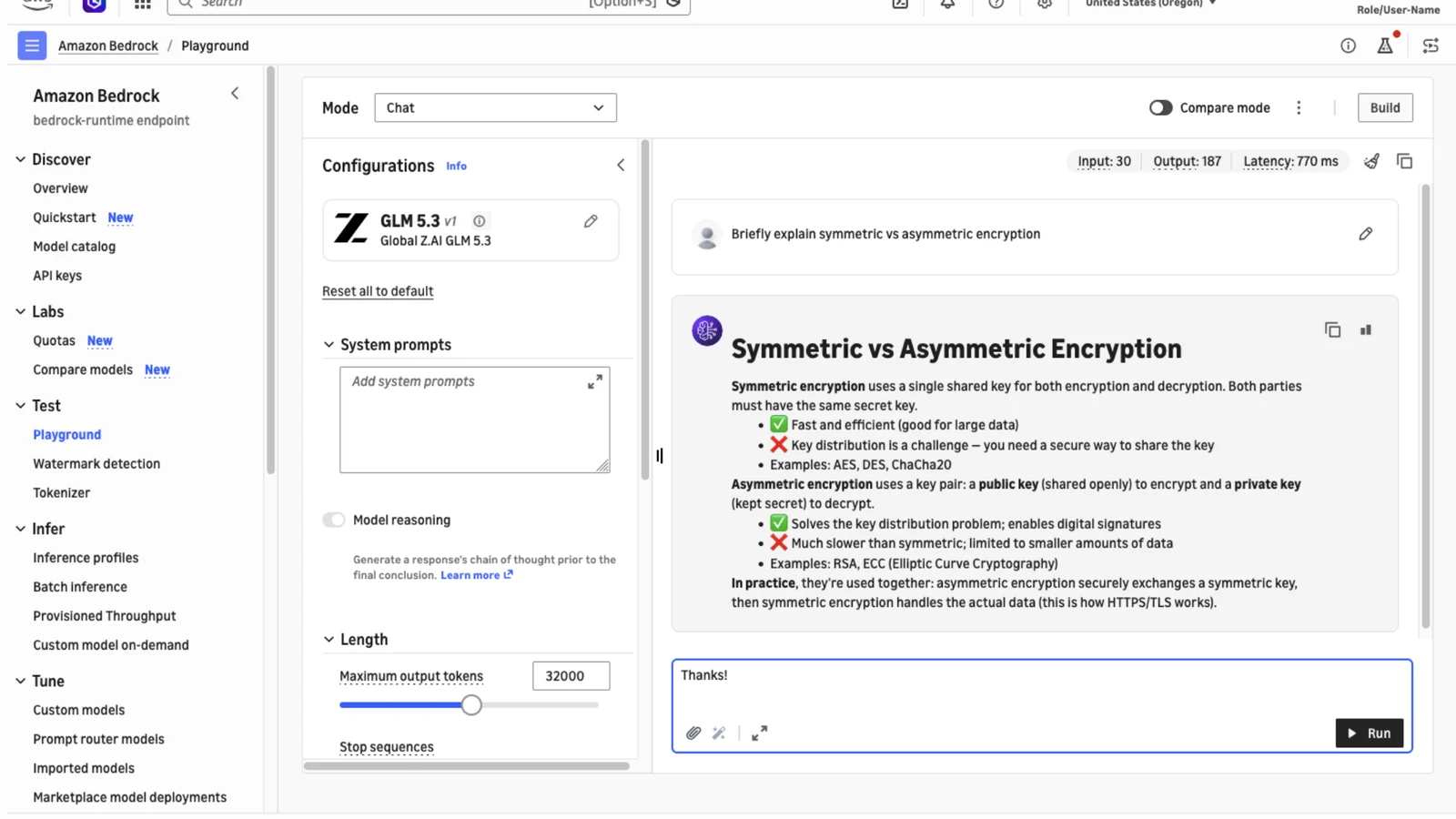
For development workflows, users can test the model directly inside the AWS Management Console playground or build code integrations using Python 3.10 or later alongside security testing frameworks like Strix configured with the bedrock extra.
Sources
- AWS Machine Learning BlogIntroducing GLM 5.3 on Amazon Bedrock
Continue chronologically

Related entity coverage
Related stories
Build Multi-Agent Pipelines with Amazon Bedrock AgentCore
Learn how to build a multi-agent music production pipeline on Amazon Bedrock AgentCore Runtime Instances using shared sessions and GPU infrastructure.

Query Claims in Natural Language With Amazon Bedrock
Learn how to build a conversational claims assistant using Amazon Bedrock Knowledge Bases to answer natural-language queries with citations.
Amazon Bedrock brings Claude models to India for local data processing
Amazon Bedrock expands Anthropic's Claude model availability to India using geographic cross-Region inference, keeping data processing local.
Agentic Retrieval with LangChain and Amazon Bedrock
Explore building Retrieval Augmented Generation applications using LangChain and Amazon Bedrock Managed Knowledge Base for complex multi-part questions.