OpenAI Adding Invisible Watermarks to EU Text and Code
OpenAI is preparing to deploy invisible watermarks for text generated by ChatGPT and Codex within the European Union, aligning with new regional transparency requirements.
 Radwan AbdulhadiEditor and technology writer

Complying with EU Transparency Rules
OpenAI is preparing to introduce invisible watermarks to text and code generated by ChatGPT and Codex within the European Union, as [explained] in recent company documentation. This move is designed to comply with the European Union's new AI transparency rules, specifically addressing mandates that require generative AI system providers to make text outputs identifiable in a machine-readable way.
While the technology is being automatically implemented for eligible regional outputs, OpenAI is not making watermarking a global default. However, starting immediately, API developers worldwide can opt in to watermarking for supported models.
How textGrain Technology Works
The underlying mechanism, called textGrain, does not alter the appearance of the text when read or copied by users. Instead, it slightly adjusts the model's word choices to generate a distinct statistical pattern that specialized detectors can later recognize.
OpenAI notes that the proprietary system matches or exceeds the performance of alternative frameworks such as [SynthID for text], though the company emphasizes that ideal lab conditions do not guarantee seamless everyday reliability.

Limitations and Editing Vulnerabilities
Despite its utility under controlled evaluations, text watermarking remains vulnerable to basic text manipulation. OpenAI's internal tests indicate that normal editing significantly diminishes detection capabilities. For instance, in an assessment of 400-token passages, substituting just 10 percent of words with synonyms dropped detection rates from approximately 92 percent down to 66 percent.
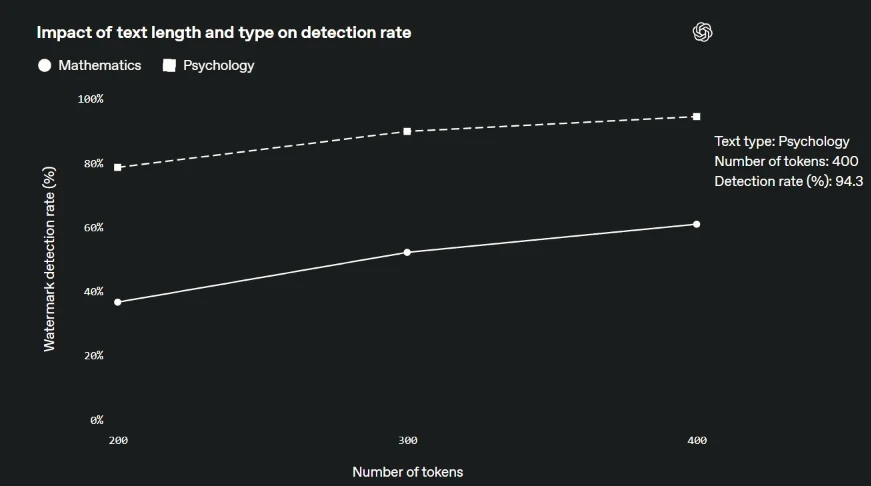
When 25 percent of the words were replaced, the detection rate fell sharply to 17 percent. Shorter passages also pose challenges; detection stood at roughly 95 percent for 400-token psychology responses, but dropped to about 80 percent for 200-token texts. Furthermore, performance suffered in academic domains like mathematics, where models have fewer alternative phrasing options.

Detector Access and Privacy Safeguards
OpenAI is opening applications for its watermark detector, but initial availability will be strictly limited to approved researchers and expert organizations. The organization has also clarified privacy boundaries regarding the scanning process.
According to the company, a detected watermark does not expose the user's account, specific prompts, conversation history, or the exact proportion of human versus machine contribution in the final text. OpenAI also cautions that the absence of a positive watermark detection does not definitively prove human authorship.
Sources
- BleepingComputerOpenAI is adding invisible watermarks to ChatGPT and Codex text in the EU
- EngadgetOpenAI will add a digital watermark to text and code generated in the EU
Continue chronologically
Related entity coverage
Related stories
OpenAI to Watermark ChatGPT Text in the European Union
OpenAI is rolling out invisible watermarks for ChatGPT and Codex text outputs in the European Union to comply with the new AI Act.
OpenAI Details Text Watermarking Approach for EU AI Act
OpenAI announces its phased text watermarking approach under the EU AI Act, featuring textGrain technology, API opt-ins, and researcher access.

OpenAI Introduces Text Watermarking in ChatGPT and Codex
OpenAI is rolling out invisible machine-readable watermarks for ChatGPT and Codex in the EU to comply with transparency rules.

OpenAI Hosts DevDay 2026 With Over 20 Major Announcements
OpenAI highlights more than 20 major announcements at DevDay 2026, introducing new agents, Codex updates, models, and builder tools.