Grok 4.7 Arrives on Amazon Bedrock for Long-Horizon Agents
SpaceXAI's advanced model arrives on Amazon Bedrock, introducing configurable reasoning effort settings and strong support for long-horizon agent workflows.
 Radwan AbdulhadiEditor and technology writer
Grok 4.7 Lands on Amazon Bedrock
SpaceXAI’s Grok 4.7 is now available on Amazon Bedrock, expanding the platform's wide selection of foundation models from multiple leading providers. According to SpaceXAI, Grok 4.7 is specifically trained to execute longer operations on challenging tasks, utilizing an advanced capability to verify its own work along the way. This capability is crucial for multi-step agent architectures that must carry out prolonged assignments and continuously validate intermediate findings.
Unlike standard look-up models, agents powered by this architecture must form candidate solutions, test them against gathered information, and refine outcomes until they meet exact criteria. To support this, Grok 4.7 exposes a tunable reasoning effort setting that controls deliberation volume before generating each response. For developers designing complex agent workloads, choosing the correct reasoning level is a vital optimization decision.
Training Improvements and Architectural Advantages
According to SpaceXAI, Grok 4.7 utilizes a substantially larger base model than its predecessor, Grok 4.6. The updated model was trained through an extended reinforcement learning run utilizing a much harder mix of tasks. This training curriculum heavily weights problems requiring many hours to resolve, empowering the underlying system to handle prolonged context windows and perform rigorous self-verification.
Published benchmark scores released alongside the launch reflect this core emphasis on sustained execution. The most notable performance improvements over Grok 4.6 appear in evaluation categories that measure long-horizon work quality rather than simple single-turn query completions.
Evaluating Reasoning Effort and Token Costs
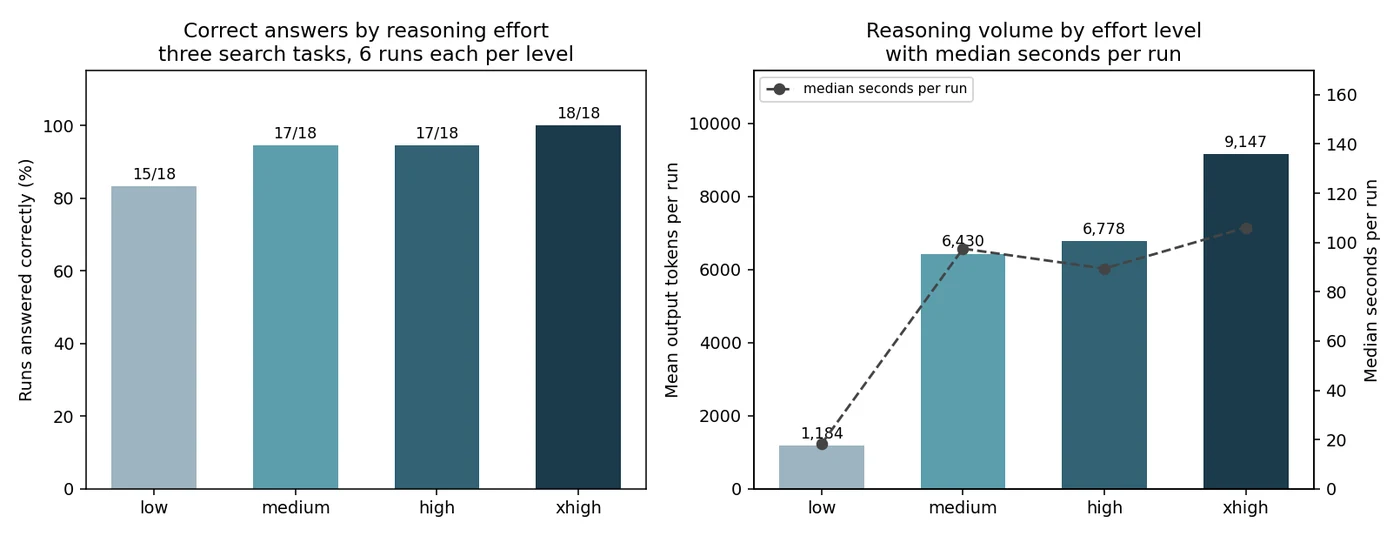
To understand how reasoning settings influence performance, technical evaluations were conducted using a custom tool-calling agent tested across three distinct reasoning tasks requiring active search rather than simple data retrieval. The evaluated tasks included diagnosing a complex two-service outage from alerts, scheduling system maintenance under interdependent constraints, and choosing an optimal set of code or data migrations within a strict budget constraint.
Across multiple test runs spanning four distinct reasoning effort tiers—low, medium, high, and xhigh—researchers measured correct completions against output token consumption. At the highest effort tier ('xhigh'), the agent successfully solved every tested scenario, whereas the lower tier successfully completed a significant majority while consuming a fraction of the output tokens. This predictable trade-off allows engineering teams to tailor reasoning settings precisely to individual request requirements.
Technical Specifications and API Integration
SpaceXAI lists a comprehensive 500K token context window for Grok 4.7, accommodating multi-modal text and image inputs alongside text outputs. Within the Amazon Bedrock ecosystem, the model natively supports configurable reasoning effort parameters, complex tool-calling mechanics, and structured output generation.
To achieve optimal throughput without manually managing infrastructure across multiple availability zones, deployments typically utilize cross-Region inference profiles. These profiles route inference requests efficiently across eligible AWS Regions while simplifying overall resource management.
Deployment Guidelines and Best Practices
Deploying Grok 4.7 on Amazon Bedrock requires an active AWS account with model access properly enabled and correctly configured IAM permissions. Security best practices for production environments recommend generating short-term bearer tokens derived from existing IAM credentials, avoiding the storage of long-lived secrets.
Developers must also properly provision output token limits to account for reasoning tokens, which are generated before the primary answer text is compiled. Ensuring adequate token headroom prevents truncation issues and ensures that long-horizon agent loops execute reliably in production settings.
Sources
- AWS Machine Learning BlogBuild long-horizon agents with Grok 4.7 on Amazon Bedrock
Continue chronologically

Related entity coverage
Related stories
Building Agentic Retrieval on Amazon Bedrock with AWS CDK
Learn how to build enterprise agentic retrieval on a Managed Amazon Bedrock Knowledge Base using the AWS CDK and Amazon Bedrock AgentCore.
Amazon Bedrock AgentCore Automates PowerPoint Generation
Learn how the new Amazon Bedrock AgentCore AI agent system automates PowerPoint presentation creation from enterprise documents in under 90 seconds.
OpenAI GPT Models Arrive on Amazon Bedrock in Asia
Amazon Bedrock brings OpenAI GPT-6 models to Thailand, Malaysia, Singapore, Indonesia, and Taiwan using global cross-Region inference.
Build Multi-Agent Pipelines with Amazon Bedrock AgentCore
Learn how to build a multi-agent music production pipeline on Amazon Bedrock AgentCore Runtime Instances using shared sessions and GPU infrastructure.