
Amazon Bedrock Adds Anthropic In-Region Inference in Seoul and Singapore
Amazon Bedrock has introduced in-region inference support for Anthropic models in Seoul and Singapore, enabling local data processing for regulated sectors.
 Radwan AbdulhadiEditor and technology writer
Expanding In-Region Inference to Seoul and Singapore
According to the AWS Machine Learning Blog, Amazon Bedrock has added support for Anthropic Claude models with dedicated in-region inference capabilities in Seoul and Singapore. Organizations with strict local data processing mandates—such as those operating in healthcare, financial services, and the public sector—can now deploy these generative artificial intelligence technologies at scale while ensuring data stays localized.
The update brings Claude Opus 5 and Claude Sonnet 5 to the Asia Pacific (Seoul) Region, alongside Claude Sonnet 5 in the Asia Pacific (Singapore) Region. Because these deployments operate on the bedrock-runtime endpoint without a separate cross-Region routing layer, input prompts and generated output results remain entirely contained within the targeted single AWS Region throughout their entire lifecycle.
Technical Architecture and Regional Constraints
Operating via in-region inference means throughput is bounded directly by the capacity of the chosen Region, with requests subject to specific per-Region service quotas. Standard on-demand pricing applies to the called Region, and monitoring tools like Amazon CloudWatch metrics and AWS CloudTrail log entries are scoped locally without source-versus-destination distinctions.
For new workloads, the platform recommends using the bedrock-runtime endpoint by invoking direct model identifiers such as anthropic.claude-opus-5 or anthropic.claude-sonnet-5. Teams can also incorporate governance controls like Amazon Bedrock Guardrails and intelligent prompt routing into their applications.
Console Testing and Exploration
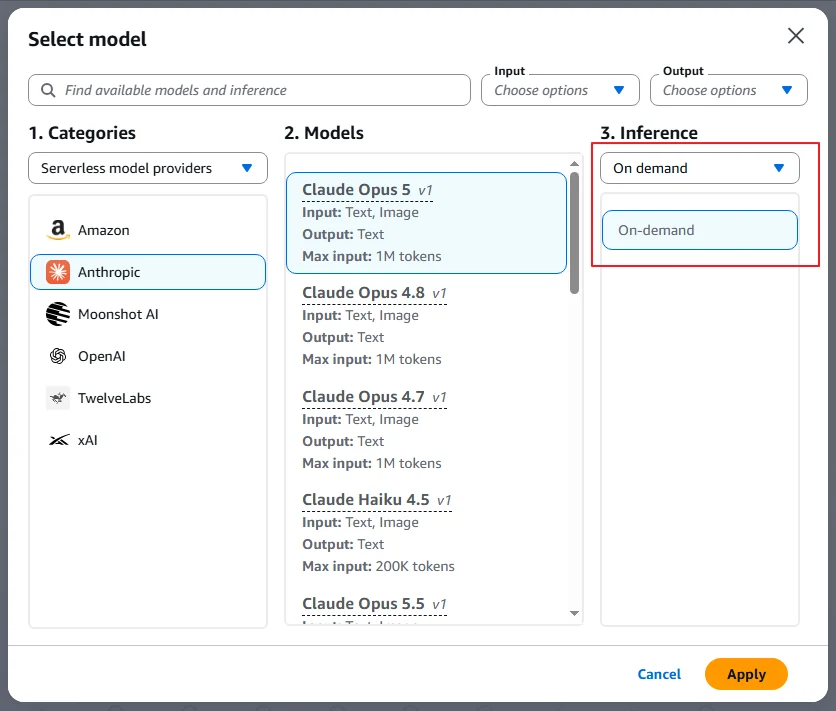
Before starting programmatic integration, engineers can experiment with the models directly inside the management console. Users can open the Amazon Bedrock console, navigate to the test playground, select an on-demand inference configuration, and generate sample responses without initial code or SDK setups.
The playground environment allows developers to adjust various inference parameters, test prompts, and evaluate different model variants to understand their behavior before transitioning to production application code.
Programmatic Access and API Integration
Developers can invoke the new regional capabilities programmatically using several established methods. Teams can utilize the Amazon Bedrock Converse API for a unified multi-model development experience, or choose the traditional InvokeModel API via the AWS Command Line Interface and standard AWS SDKs.
Alternatively, applications can interact with the models using the Anthropic Messages API through the dedicated anthropic SDK package. Prerequisites for development include an active AWS account with provisioned Amazon Bedrock access alongside the appropriate Python dependencies.
Sources
- AWS Machine Learning BlogIntroducing Anthropic models on Amazon Bedrock for in-region inference in Seoul and Singapore