
Claude Opus 5.5 Arrives on Amazon Bedrock and AWS
Anthropic's new flagship model brings enhanced agentic coding capabilities, adaptive thinking, and lower per-token costs to enterprise workflows.
 Radwan AbdulhadiEditor and technology writer
Introduction to Claude Opus 5.5 on AWS
Anthropic has officially launched its new flagship model, marking the introduction of the Claude 5.5 family to enterprise cloud environments. According to the AWS Machine Learning Blog, Claude Opus 5.5 is now available on Amazon Bedrock and Claude Platform on AWS, offering enhanced performance for complex knowledge work, agentic coding, and long-running operational tasks.
As the most capable Opus model released by Anthropic to date, the system is designed to handle demanding enterprise scenarios where deep reasoning and long context retention are vital. Development teams can begin testing and deploying the model immediately through the official Amazon Bedrock console.
Efficiency, Pricing, and Performance Improvements
According to information provided by Anthropic, Claude Opus 5.5 is engineered to accomplish significantly more work using fewer tokens compared to the previous generation Claude Opus 5. These underlying efficiency gains are directly passed on to customers through new pricing structures that feature lower per-token rates and much more affordable cache reads.
When combined, these cost reductions result in a lower average cost per task. This allows enterprise engineering teams and data science departments to scale up their ambitious agentic workloads without incurring proportional cost increases.
Advanced Reasoning and Safety Features
A notable addition to Claude Opus 5.5 is its enhanced communication style during complex operations. The model is specifically trained to explicitly surface its intermediate steps, showing what actions it has taken, what findings it has uncovered, and what requirements remain unsatisfied. This transparency makes long-running execution sequences substantially easier for human operators to follow and audit.
Additionally, the model features always-on adaptive thinking, allowing Opus 5.5 to dynamically determine the appropriate amount of reasoning required for each specific prompt. Users can configure effort levels directly as a control parameter instead of relying on manual thinking budgets.
Furthermore, Claude Opus 5.5 is the first Opus variant equipped with specialized safety classifiers across critical domains including biology, cyber security, and AI development, resulting in more frequent request refusals when encountering restricted content compared to earlier Opus versions.
Industry Applications in Software and Knowledge Work
The capabilities of Claude Opus 5.5 align closely with industry sectors that demand high consistency, accuracy, and depth. In software engineering workflows, the model provides clear improvements over its predecessor during extended coding sessions, offering better explainability that simplifies review and fosters greater trust.
For knowledge management and enterprise reporting, the model significantly reduces the volume of human corrections required when synthesizing, editing, and generating lengthy documentation.
Getting Started and Developer Integration
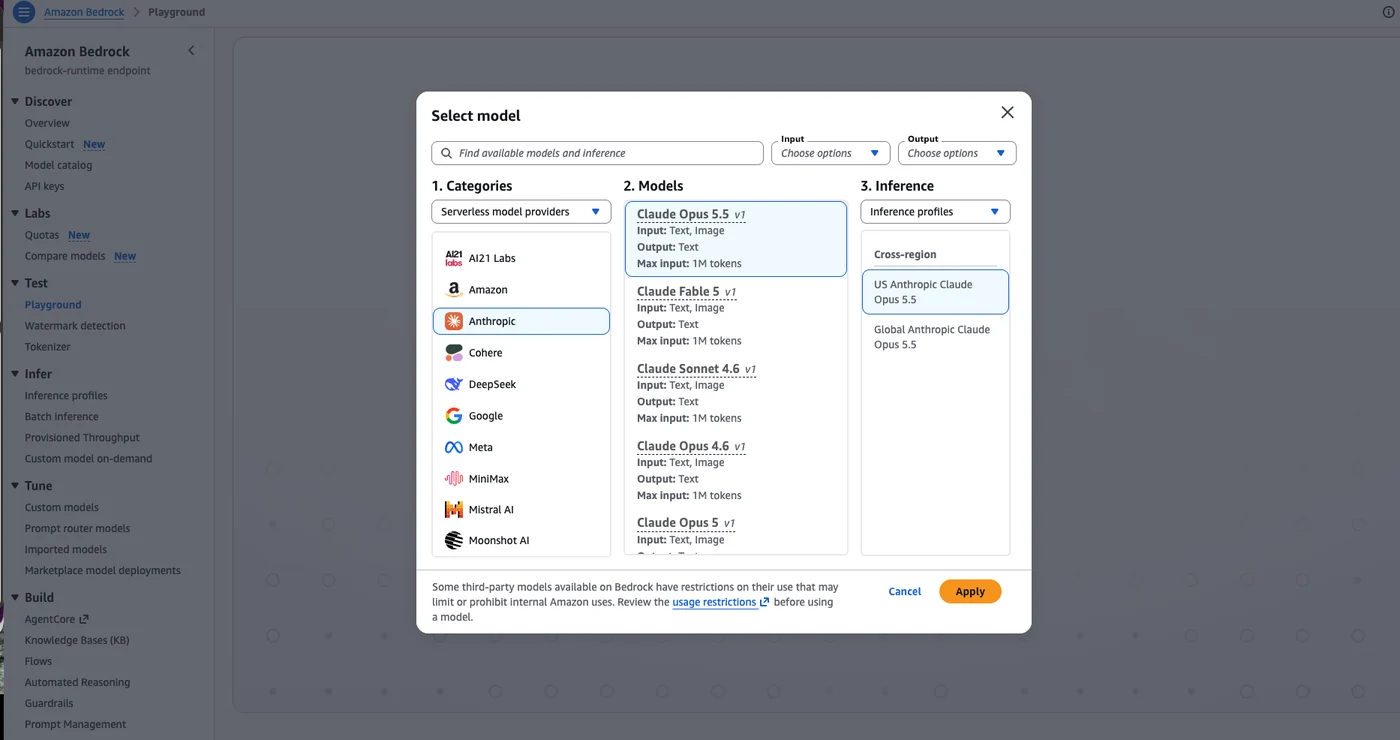
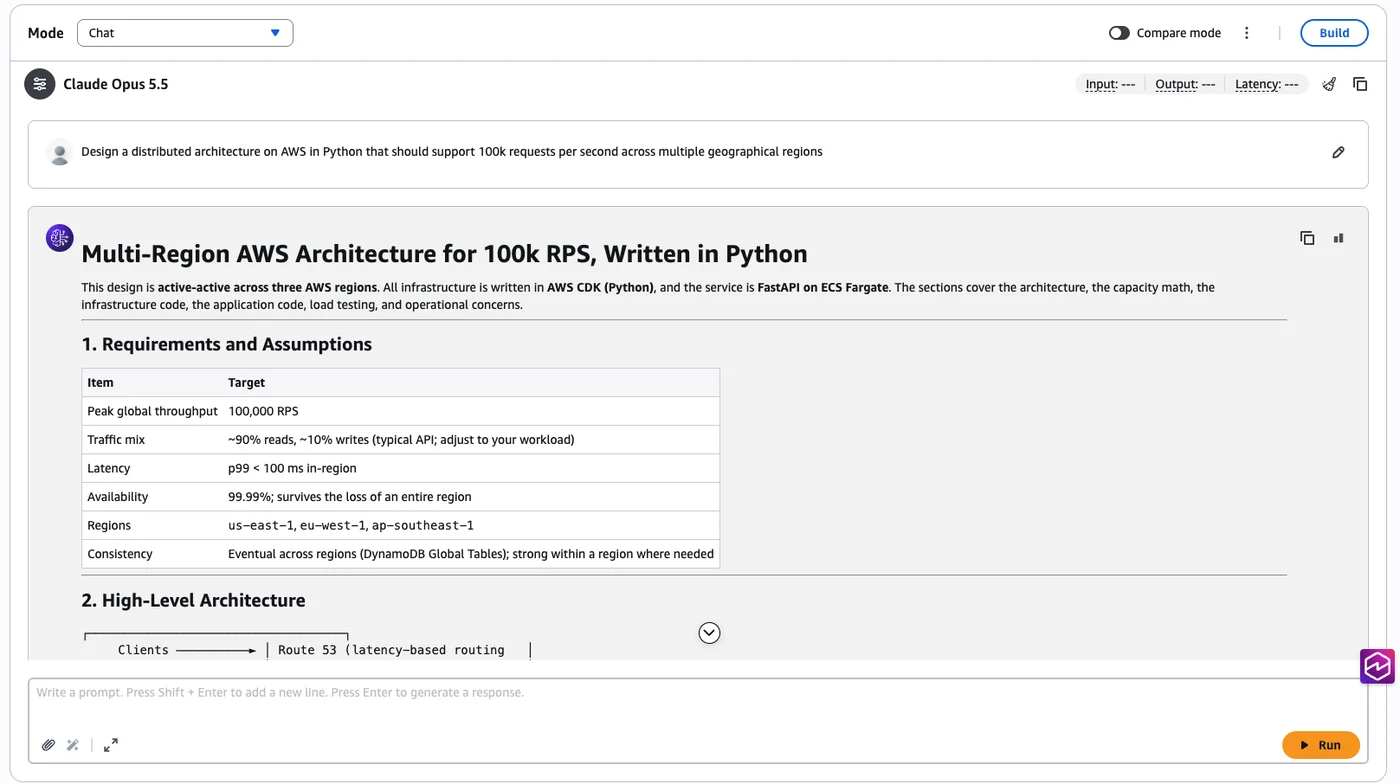
Engineers and developers can evaluate the model interactively by navigating to the Amazon Bedrock console, selecting Test followed by Playground, and choosing Claude Opus 5.5 from the model selection menu.
For programmatic integration, applications can interact with the model using the Anthropic Messages API against bedrock-runtime and bedrock-mantle endpoints via the Anthropic SDK. Teams can also utilize standard tools like the AWS Command Line Interface (AWS CLI) and various development packages.
The model is available immediately across multiple geographic inference profiles on bedrock-runtime, including US, EU, AU, JP, and Global regions, as well as select regional zones on bedrock-mantle. Developers can also explore the Getting Started notebook on GitHub for practical implementation examples.
Sources
- AWS Machine Learning BlogClaude Opus 5.5 is now available on AWS