Gen Digital Launches Norton Revamp Platform with AI News Engine
Launched in March 2026 by a small engineering team, Norton Revamp utilizes advanced cloud infrastructure and managed web search capabilities to deliver real-time, cited content suggestions for ambitious professionals.
 Radwan AbdulhadiEditor and technology writer
Introduction to Norton Revamp and Real-Time Grounding
As professional reputations increasingly live online first, standing out requires real-time awareness of current industry developments rather than reliance on static knowledge bases. To address this challenge, Gen Digital introduced <a href="https://revamp.norton.com/">Norton Revamp</a>, a generative AI-powered professional reputation management platform designed to help users turn fresh ideas into engaging social media content. Built by a small group of engineers and launched in March 2026, the platform centers on an AI-curated News Engine that grounds content suggestions, goal recommendations, and news feed items in current, cited web knowledge.
Developing a platform capable of handling real-time professional grounding required overcoming significant technical hurdles. Traditional approaches such as custom web crawlers, third-party news APIs, and static content databases often introduce infrastructure overhead, stale data, vendor complexity, or data egress risks. To maintain strict data privacy while delivering timely insights, the engineering team at <a href="https://www.gendigital.com/us/en/">Gen</a> evaluated several alternatives before selecting managed cloud capabilities.
Integrating Amazon Bedrock AgentCore Web Search
The core intelligence driving the platform's news engine relies on <a href="https://aws.amazon.com/bedrock/agentcore/">Amazon Bedrock AgentCore</a>, which provides a fully managed web search capability compliant with the Model Context Protocol (MCP). Operating as a managed connector on the AgentCore Gateway, the search tool accepts natural-language queries from the system's agents and returns relevant snippets, source URLs, titles, and publication dates. This mechanism allows the underlying large language models to produce accurate, grounded responses without exposing sensitive workflows to external third-party data egress risks.
By utilizing this fully managed infrastructure, <a href="https://aws.amazon.com/blogs/machine-learning/">Artificial Intelligence</a> workflows within the application can process current industry shifts and deliver personalized content streams. Whether a user focuses on cybersecurity threat intelligence or marketing developments, their feed acts as a goal-aware discovery engine that refreshes dynamically with every session rather than relying on a static RSS aggregator.
Event-Driven Architecture and Processing Pipeline
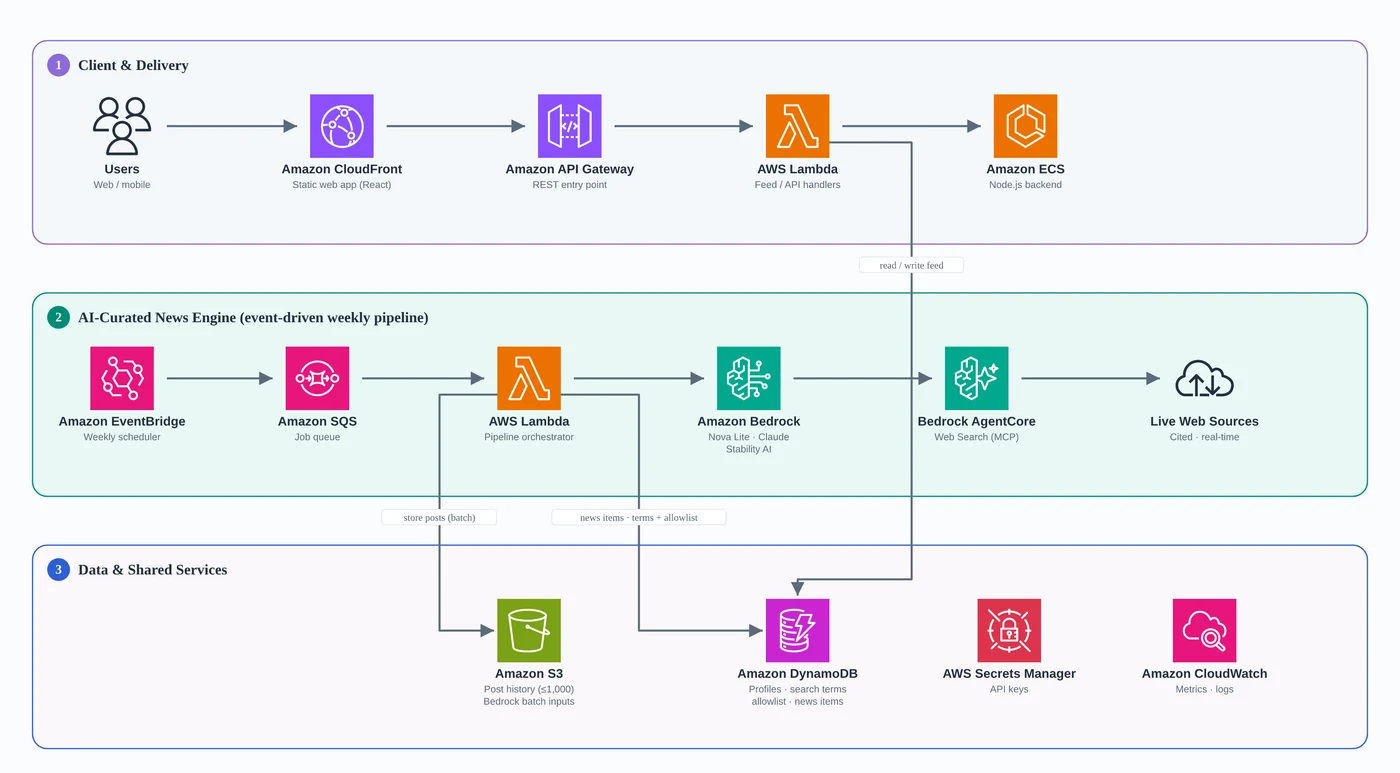
The technical architecture behind the application follows an event-driven design pattern built to ensure seamless data flow and zero-downtime releases. When users set or update their professional objectives, Amazon Nova through Amazon Bedrock generates targeted search queries based on recent activity and engagement patterns. These queries are dispatched to the search engine, and the resulting data is ranked by an internal AI Learning System for relevance, recency, and source credibility before serving as grounding context for content generation.
The platform's processing pipeline incorporates multiple distinct stages, including a Full Scan that pulls historical posts and stores them in Amazon S3 for batch analysis, an incremental Daily Scan triggered by Amazon EventBridge, Weekly Goal Generation powered by Lambda, and synchronous Content Coaching calls. Throughout these stages, supporting backend components including Amazon ECS, AWS Lambda, Amazon DynamoDB, Amazon API Gateway, and AWS Secrets Manager ensure reliable performance managed via Terraform.
AI-Native Development Methodology and Engineering Impact
In building the platform, the development team adopted an AI-native mindset from day one, employing generative artificial intelligence as both the product foundation and the primary development methodology. A strict division of responsibility was maintained, keeping human engineers in control of core architecture decisions, security reviews, business logic, and personalization algorithms, while delegating code generation, documentation, test scaffolding, and UI component creation to AI tools.
Leveraging advanced models such as Claude enabled the engineering group to produce multiple design variants per concept rapidly, compressing design-to-prototype timelines from weeks down to hours. This streamlined workflow allowed the creators to generate a significant portion of the user interface code using AI and test multiple pricing models and gamification iterations efficiently prior to the official product launch.
Sources
- AWS Machine Learning BlogHow Gen Digital built Norton Revamp’s AI-curated News Engine with Amazon Bedrock AgentCore Web Search
Continue chronologically

Related entity coverage
Related stories
Build a Voice Travel Concierge with Amazon Bedrock
Learn how to build a voice travel concierge for airline apps using Amazon Bedrock AgentCore, Managed Knowledge Bases, and real-time speech models.

Amazon Bedrock AgentCore Automates PowerPoint Generation
Learn how the new Amazon Bedrock AgentCore AI agent system automates PowerPoint presentation creation from enterprise documents in under 90 seconds.
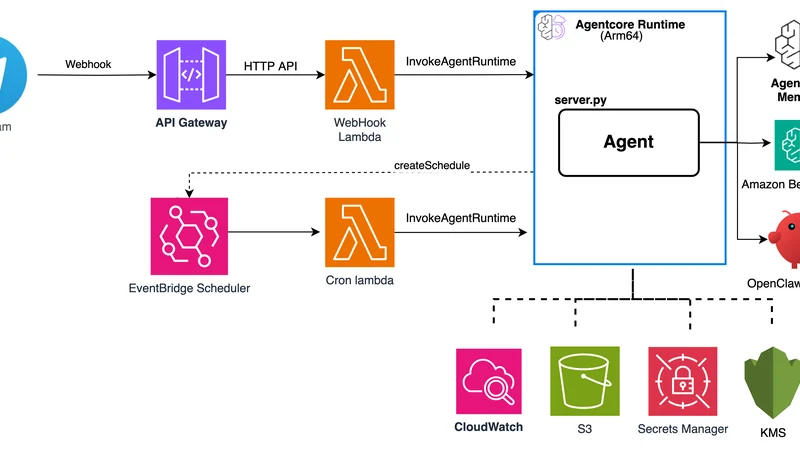
Building Context-Aware AI Assistants with AgentCore and OpenClaw
Learn how to build context-aware personal AI assistants using OpenClaw and Amazon Bedrock AgentCore runtime with durable, structured memory.
Build Multi-Agent Pipelines with Amazon Bedrock AgentCore
Learn how to build a multi-agent music production pipeline on Amazon Bedrock AgentCore Runtime Instances using shared sessions and GPU infrastructure.