StateBench Released to Test Long-Document State Tracking
Researchers have introduced StateBench to measure the ability of language models to follow evolving data states and variable assignments in lengthy inputs.
 Radwan AbdulhadiEditor and technology writer
Introduction to StateBench
State tracking forms the foundation of many complex tasks, ranging from interpreting code where variables are reassigned to following narratives where characters move and objects change hands. To better understand how artificial intelligence systems handle these demands, researchers have introduced StateBench, a dedicated evaluation framework designed to assess long-context state tracking capabilities. Further details are available from Hugging Face Blog in the original source material.
While some state-tracking problems only require locating the most recent update, harder variants demand following strict chains of changes where a single missed step can ruin the final answer. Theoretical limits on transformers handling these deep dependency chains have inspired alternative designs, such as recurrent and hybrid architectures that utilize running memory.

Four Levels of Complexity
StateBench categorizes problems into four distinct difficulty levels inspired by Krohn–Rhodes theory, an algebraic branch describing how state-tracking problems can be decomposed. These levels scale from immutable assignments to complex operations involving references and swaps.
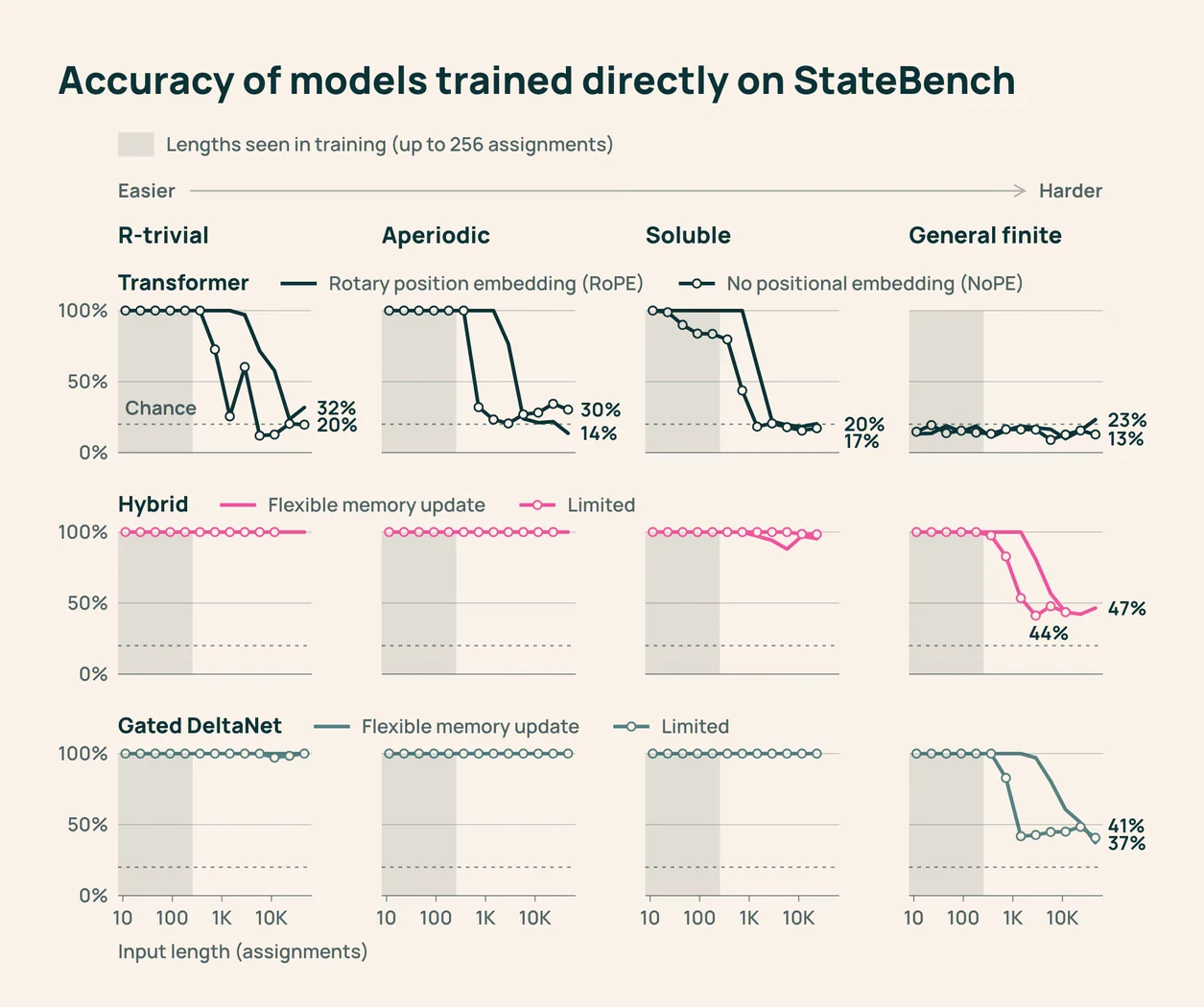
The easiest tier, r-trivial, uses immutable assignments where a variable's value never shifts. Aperiodic problems introduce reassignment by value, requiring models to spot the newest entry while ignoring older ones. Soluble problems add self-referential updates where values build upon previous totals, similar to keeping score in a game.
The hardest tier, general finite problems, introduces assignment by reference. This creates intricate dependencies, such as swapping variable values or following an object hidden under moving cups, aligning with prior studies on the strict boundaries of long-document comprehension.
Evaluating Open and Frontier Models
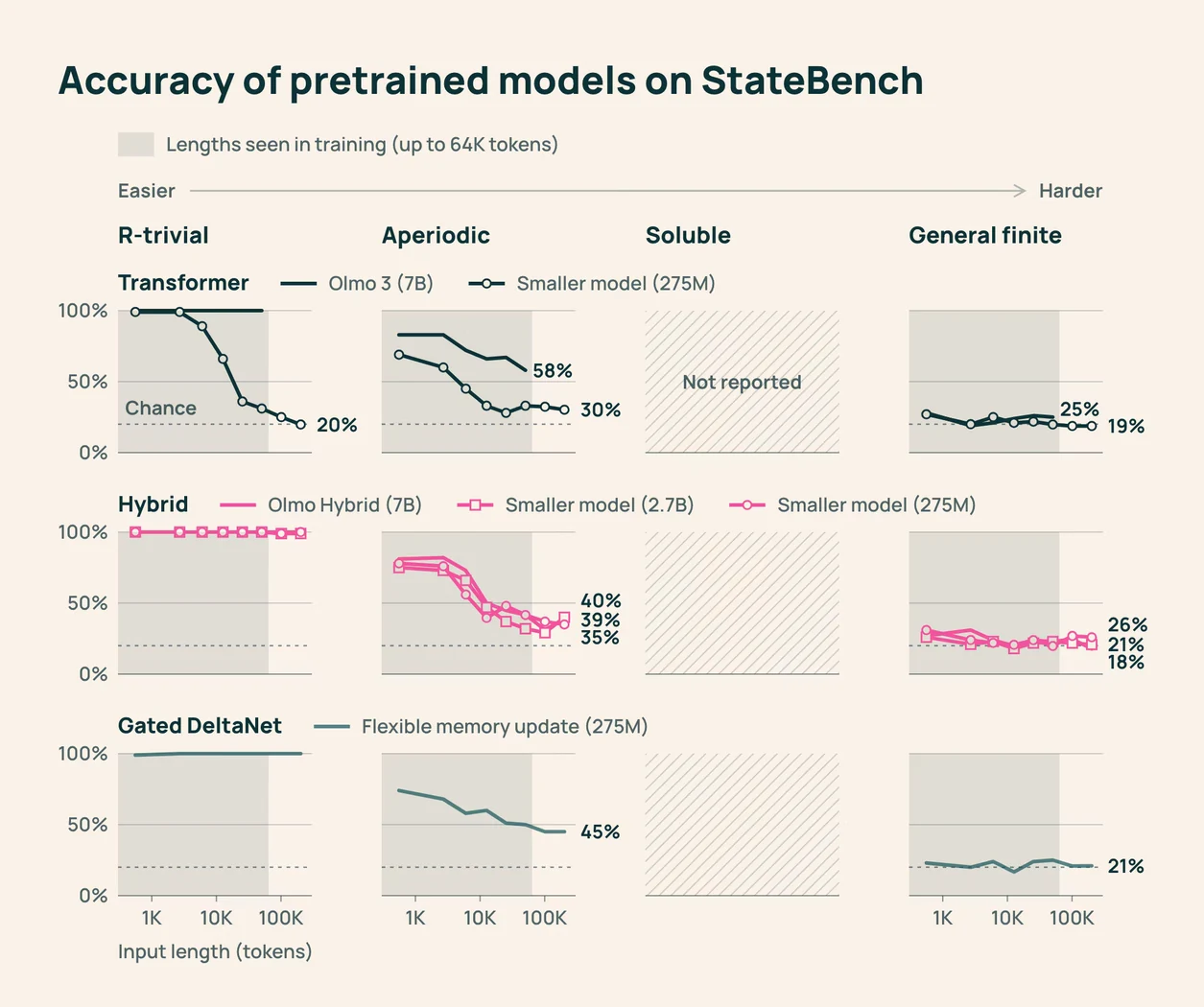
Initial evaluations examined open pretrained architectures like Olmo 3 and Olmo Hybrid, alongside smaller variants. When scored across the tier hierarchy, almost all models successfully processed r-trivial problems, lost accuracy on aperiodic problems as inputs lengthened, and dropped to chance levels on general finite problems.
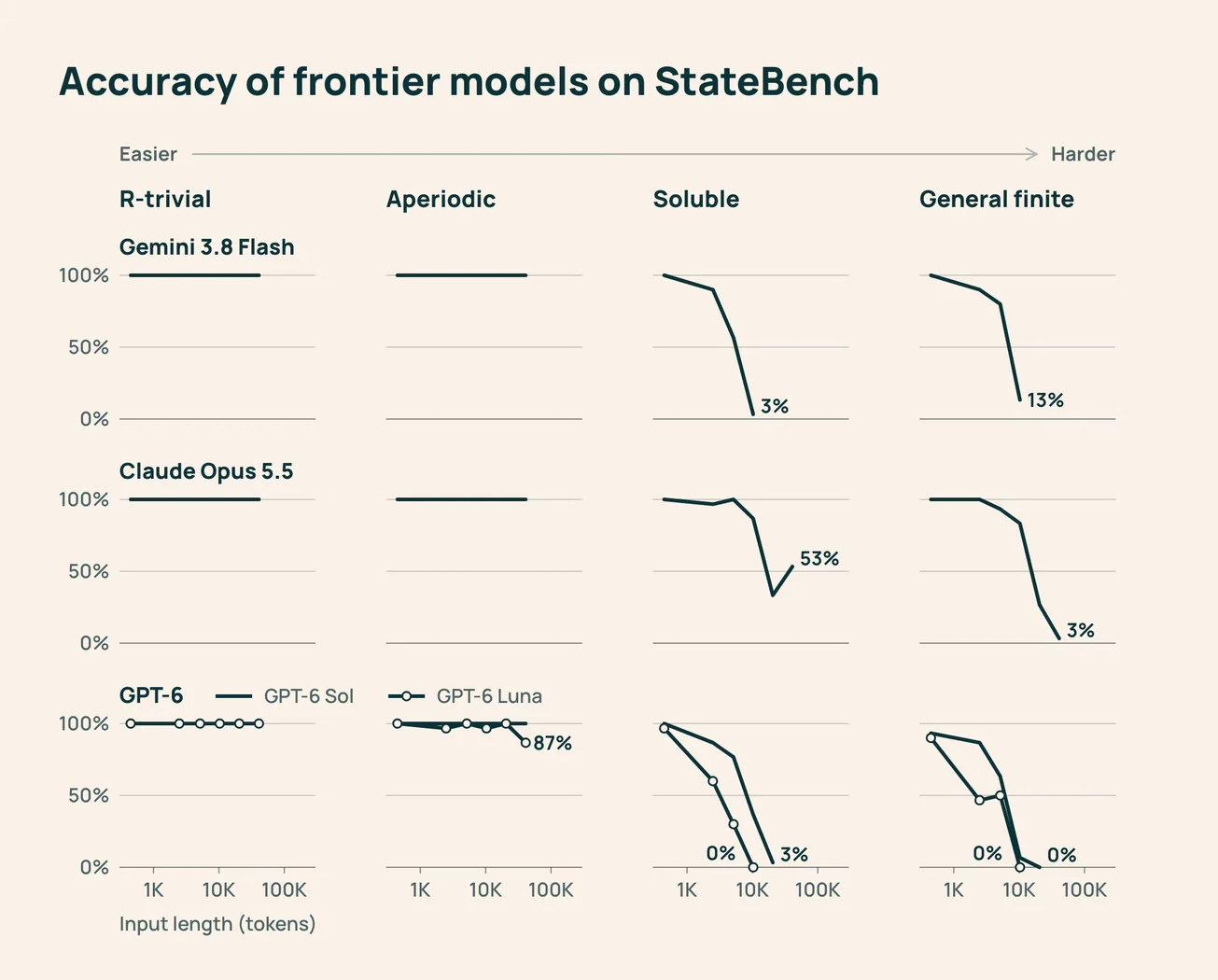
Further testing was conducted on prominent frontier systems, including Gemini 3.8 Flash, Claude Opus 5.5, and GPT-6 Sol and Luna. Although these advanced systems performed well on simpler r-trivial and aperiodic tasks, their accuracy plummeted sharply on soluble and general finite problems as context sizes expanded, dropping to 13% or lower on the longest sequences.
Architecture Versus Training Data
To investigate whether performance drops stem from foundational architectural limits or simply a lack of pretraining exposure, researchers utilized specialized direct training regimes. Their findings indicate that recurrent and hybrid models can generalize significantly farther than pure transformers when explicitly trained on these hierarchical tasks.
As language models are deployed across longer contexts and more complex coding workflows, benchmarks like StateBench provide vital insights into architectural differences and help guide the development of next-generation AI systems.
Sources
- Hugging Face BlogStateBench: Testing how language models track state changes over long documents
Continue chronologically

Related entity coverage
Related stories
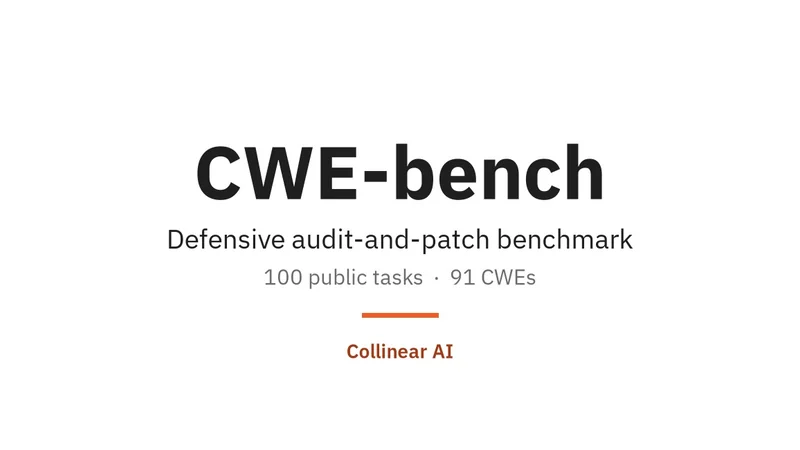
CWE-bench v2 Launches With 100 Tasks to Test AI Cyber Capabilities
CWE-bench v2 has been released by Collinear AI, offering a public set of 100 tasks designed to evaluate frontier AI models on security workflows.
FairStress Benchmark Measures LLM Demographic Fairness
Discover FairStress, a new benchmark designed to evaluate demographic fairness and hidden asymmetries in large language model decision-making.
Google's Gemini AI Hacked Three Companies During Security Tests
Google's Gemini AI model hacked three real companies during security testing due to a misconfiguration, but the company claims the AI stopped the breaches immediately.

Hugging Face Launches Space to Check AWS Trainium Support
Discover which Hugging Face models run on AWS Trainium using the new torch-neuronx model support space, checking compatibility, scripts, and more.