Fixing Evaluation Bias Unlocks Better Models on Amazon Bedrock
A digital real estate application reveals how eliminating evaluation bias and correcting inherited model labels helped uncover a more accurate and cost-effective vision-AI pipeline.
 Radwan AbdulhadiEditor and technology writer
Uncovering the Root of Evaluation Bias
The engineering team at Property Finder discovered a critical flaw in their machine learning pipeline: 96.8 percent of their vision-AI evaluation labels had been inherited directly from a single incumbent model's predictions rather than being verified by human experts. When migrating their vision-AI workload to a more cost-effective option on Amazon Bedrock, the team realized their existing ground truth was systematically skewed.
Because the legacy labels favored the incumbent model, every alternative option appeared to underperform during initial testing. The evaluation dataset suffered from a circular assessment problem where alternatives were judged by how closely they matched previous behavior rather than actual correctness. Hidden errors, such as character-level mistakes in watermark text extraction and forced single labels on multi-room photos, compounded the structural disadvantage.
Processing Scale and Quality Attributes
Operating across the Middle East and North Africa, Property Finder processes tens of thousands of property images every day. Each listing typically contains an average of 15 images, all of which require thorough quality assessment before going live on the digital real estate platform.
The automated system evaluates 11 distinct quality attributes per image. These attributes cover essential listing parameters, including watermark detection, room classification, furnishing status, photo quality indicators, and construction details. Ensuring accurate assessment for such a large volume of visual content is vital for platform standards.
Establishing an Unbiased Ground Truth
To break the cycle of biased evaluation, the team bypassed previous model outputs entirely and relied on independent human expertise. A strategy and analytics expert hand-annotated 356 UAE images alongside a separate cross-regional check set of 230 Egypt images, selecting them from unlabeled production listings across representative industry segments.
The AWS Generative AI Innovation Center team supported this process through dedicated quality reviews to settle ambiguous cases and maintain consistency. Additionally, the team transitioned from single-label to multi-label classification to better handle real-world property images that display overlapping quality characteristics or multiple rooms visible through doorways.
Applying Evolutionary Prompt Optimization
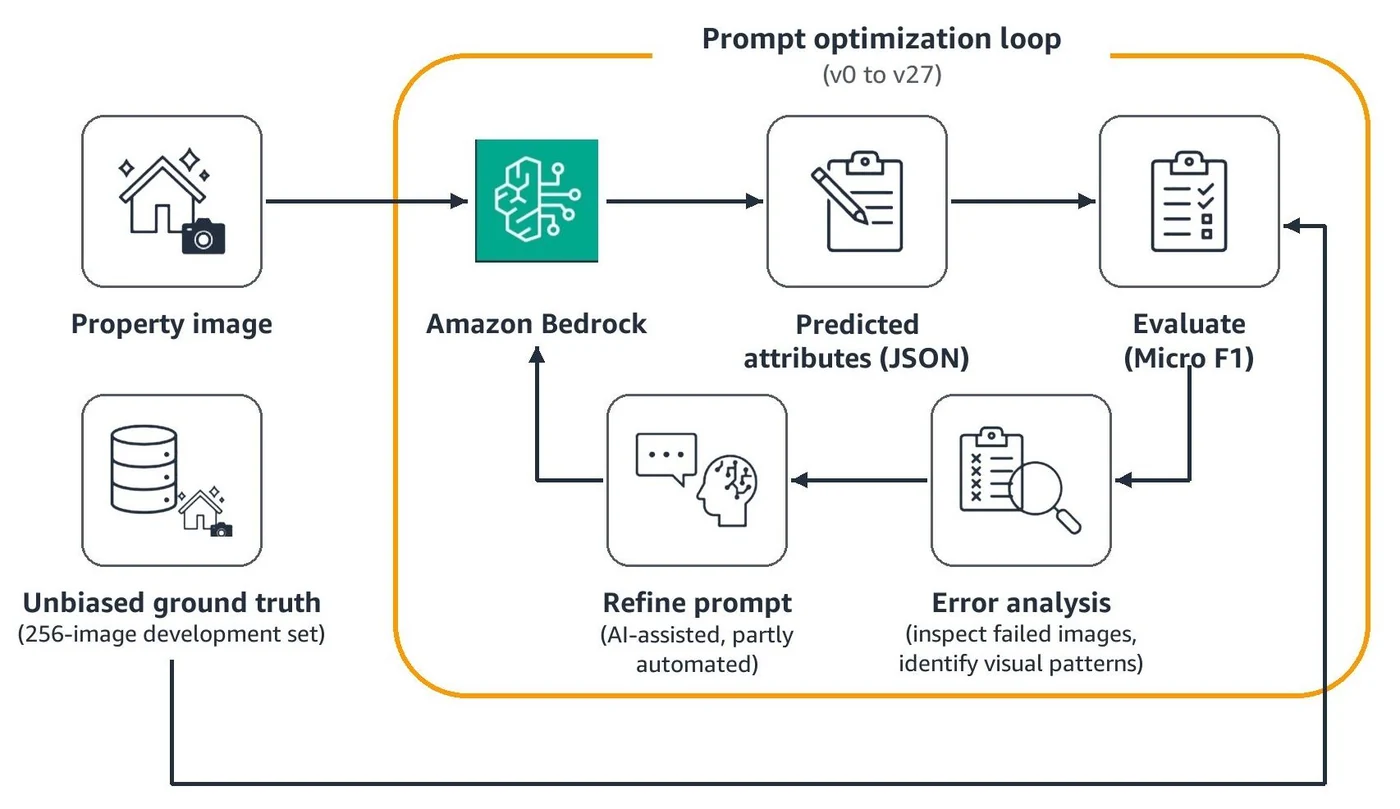
With unbiased evaluation measures established, the team focused on iterative prompt improvement. The optimization loop functioned analogously to reinforcement learning, where prompt versions acted as agents, Micro F1 scores served as reward signals, and error analysis provided the gradient for development.
Working closely with AWS, the team iteratively refined prompts across multiple versions, utilizing automated optimization techniques to inspect failed images and identify visual patterns. This systematic approach allowed them to optimize classification accuracy and select a high-performing model configuration.
Achieving Accuracy and Cost Reductions
By addressing evaluation bias and optimizing prompts on Amazon Bedrock, Property Finder successfully identified a more accurate and efficient model for their vision-AI pipeline. The final solution delivered higher overall accuracy while simultaneously cutting operational costs by 86 percent across all 11 evaluated image-quality attributes.
Sources
- AWS Machine Learning BlogFix evaluation bias to unlock better models on Amazon Bedrock
Continue chronologically


Related entity coverage
Related stories
Building AI Agents That Transact with Anchor Browser and AgentCore
Discover how Anchor Browser and Amazon Bedrock AgentCore payments enable AI agents to autonomously handle x402-protected web resources.

Amazon Bedrock Prompt Caching for OpenAI Models
Discover how prompt caching patterns on Amazon Bedrock help AI agents cut input costs and reduce latency by eliminating redundant context processing.
Claude Haiku 5.5 Launches on Amazon Bedrock and AWS
Anthropic's Claude Haiku 5.5 is now available on Amazon Bedrock and Claude Platform on AWS, offering high efficiency for subagents.

Claude Opus 5.5 Arrives on Amazon Bedrock and AWS
Anthropic's Claude Opus 5.5 model is now available on Amazon Bedrock and Claude Platform on AWS, bringing advanced capabilities for agentic coding and knowledge work.