Building AI Agents That Transact with Anchor Browser and AgentCore
AI agents can now autonomously pay for x402-protected web resources and APIs through a collaboration involving the AWS Generative AI Innovation Center Partner Agent Factory, Anchor Browser, and Amazon Bedrock AgentCore payments.
 Radwan AbdulhadiEditor and technology writer
Autonomous Web Transactions for AI Agents
Artificial intelligence agents increasingly need access to web resources that are priced on a per-request basis, such as premium datasets and research APIs. When an agent encounters these paid resources, servers typically return an HTTP 402 Payment Required status. Without a native payment mechanism or budget attached to the session, the task normally stalls and demands manual intervention.
To solve this workflow friction, developers can leverage tools featured on the [AWS Machine Learning Blog](https://aws.amazon.com/blogs/machine-learning/building-agents-that-transact-with-anchor-browser-and-agentcore-payments/) to build agents that autonomously pay for x402-protected web resources and APIs. Developed in collaboration with the [AWS Generative AI Innovation Center Partner Agent Factory](https://aws.amazon.com/blogs/awsmarketplace/aws-genaiic-partner-agent-factory-new-ai-agents-now-in-aws-marketplace/), the specialized browser solution handles machine-to-machine payment workflows on behalf of running agents.
Integrating Anchor Browser and AgentCore Payments
Anchor Browser functions as a cloud-based browser automation platform purpose-built for AI agents. It maintains authentication state, handles navigation, captures network requests, and gives operators a live view of page interactions. Agents running within this environment utilize a built-in tool that natively processes paid API calls directly within the browser context without requiring changes to standard Playwright, Puppeteer, or Chrome DevTools Protocol workflows.
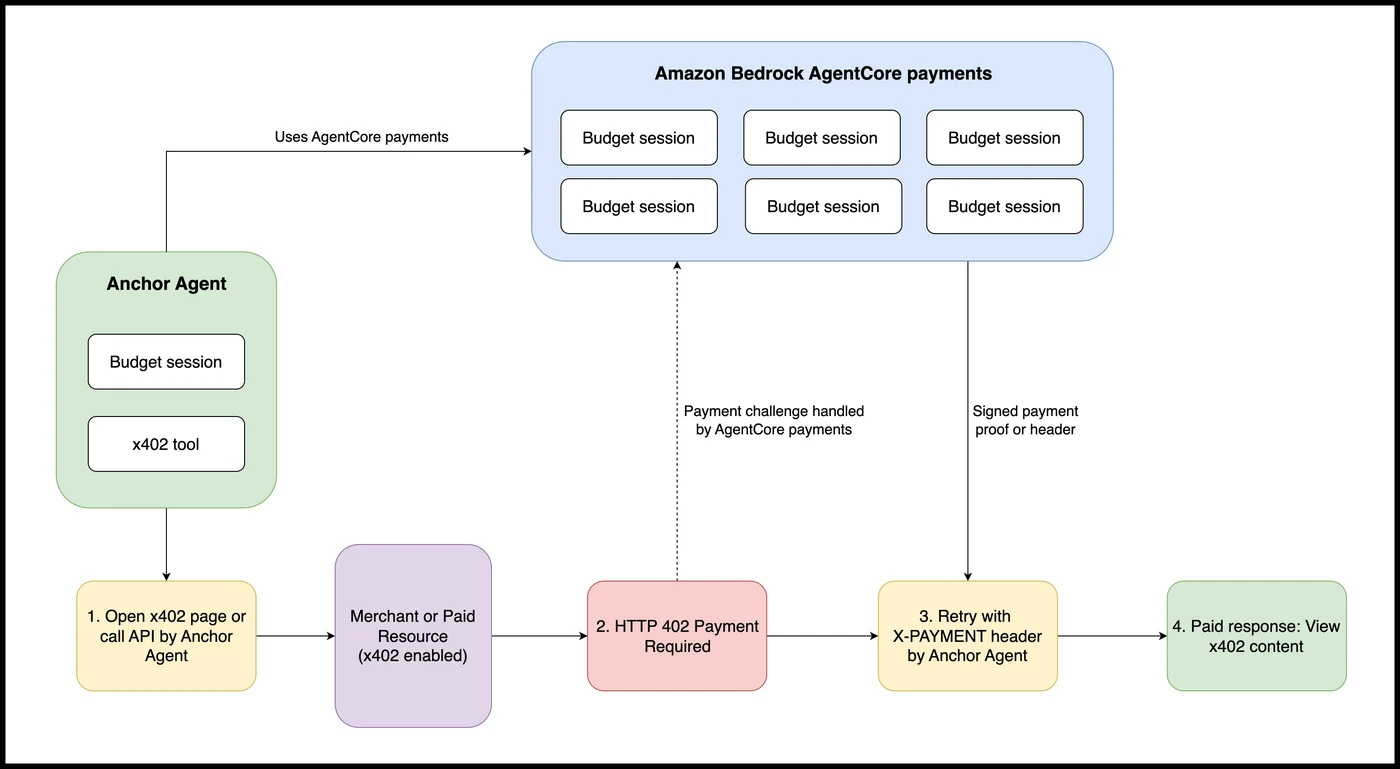
Complementing this browser capability, [Amazon Bedrock AgentCore payments](https://docs.aws.amazon.com/bedrock-agentcore/latest/devguide/payments.html) provides a fully managed infrastructure layer. The system manages wallet connectivity, enforces configurable spending limits, and processes payments via the x402 protocol, which is an open standard where servers respond with payment amounts, accepted methods, and destination addresses.
Overcoming Complexities in the Payment Stack
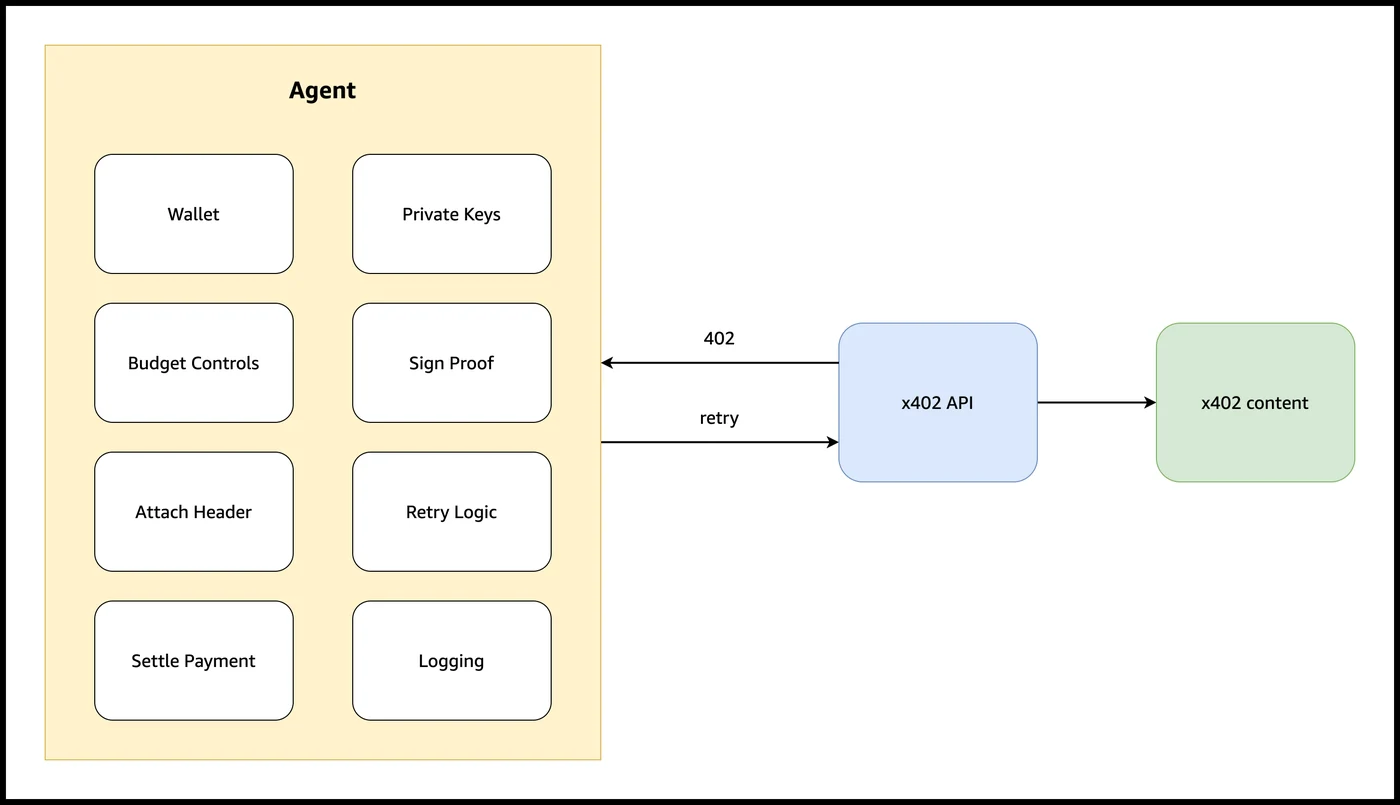
Without a managed payment service, developers face significant engineering complexity when building custom payment stacks. They must detect and parse 402 challenges, construct correct cryptographic proof headers, support multiple protocol variants, maintain compatibility across disparate merchant implementations, and handle wallet lifecycle operations like key rotation and credential refresh.
Furthermore, managing payment logic internally forces agents to store private keys directly within execution environments that might be exposed to untrusted web inputs. Offloading these responsibilities to managed infrastructure ensures that private keys never enter the agent runtime directly, thereby mitigating major security vectors associated with key exposure and uncontrolled spending loops.
Infrastructure Security and Observability
Security considerations extend well beyond initial engineering efforts. Uncontrolled spending remains a persistent risk if hard spending limits are absent at the infrastructure level, as bugs, retry loops, or prompt injections can trigger unintended recurring payments. By utilizing managed architectures, organizations can enforce strict per-session and per-transaction spend limits alongside real-time budget tracking.
Additionally, system operators gain robust observability into all payment activities. Every payment attempt, approval, denial, and settlement can be tracked and logged for compliance and auditing reconciliation, ensuring total transparency across concurrent agent executions.
Availability and Ecosystem Resources
The integrated browser and payment solution is accessible to developers looking to scale automated workflows. The offering is listed directly on the [AWS Marketplace](https://aws.amazon.com/marketplace/), allowing teams to quickly provision necessary components for their cloud architectures.
For teams wanting to dive deeper into the technical implementation, comprehensive guides and references are available. Developers can consult the [Anchor Browser technical documentation](https://docs.anchorbrowser.io/advanced/automatic-x402-payments) for specific instructions on managing automatic payments or review the [Quick Start](https://docs.anchorbrowser.io/quickstart/use-via-api) resources to integrate via API.
Sources
- AWS Machine Learning BlogBuilding agents that transact with Anchor Browser and AgentCore payments
Continue chronologically

Related entity coverage
Related stories
Amazon Bedrock Adds Structured Outputs for Anthropic Claude
Amazon Bedrock now provides schema-compliant JSON responses for all Anthropic Claude models using constrained decoding and strict tool use.
Amazon Announces New AgentCore Runtime for Bedrock Agents
Amazon Bedrock introduces a new AgentCore runtime designed to improve memory efficiency and ensure consistent startup speeds for production-grade AI agents.
Amazon Bedrock Prompt Caching for OpenAI Models
Discover how prompt caching patterns on Amazon Bedrock help AI agents cut input costs and reduce latency by eliminating redundant context processing.
Building Ambient Agents with Amazon Bedrock AgentCore
Learn how to build framework-agnostic ambient agents on Amazon Bedrock AgentCore that respond to event-driven signals and human-in-the-loop workflows.