Third Moment Research Runs 10,000 AI Agents for 36+ Hours
Third Moment Research is utilizing advanced OpenAI models to deploy thousands of autonomous agents on complex, multi-day investigations.
 Radwan AbdulhadiEditor and technology writer

Scaling Autonomous Agents for Deep Research
Every company handles unique workflows, tools, and edge cases, which is why Third Moment Research believes specialized AI agents should excel at specific tasks while continuously improving through usage. Detailed insights on this lab can be found in the official announcement on [Third Moment Research (opens in a new window)](https://thirdmomentresearch.com/).
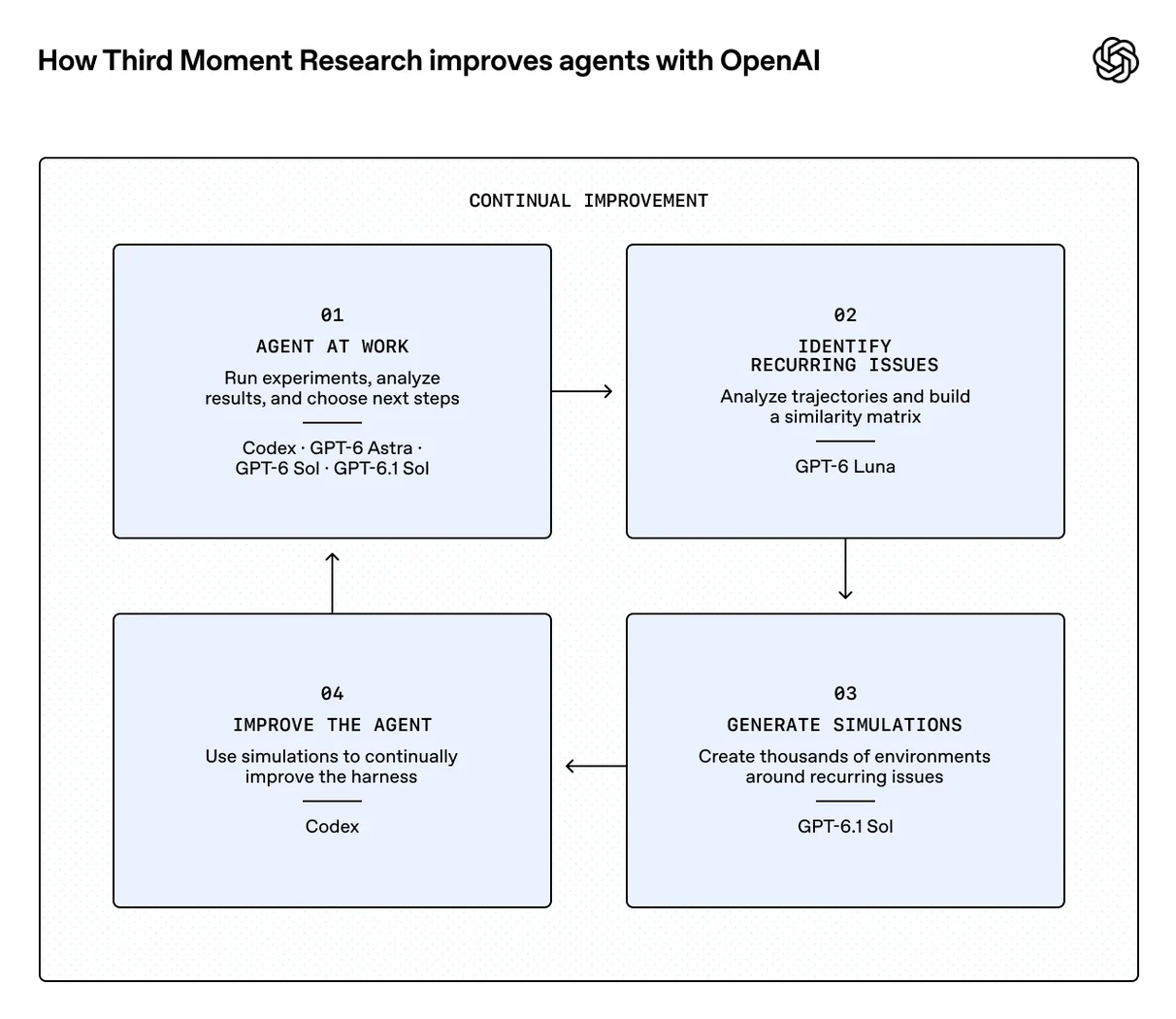
The company constructs a self-improving artificial intelligence system leveraging OpenAI models to evaluate agent behavior, detect recurring weaknesses, and generate thousands of synthetic scenarios. Models such as Codex, GPT-6 Astra, GPT-6 Sol, and GPT-6.1 Sol support these computational research workflows, enabling the lab to operate 10,000 agents concurrently during investigations spanning 36 to 48 hours.
Applications in Quantitative Finance and Optimization
Quantitative finance serves as one of Third Moment's early applications because it offers a clear measure of success and a concrete framework to analyze agent performance. Startups and developers interested in similar applications can learn how to [Start building (opens in a new window)](https://openai.com/startups) with OpenAI.
In a quantitative research setting, agents operate inside a default Codex harness within a Dockerized environment. They receive documentation, a terabyte of data, and a repository featuring modules for feature engineering, model training, and trading strategies. GPT-6 Astra, GPT-6 Sol, and GPT-6.1 Sol handle reasoning, while the Codex harness provides tools to build plans, set objectives, spawn subagents, and compact context.
Previously, models could only perform experiments explicitly commanded by users. However, newer iterations allow models to use incoming results to design subsequent experiments. During testing, GPT-6.1 Sol even uncovered the impact of non-displayed trades on an exchange—an unexpected finding that the human research team had not initially considered.

Resolving Bottlenecks and Enhancing Token Efficiency
During simulation trajectories, Codex identified a significant bottleneck where backtesting a trading strategy across a year of equity data took several hours. While waiting, agents repeatedly polled for completion, which wasted tokens and cluttered their context windows.
By analyzing inputs and usage, Codex applied a caching optimization and a memory-packing technique, reducing the backtest time from roughly three hours down to three to five minutes. This efficiency conserved token budgets, leaving more resources available for further experimental iterations.
To prevent agents from terminating prematurely, Third Moment uses Codex as a subagent inside an outer harness powered by GPT-6 Sol or GPT-6.1 Sol. The outer harness reviews unfinished tasks to decide whether to retry, terminate, or escalate the job to human review.

Security and Infrastructure Testing at Scale
Running 10,000 autonomous agents simultaneously requires robust security protocols to test environments before launching simulations. The lab uses the Daybreak cybersecurity platform to automate infrastructure testing and check if agents could escape their assigned environments to reach the wider network.
Adam notes that utilizing Daybreak enables agents to perform penetration testing on the simulation infrastructure itself, ensuring high standards of security and reliability during deep autonomous research operations.
Future Expansion Toward Collaborating Subagents
Third Moment plans to expand beyond individual investigations toward networks of hundreds of thousands of collaborating subagents. Its roadmap targets trillions of tokens supporting dependent experimental chains, aiming to use autonomous research to continuously upgrade agents as new challenges emerge.
For more news and updates on similar developments, visitors can explore the [View all: https://openai.com/news/](https://openai.com/news/) resource page provided by OpenAI.
Adam suggests this progression will eventually allow human operators to step into a leveraged supervisory role, focusing on optimizing the research process rather than executing the manual labor of research itself.
Sources
- OpenAI NewsHow Third Moment Research runs 10,000 agents for 36+ hours
Continue chronologically
Related entity coverage
Related stories
OpenAI Prepares New Security Sprint With Cathedral Systems
OpenAI announces its next internal security sprint in partnership with Cathedral Systems to test and strengthen its AI defenses and systems.
Proaction boosts sales 60% and saves 75+ hours with Codex
Discover how Proaction uses OpenAI's Codex and GPT models to build, operate, and sell modern fleet management software faster.
Sullivan & Cromwell Develops Agreement Analyzer with OpenAI
Sullivan & Cromwell has collaborated with OpenAI to develop Agreement Analyzer, an AI tool designed to identify issues and review draft agreements.
Qodo Brings Organizational Context and Code Review to Codex
Discover how Qodo's new Codex plugin integrates organizational knowledge, coding standards, and independent review to catch P0 bugs early.