Bayer Builds Agentic Decision Engine on Amazon Bedrock AgentCore
Bayer Crop Science has introduced a multi-agent platform designed to help researchers, breeders, and analysts query complex analytics workflows using natural language.
 Radwan AbdulhadiEditor and technology writer
Solving the Analytics Bottleneck in Plant Breeding
Plant breeding decisions rely heavily on vast amounts of data spanning genomics, field trials, imagery, environmental conditions, and complex model outputs. To manage these operations, Bayer Crop Science previously built the Connected Decision Engine (CDE) to deploy, orchestrate, monitor, and reuse machine learning workflows consistently. However, as adoption grew within the organization, the primary operational bottleneck shifted from running these workflows to understanding their outcomes and troubleshooting failures.
Explaining a specific workflow result traditionally required piecing together context across disparate APIs, documentation, metadata stores, dashboards, and system logs. To bridge this operational gap, the team created the Agentic Decision Engine (ADE), a multi-agent interface that allows users to ask natural language questions. According to project metrics, ADE successfully resolves roughly 80 percent of initial user inquiries without requiring direct engineering support.
Architecture and Core Technologies of ADE
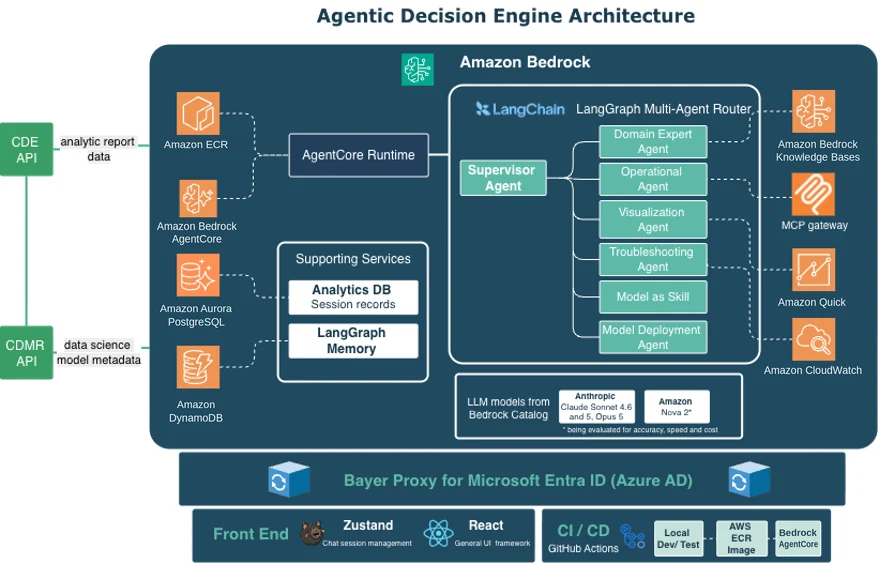
The Agentic Decision Engine operates on Amazon Bedrock AgentCore, an AWS service built to facilitate the creation, connection, and optimization of scalable agents utilizing any chosen framework or model. By adopting this managed service, the engineering team avoided the overhead of operating custom agent hosting environments, session isolation layers, and tool access mechanisms.
The platform structure is organized into four distinct layers encompassing the user experience, agent orchestration, specialist agents, and backend tools or data sources. Requests flow from a React web interface through an identity proxy for Microsoft Entra ID before reaching the agent infrastructure. Container images are built via GitHub Actions and pushed directly to Amazon Elastic Container Registry (Amazon ECR) for deployment.
Specialized Agents and Distributed Data Infrastructure
The production environment for ADE deploys 22 specialist agents, each tailored to a specific operational domain with dedicated tools and data sources. For instance, the Domain Expert Agent answers conceptual questions using retrieval-augmented generation, while the Operational Agent pulls live workflow metrics from CDE. Furthermore, the Troubleshooting Agent rapidly parses operational telemetry to diagnose errors.
The data plane is partitioned by functional responsibility across several cloud services. System state and checkpoints are managed using Amazon DynamoDB, while session records, user feedback, and analytics metrics reside in Amazon Aurora. Additionally, agent responses are cached via Amazon ElastiCache, and domain content stored in Amazon Simple Storage Service (Amazon S3) is indexed in Amazon OpenSearch for retrieval-augmented generation tasks.
Operational Telemetry and Performance Impact
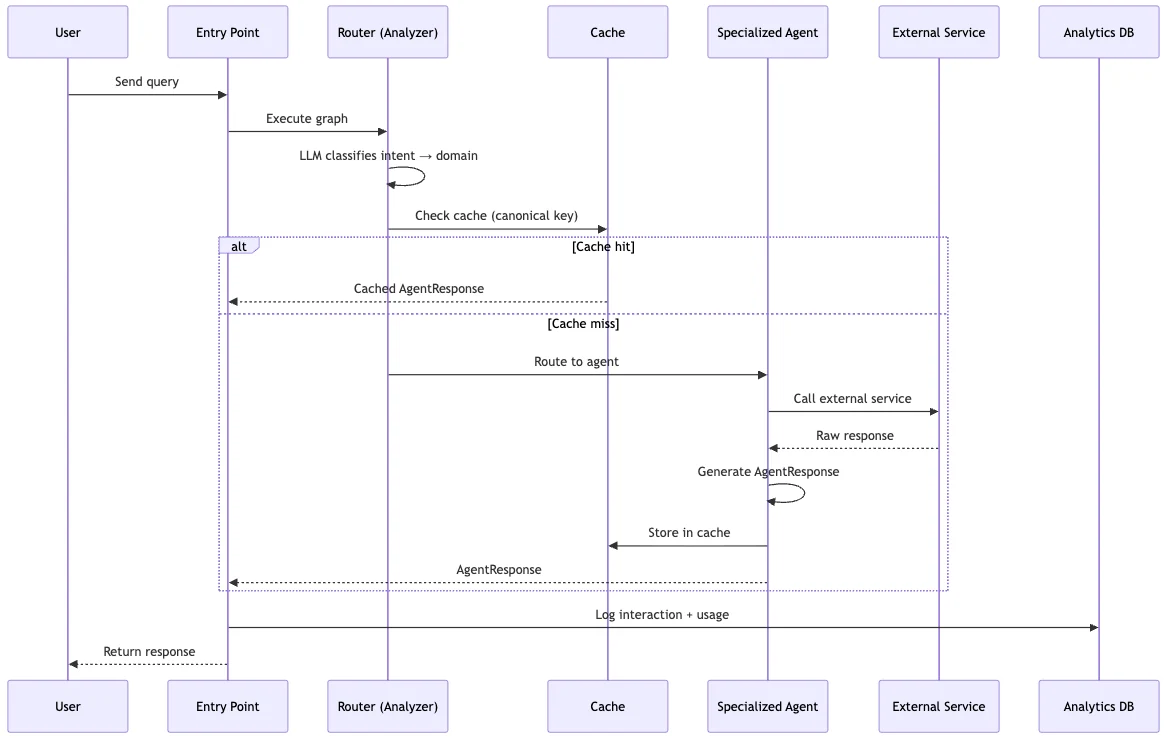
Application telemetry and runtime metrics are captured continuously through Amazon CloudWatch. When a breeder investigates a failed phenotyping workflow, a supervisor agent classifies the user intent and routes the task to the Troubleshooting Agent. This specialist queries workflow telemetry and status logs to identify failure points instantly, reducing diagnosis times from over an hour of manual log searching to under ten minutes.
Collaboration with AWS Unified Operations
To prepare the architecture for production workloads and manage ongoing operations, Bayer collaborated closely with AWS Unified Operations. This engagement integrated a designated Technical Account Manager and a generative AI Domain Specialist Engineer directly into the Bayer project team throughout the design and rollout phases.
The assigned specialists participated in weekly technical standups to evaluate critical architectural decisions against native AWS service behaviors. This collaborative approach enabled the development team to establish robust design patterns—such as externalizing orchestration state and securing gateway access—while retaining full ownership of the final platform implementation.
Sources
- AWS Machine Learning BlogHow Bayer Crop Science built an agentic decision engine on Amazon Bedrock AgentCore with AWS Unified Operations
Continue chronologically
Related entity coverage
Related stories
Building Trust in AI Agents With Amazon Bedrock AgentCore
Discover a nine-stage production evaluation framework built on Amazon Bedrock AgentCore to catch silent AI agent regressions.
Build Self-Improving Document Processing With Amazon Bedrock AgentCore
Learn how to build an agentic intelligent document processing system using Amazon Bedrock AgentCore to automatically classify and extract data.
Migrating Multi-Model AI Agents to Amazon Bedrock AgentCore
AWS introduces a streamlined path to migrate multi-model AI agents from self-managed ECS to Amazon Bedrock AgentCore, reducing operational complexity.
Stream Low-Latency Speech With Kokoro TTS on Amazon SageMaker AI
Learn how to stream low-latency speech from AI voice agents using the Kokoro-82M text-to-speech model hosted on Amazon SageMaker AI.