Building Trust in AI Agents With Amazon Bedrock AgentCore
Autonomous AI agents often fail softly by returning fluent yet incorrect answers. To address this, organizations are adopting continuous evaluation frameworks across the full agent lifecycle.
 Radwan AbdulhadiEditor and technology writer
The Silent Failure Problem in Autonomous AI Agents
Every organization racing to deploy AI agents faces a distinct operational challenge: an agent that demonstrates exceptional performance during initial tests can quietly degrade in production. While traditional software fails loudly with visible errors, autonomous AI agents often fail softly. They return answers that look confident, read fluently, and are completely incorrect.
When an erroneous answer drives a critical business decision, the impact goes beyond a broken software feature. It risks fracturing trust with the user. The core challenge is proving that agents continue working reliably at scale, across every sub-agent, workflow, and release cycle, rather than simply functioning successfully during an initial demonstration.
Deploying Specialized Sub-Agents at Scale
At AWS, the Sales, Marketing, and Global Services (SMGS) Operations team developed a multi-agent system serving field sales worldwide. This architecture relies on several specialized components, including the Performance Insights Agent to turn raw metrics into actionable narratives, and the Customer Insights Agent to assemble 360-degree customer views.
In addition to these capabilities, account teams utilize the Data Insights Agent as a text-to-SQL solution to query structured analytics data in plain English without writing manual SQL queries.
Uncovering Pre-Production Quality Risks
Coordinating multiple specialized agents reliably at scale demonstrates that agentic quality cannot be managed as an afterthought. A single degraded sub-agent can silently corrupt downstream responses in ways that traditional monitoring tools fail to capture.
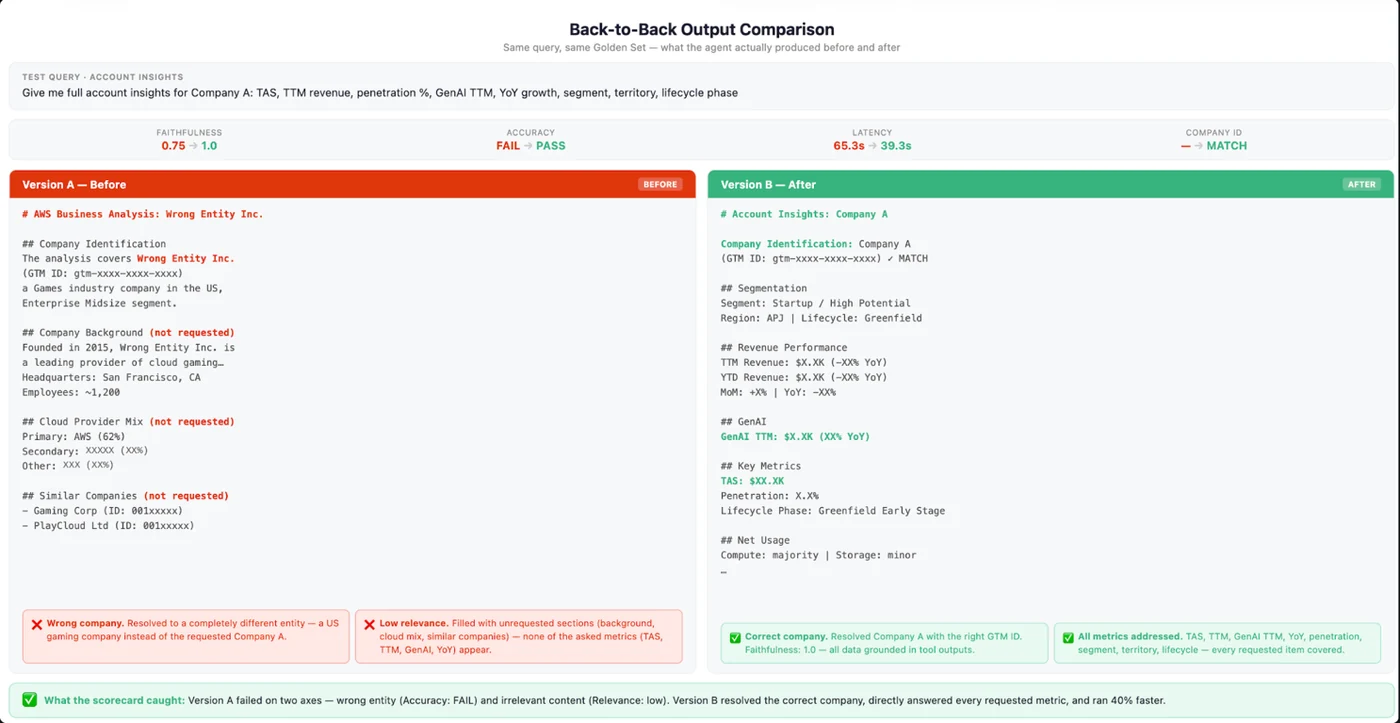
During pre-production evaluations of the Customer Insights Agent, internal teams identified instances where revenue figures were incorrectly scaled into millions, calculations were presented as sourced facts, and unverified recurring revenue estimates appeared without supporting data. Standard monitoring dashboards remained green during these runs because they only tracked whether the system responded, not whether the generated answer was accurate.
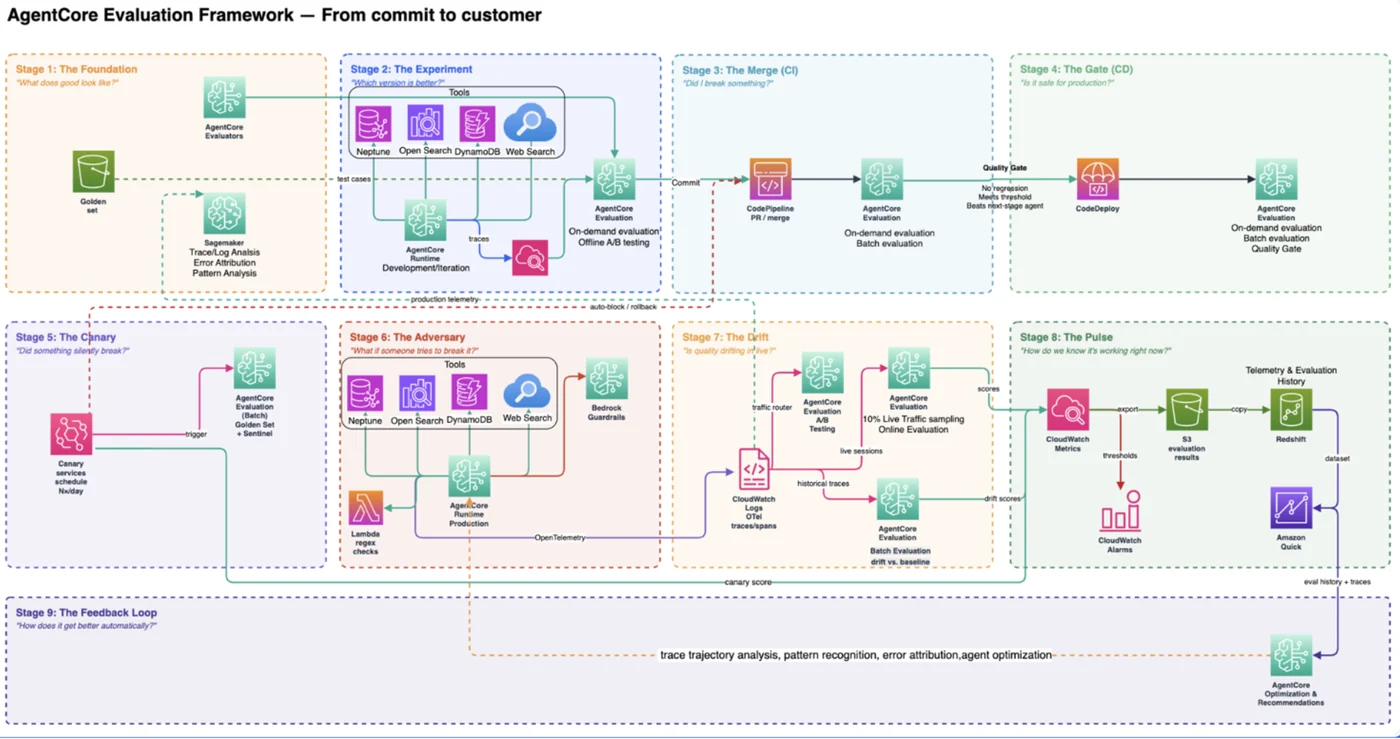
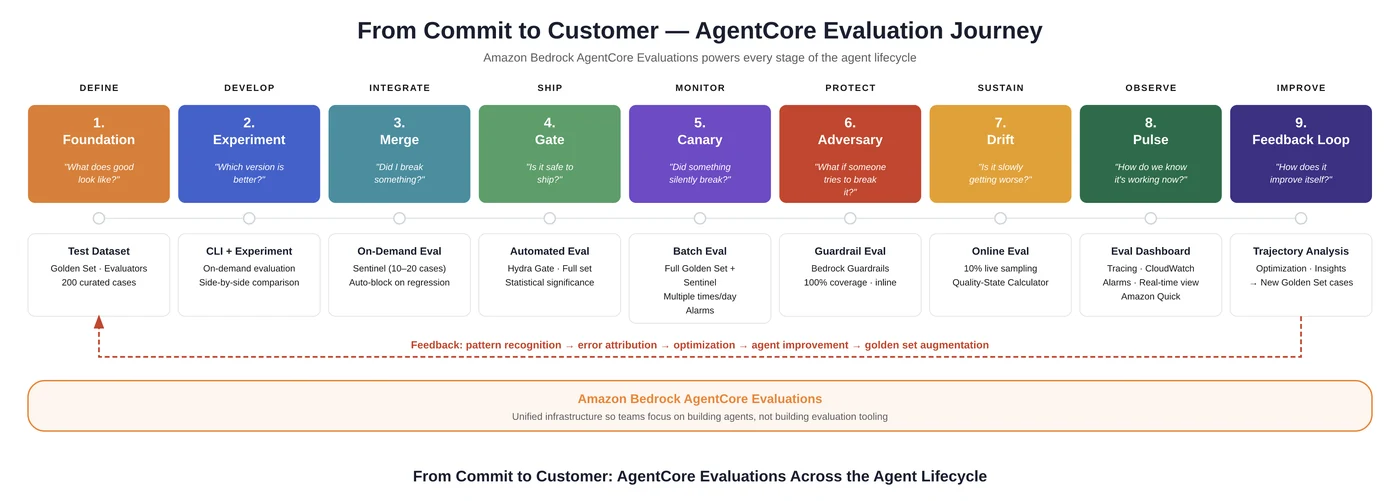
A Comprehensive Nine-Stage Evaluation Framework
To address these risks before launch and continuously in production, teams require a robust validation architecture. AgentCore Evaluations serves as the core connective tissue for this methodology, working alongside Amazon Bedrock Guardrails for safety, Amazon CloudWatch for metrics and tracing, and AWS Lambda for custom evaluators.
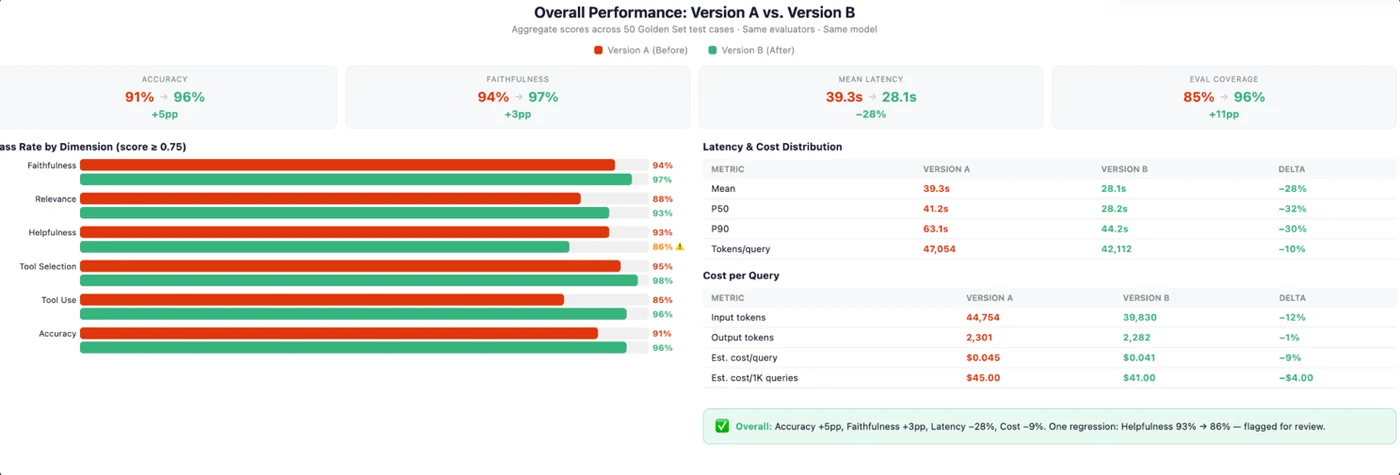
The framework traces failures back to their root causes across data pipelines, prompts, or underlying agent code. It implements structured evaluation metrics including response relevance, faithfulness, helpfulness, instruction following, and tool selection accuracy to maintain dependable enterprise operations.
Sources
- AWS Machine Learning BlogBuilding trust in AI agents: A production-ready evaluation framework with Amazon Bedrock AgentCore
Continue chronologically
Related entity coverage
Related stories
Bayer Builds Agentic Decision Engine on Amazon Bedrock AgentCore
Bayer Crop Science has developed the Agentic Decision Engine using Amazon Bedrock AgentCore and AWS Unified Operations to streamline plant breeding analytics.
Migrating Multi-Model AI Agents to Amazon Bedrock AgentCore
AWS introduces a streamlined path to migrate multi-model AI agents from self-managed ECS to Amazon Bedrock AgentCore, reducing operational complexity.
Build Self-Improving Document Processing With Amazon Bedrock AgentCore
Learn how to build an agentic intelligent document processing system using Amazon Bedrock AgentCore to automatically classify and extract data.
Training AI Agents with Multi-Turn Reinforcement Learning
Explore Multi-Turn Reinforcement Learning on Amazon SageMaker AI using a Wordle hands-on guide to train models on multi-step task outcomes.