AI Engineer Compiles 32-Bit RISC-V CPU Into Qwen LLM Weights
An experimental project blends the stock Qwen 3.5 4B AI model with a complete 32-bit RISC-V CPU, allowing it to execute code and perform exact arithmetic operations using its own weights as RAM.
 Radwan AbdulhadiEditor and technology writer
Introduction to Qwenputer
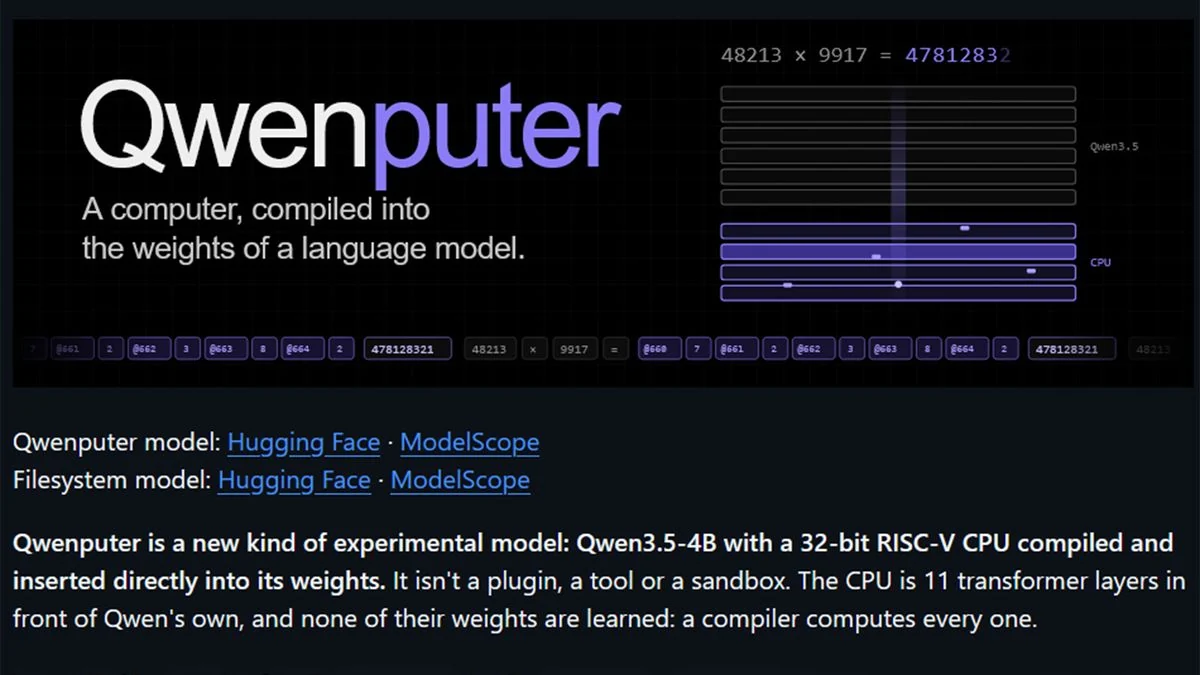
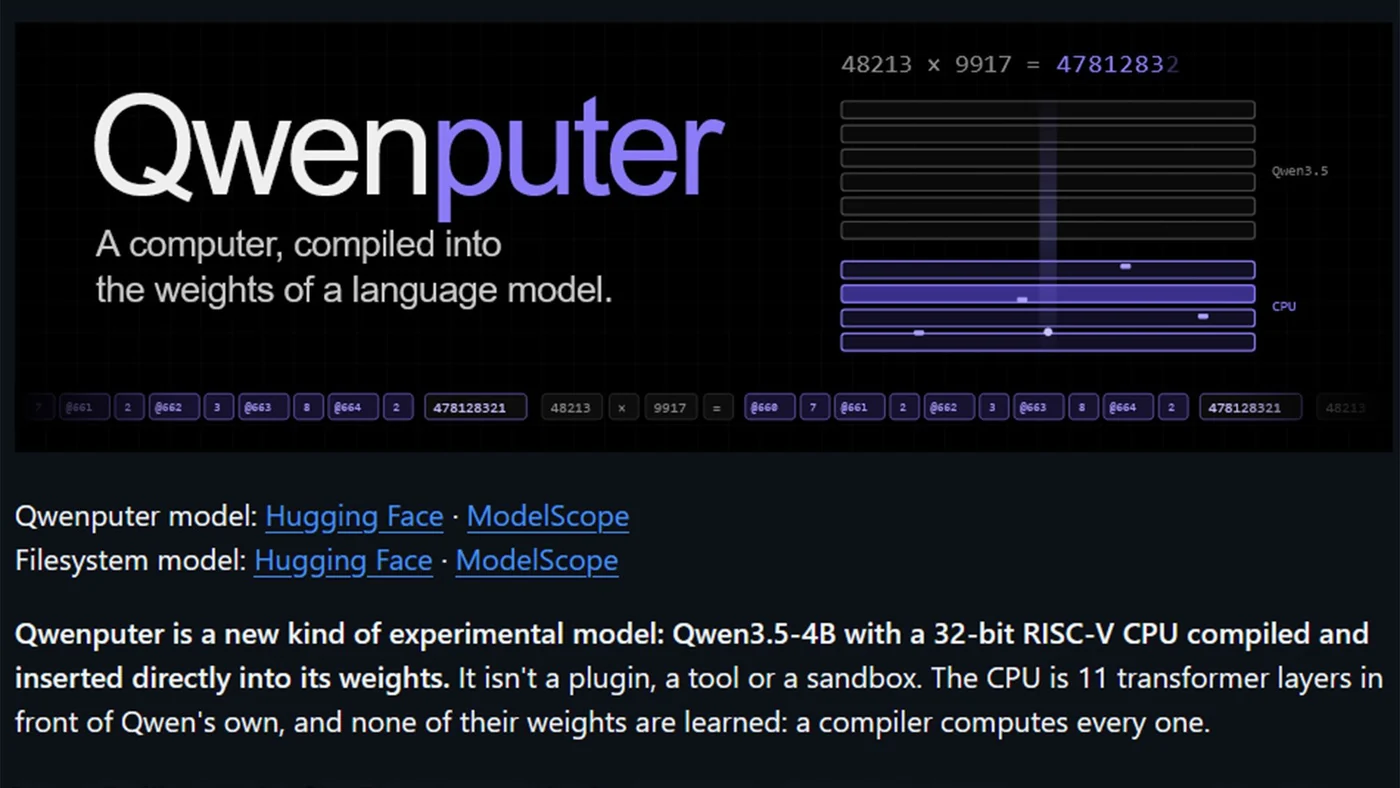
AI engineer Divyansh Agrawal has introduced an experimental project known as Qwenputer, which blends the stock Qwen 3.5 4B AI large language model with a fully functional 32-bit RISC-V CPU compiled and inserted directly into its weights. Detailed further in reports from Tom's Hardware, this setup enables the underlying model to execute processor arithmetic operations, run C and MicroPython code on its built-in CPU, and even play DOOM without relying on external runtimes or tool calls.
The developer showcased the achievement online, highlighting that the system successfully boots and runs the E1M1 level of DOOM on the embedded RISC-V architecture. While the game runs very slowly, the broader technical achievement demonstrates an unprecedented level of integration between neural network weights and traditional microprocessor instructions.
Technical Architecture and Fast Weights as RAM
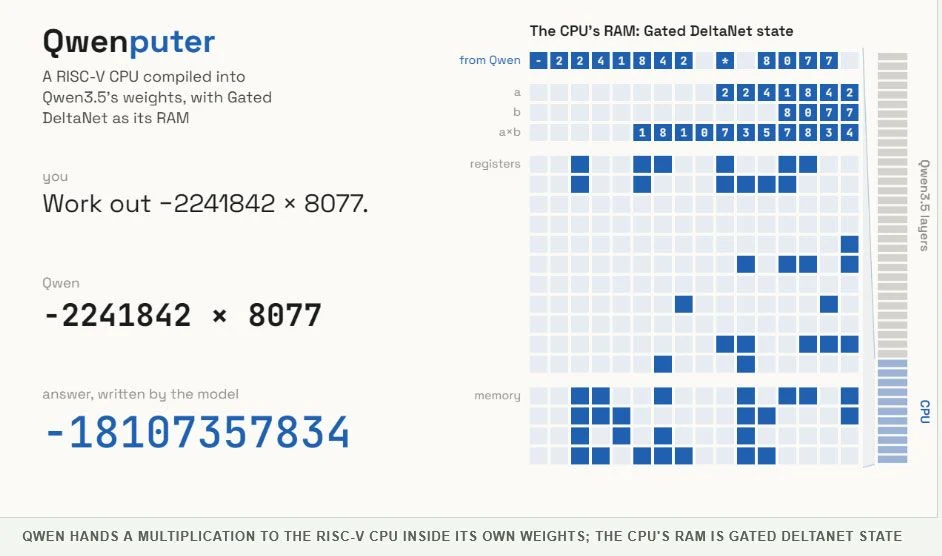
The implementation behind Qwenputer leverages several creative engineering solutions. Most notably, the developer utilized Qwen's Gated DeltaNet (GND) state to serve as random-access memory (RAM). While using these fast weights as memory is not an entirely original concept, modifying the Qwen 3.5 architecture in this specific manner appears to be a first.
Unlike standard machine learning workflows, adding this CPU does not involve training model parameters. Instead, the RISC-V implementation consists of 11 transformer layers positioned in front of Qwen's own layers, where none of the weights are learned through traditional training. A compiler instead computes every single weight. Agrawal noted that the built-in CPU passes official RISC-V tests, matches QEMU program execution, and has successfully run 18 million instructions free-running without a single error.
Overcoming LLM Arithmetic Weaknesses
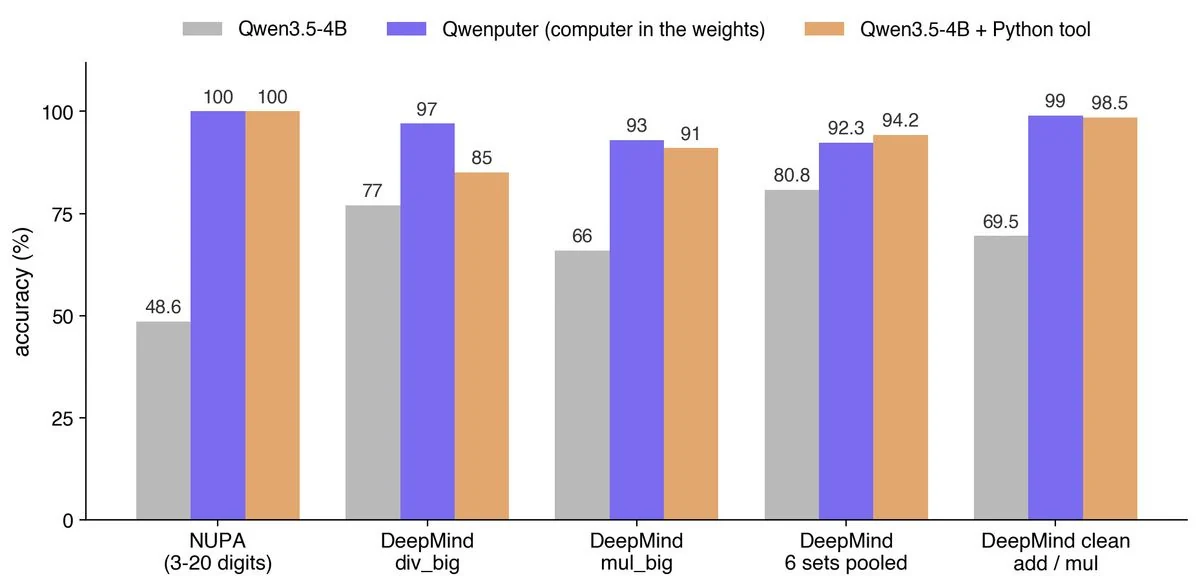
A persistent limitation of many large language models is their weakness in handling exact mathematical calculations. By embedding a dedicated hardware-equivalent CPU architecture directly inside the network, Qwenputer bypasses these hurdles. The model can send instructions and read back results natively without depending on external Python environments or tool use.
In practice, this integration gives users the ability to execute conventional programming code directly within the LLM. Both C and MicroPython are supported, opening up possibilities for precise computations embedded seamlessly into language model workflows.
Adding a Persistent Filesystem
Not content with embedding a processing unit into the neural weights, Agrawal also equipped the model with a filesystem. Because the DeltaNet state already provides functional RAM, extending the architecture to support storage proved to be a relatively straightforward addition.
The filesystem includes 1,024 storage slots capable of holding up to 512 files. Furthermore, this storage is fully persistent if the user saves the state at the conclusion of a conversation with the LLM, giving the AI model a form of long-term local data retention.
Hardware Requirements and Availability
The massive expansion of resources required to compile a CPU and filesystem directly into the model has significantly increased its footprint. Qwenputer effectively doubles the size of the underlying Qwen 3.5 4B LLM, bringing the total size to nearly 19GB. Consequently, testing the experimental version requires a workstation equipped with 24GB of VRAM or more.
Current development efforts are focused on streamlining the coding experience and improving execution speed. Additional project details, documentation, and the MIT-licensed code are available via GitHub, while the experimental model weights can be accessed directly on Hugging Face as detailed in the Qwenputer developer blog.
Sources
- Tom's HardwareAI model gets a 32-bit RISC-V CPU compiled directly into its weights, then runs DOOM on it — experimental AI model can run Doom and C code using its own weights as RAM
Continue chronologically


Related entity coverage
Related stories
Building Custom AI Models Using ML Intern
Discover how developers are leveraging HuggingChat with ML Intern to autonomously plan, train, evaluate, and publish custom open-source AI models.

FairStress Benchmark Measures LLM Demographic Fairness
Discover FairStress, a new benchmark designed to evaluate demographic fairness and hidden asymmetries in large language model decision-making.

Hugging Face Skills Automate SageMaker Model Deployments
Hugging Face and AWS release open-source agent skills, letting coding agents automate production-ready model deployments on Amazon SageMaker AI.

Hugging Face Crypto-Mining Malware Campaign Returns
A cryptomining and backdoor campaign abusing Hugging Face model repositories has quickly returned following an initial takedown.