Build Efficient Agents Using Sequence-Level Knowledge Distillation
A new guide outlines how developers can use sequence-level knowledge distillation on Amazon SageMaker AI to deploy efficient agentic assistants while reducing production costs.
 Radwan AbdulhadiEditor and technology writer
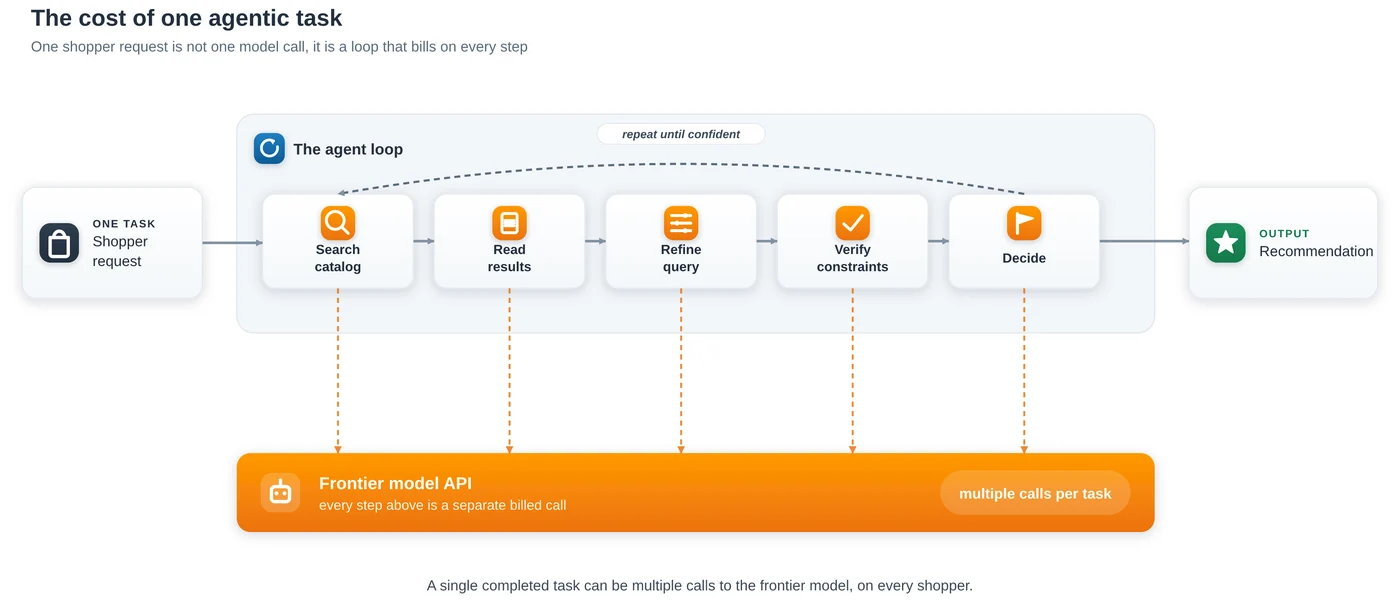
The Production Challenge of Agentic Workloads
Agentic assistants built on frontier models typically execute a multi-step tool loop involving search, reading results, refining, verifying, and deciding. Because a single completed task requires multiple model calls, per-task costs compound rapidly at production scale, eroding project ROI and hindering deployment. Using a smaller model offers a faster and more cost-effective alternative, but smaller models often fall short on complex agentic tasks.
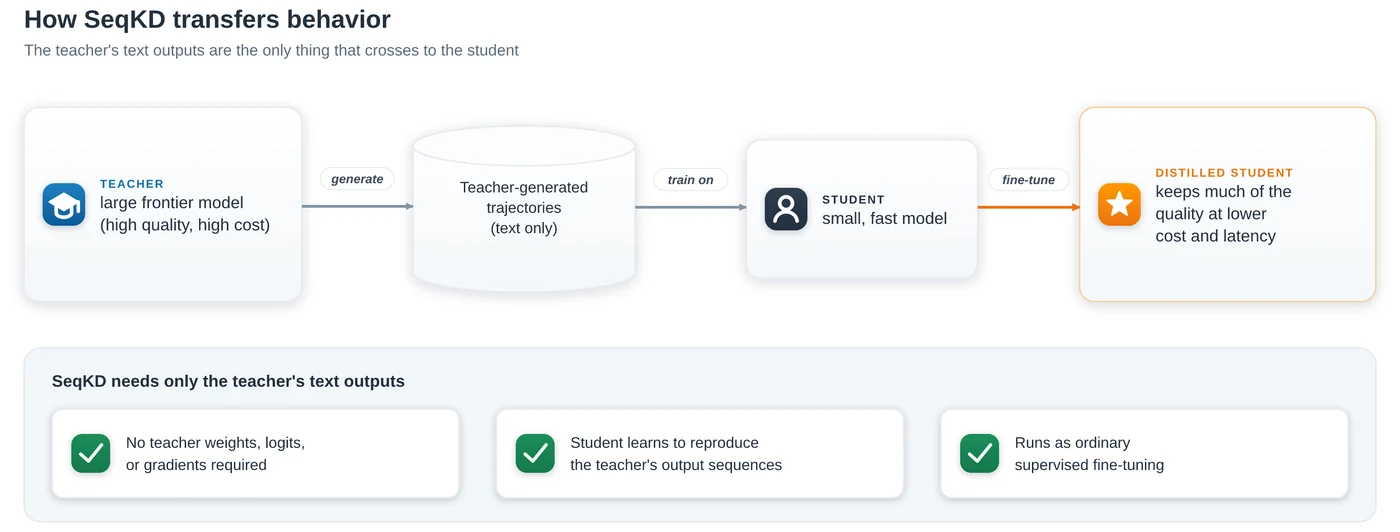
To bridge this performance gap, developers can turn to knowledge distillation. This technique transfers the behavior of a larger teacher model into a smaller student model, training the student to reproduce the teacher's outputs and maintain quality at a reduced speed and cost.
Understanding Sequence-Level Knowledge Distillation
The applicable form of distillation discussed in the guidance is sequence-level knowledge distillation, or SeqKD. It operates by using a teacher model to generate high-quality responses, which are then used to train a student model via supervised fine-tuning. Because SeqKD requires only the teacher's text without access to teacher logits or reinforcement learning infrastructure, it functions seamlessly even with closed or API-only frontier models.
In the context of agents, the teacher produces a trajectory—an ordered run of reasoning, tool calls, and observations where each step depends on prior actions. Training the student on the entire sequence teaches it the reasoning path that leads to each action rather than just a single paragraph of answer text. Well-known examples of this approach include DeepSeek-R1 distilled models, which were created by fine-tuning smaller students on a large teacher's generated reasoning traces.
Prerequisites and Infrastructure Requirements
Implementing this workflow requires an AWS account equipped with an AWS Identity and Access Management (IAM) role for SageMaker AI that grants read and write permissions to an Amazon S3 bucket and permits invocation of the teacher model. Additionally, developers need access to Amazon SageMaker AI model customization in a supported AWS Region alongside a frontier teacher model hosted on Amazon Bedrock.
For the local environment, teams can utilize Amazon SageMaker Studio or a local IDE with the AWS CLI configured. The setup requires a Python 3.12 or higher kernel running the SageMaker Python SDK v3 and boto3. For data preparation and local scoring tasks executed on the CPU, an ml.m5.4xlarge instance is recommended as a minimum for the notebook environment.
Executing the Distillation Pipeline
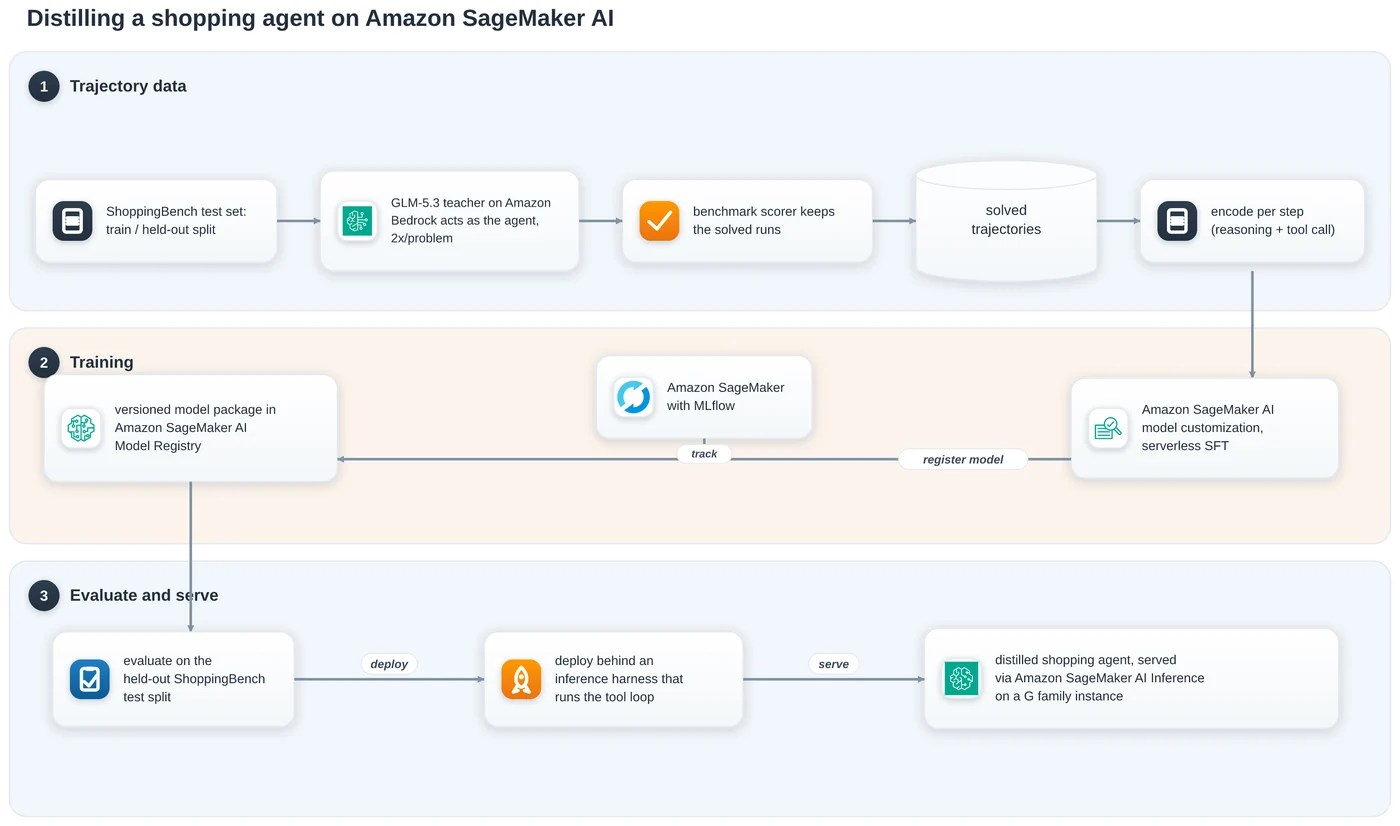
The end-to-end pipeline involves generating agent trajectories using a frontier teacher model, such as GLM-5.3 accessed through Amazon Bedrock. A programmatic scorer filters the generated data to retain only the trajectories that successfully solve the task. These verified trajectories are then used to fine-tune a student model via serverless supervised fine-tuning leveraging Amazon SageMaker AI model customization.
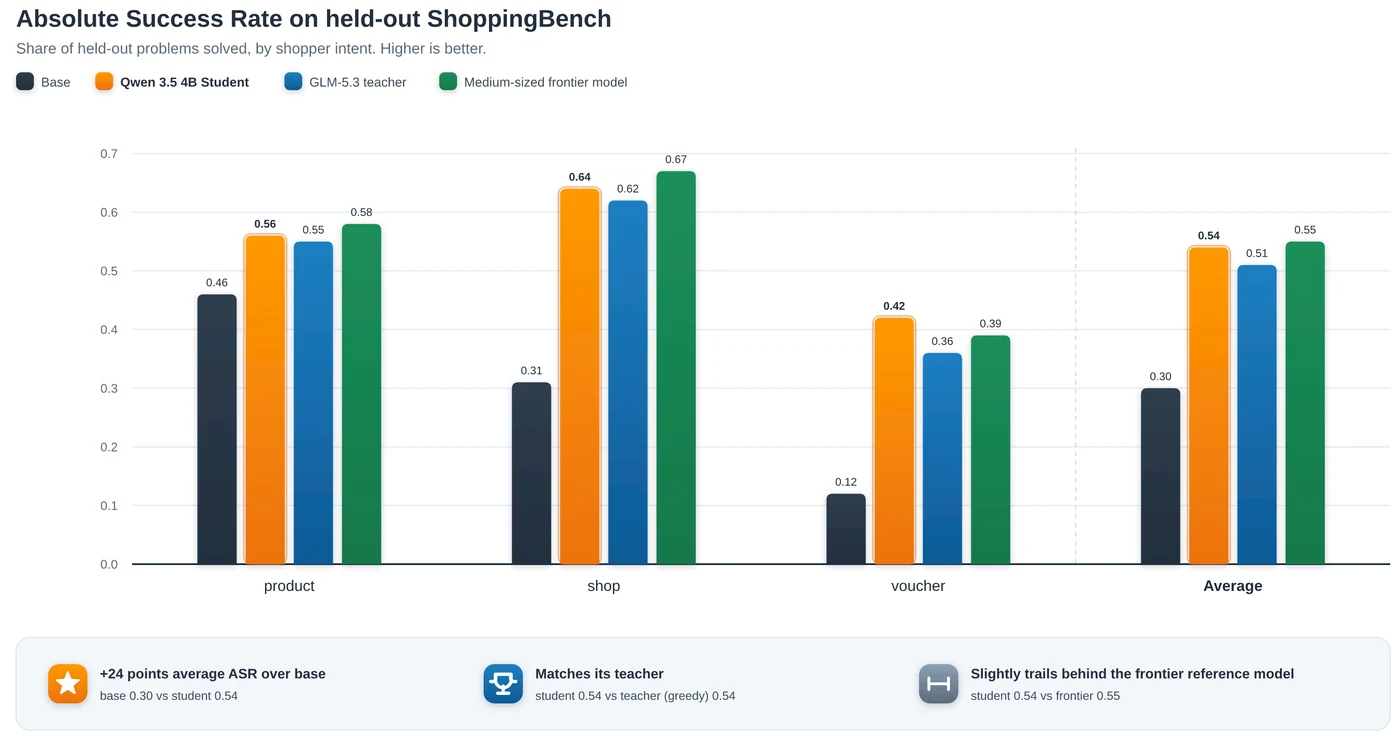
Following the fine-tuning process, the resulting distilled student model can be evaluated against a held-out benchmark split on Amazon SageMaker AI, allowing organizations to maintain high agent performance while significantly lowering operational and inference expenses.
Sources
- AWS Machine Learning BlogBuild efficient agents with knowledge distillation on Amazon SageMaker AI
Continue chronologically

Related entity coverage
Related stories
uniopen Customizes Amazon Nova for Retail Content Moderation
Learn how retail platform uniopen used supervised fine-tuning and prompt optimization to adapt Amazon Nova 2 Lite for production moderation.
Amazon Payments Boosts Funnel Conversion with AWS AI
Amazon Payments applied multi-objective contextual bandits on Amazon SageMaker AI to personalize acquisition funnels and drive conversion lifts.
Training AI Agents with Multi-Turn Reinforcement Learning
Explore Multi-Turn Reinforcement Learning on Amazon SageMaker AI using a Wordle hands-on guide to train models on multi-step task outcomes.
Migrating Multi-Model AI Agents to Amazon Bedrock AgentCore
AWS introduces a streamlined path to migrate multi-model AI agents from self-managed ECS to Amazon Bedrock AgentCore, reducing operational complexity.