
NVIDIA Details Warp and MJWarp Robotics Workflows
A new technical guide highlights how developers can leverage NVIDIA Warp and MuJoCo Warp (MJWarp) to scale robot simulations into thousands of parallel GPU environments.
 Radwan AbdulhadiEditor and technology writer
Scaling Robotics Simulation with NVIDIA Warp and MJWarp
Classic MuJoCo delivers fast CPU-based robot simulation for developing, testing, and controlling robots by parallelizing sampling across CPU cores. However, as learning workloads scale, the primary focus shifts from how quickly a single world can run to how many simulated worlds can operate simultaneously. GPU acceleration enables these environments to advance in large batches while maintaining simulation and learning data close to the device.
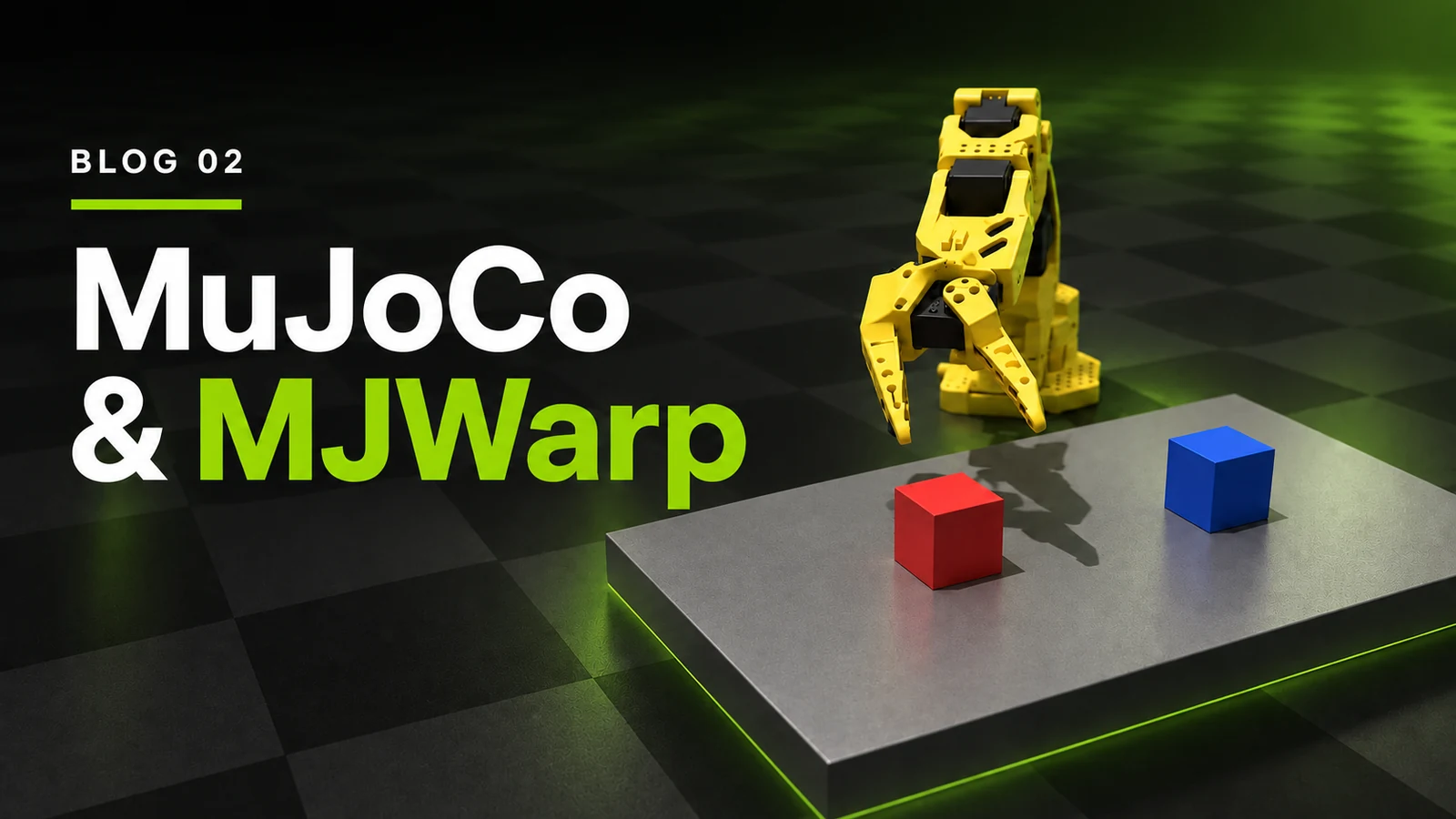
According to the official <a href="https://huggingface.co/blog/nvidia/how-to-use-nvidia-warp-and-mjwarp">Hugging Face Blog</a>, MuJoCo Warp (MJWarp) builds upon NVIDIA Warp to bring compatible MuJoCo models into a GPU-scale regime. This approach moves an SO-101 follower arm from a traditional MuJoCo workflow to as many as 2,048 parallel MJWarp environments, allowing developers to examine the foundational technology and validation steps required for the transition.
Understanding NVIDIA Warp and Kernel Compilation
NVIDIA Warp functions as a Python framework designed for writing high-performance, GPU-accelerated kernels. It allows developers to author statically typed kernels in Python and compiles them for either CPU or CUDA execution. The initial launch builds and caches a native module, while subsequent launches reuse it. The kernel language is a performance-oriented subset of Python, leaving ordinary Python responsible for configuration, allocation, and launch orchestration.
This architecture enables developers to build complex simulation logic where a single logical thread can handle individual points, contacts, bodies, or worlds. Consequently, code can scale seamlessly from a few points to millions without requiring deep GPU terminology within the core control flow.
Key Properties for Robotics Workloads
The framework incorporates three fundamental properties that make it particularly useful in robotics workflows. First, explicit parallel work uses specific identifiers to determine the exact point, contact, body, or world owned by the current logical thread. Second, explicit device arrays reside on selected devices, allowing developers to manage data efficiently.
Third, composable kernel launches enable programs to execute a sequence of focused kernels and capture supported CUDA work into a graph, which reduces repeated dispatch overhead. Furthermore, Warp kernels support differentiability and deterministic execution modes, offering robust tools for simulation, validation, and design optimization pipelines.
Transitioning from Single CPU Worlds to Batch Processing
A robot simulator repeatedly computes future states based on current joint positions, velocities, controls, and contacts, advancing the scene by small timesteps. While standard MuJoCo suits developing and inspecting single or few CPU worlds, MJWarp implements MuJoCo's physics pipeline directly on NVIDIA GPUs. This enables a single function call to advance an entire batch of independent states simultaneously.
The primary value of MJWarp lies in aggregate throughput rather than single-world latency improvements. By completing a massive total of world-steps per second, the framework supports reinforcement learning and large-scale sampling where gathering comprehensive experience outweighs minimizing the latency of an individual environment.
Validation and Practical Scene Configuration
To validate the pipeline, developers use standard simulation scenes represented in ordinary MJCF formats. For instance, a pick-and-place scene featuring an SO-101 arm, a table, and cubes can be loaded directly into MuJoCo CPU simulations for rendering and comparison against MJWarp validation steps.
Proper allocation of batched resources requires precise sizing of memory buffers and careful consideration of solver iteration limits. By configuring contact and constraint parameters correctly, developers can ensure smooth execution across thousands of parallel environments without altering underlying task behaviors.
Sources
- Hugging Face BlogHow to Use NVIDIA Warp and MjWarp to Accelerate Robotics Simulation and Learning Workflows