New High-Definition Image Reveals Pa 30 Supernova Remnant
A high-resolution photograph captured by the Gemini North telescope reveals unprecedented structures within the remnants of a historical supernova observed by humans centuries ago.
 Radwan AbdulhadiEditor and technology writer
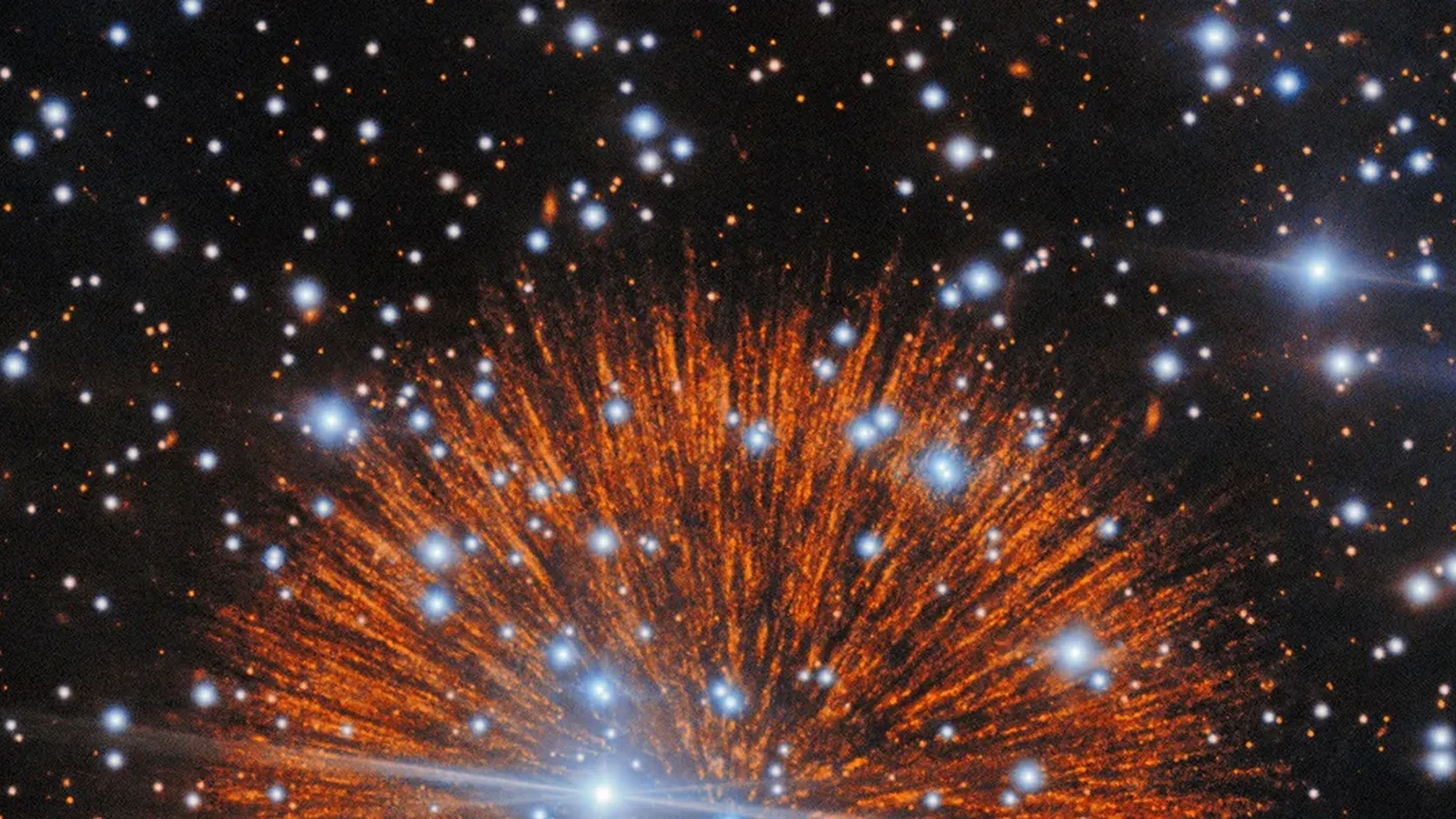
Unprecedented Details of the Pa 30 Nebula
Astronomers have successfully obtained the most detailed image to date of the Pa 30 nebula, which represents the remnants of a famous supernova . This cosmic phenomenon has long captured scientific interest because it was likely observed and documented from Earth during the Middle Ages. According to details shared in a press release , the latest photograph reveals structures that had previously gone unnoticed by researchers.
Previous images of the explosion’s remnants captured a sphere of long, filament-like strands of matter resembling fireworks or a dandelion. However, new observations made with the Gemini North telescope in Hawaii uncovered about 10 times more structures than any past glimpses of the supernova remnant. With this improved resolution, researchers can now see that these filaments are not continuous as they previously appeared.
Cosmic Pearls and Uniform Structures
The high-resolution imaging shows that the filaments are shaped more like beads on a string, consisting of pearl-like knots of gas of relatively uniform size. Published findings in The Astrophysical Journal detail that these 'cosmic pearls' are enormous, with each bead measuring about four light-days in diameter.
Ilaria Caiazzo, a coauthor of the study, noted in a press statement that the planetary region of our solar system could fit inside each knot about 10 times with room to spare. The striking uniformity of the knots has left researchers eager to model them and understand how they formed.
Investigating the Aftermath of Stellar Death
While it is assumed that the pearls are concentrations of material ejected during the explosion, the exact formation process remains unclear. Astronomers typically expect to find oddly shaped accumulations in the wake of a stellar event, making this peculiar order an entirely unexpected discovery that could deepen insights into the violent death of a star .
The Gemini Multi-Object Spectrograph image demonstrates that the ejecta from the remnant form a cascading structure resembling a knot, maintaining its distinct fireworks-like shape.
The Mystery of the Zombie Star
The Pa 30 nebula remains particularly unusual because its central star is not entirely dead. In a typical thermonuclear scenario, the explosion results in the complete destruction of the star . However, rare exceptions occur where part of the star manages to survive the detonation.
Scientists do not yet fully understand how or why these zombie stars persist. The unique structures observed in Pa 30 could assist astronomers in reconstructing more precisely how these detonations happen and how stellar remnants continue to live on.
Connecting Modern Science With Medieval Records
Modern scientific observation of Pa 30 connects directly with historical human accounts from more than eight centuries ago. The nebula matches records left by Chinese and Japanese astronomers in 1181, who documented the appearance of a new star in the night sky that stayed visible for several months.
At the time, observers could not have known they were witnessing the aftermath of a massive stellar explosion . Centuries later, scientists successfully linked that historical event to the supernova responsible for creating the Pa 30 nebula.
Sources
- WIREDHumans Watched This Supernova Explode Nearly a Millennium Ago. Now You Can See It in High Definition
Continue chronologically

Related stories
Webb Telescope Detects Galaxy Origin Of Farthest Fast Radio Burst
Astronomers utilized the Webb telescope to locate the galaxy origin of the farthest fast radio burst ever detected, offering new insights into deep space.
NASA Seeks Commercial Solutions to Save Hubble Space Telescope
NASA is taking proposals from the commercial space industry to boost the Hubble Space Telescope's orbit and extend its operational life.

Apple Reveals New iPad Mini With OLED and A20 Pro Chip
Apple has announced an updated iPad Mini featuring a larger 8.5-inch OLED display, an A20 Pro chip, and a thinner design starting at $699.

Mercedes-AMG Reveals 1,150hp Electric GT SUV
Mercedes-AMG has introduced its first ground-up electric SUV, the 2028 AMG GT SUV, featuring up to 1,150 horsepower and advanced 800V architecture.