Gen Digital Details Security Risks and Defenses for AI Agents
Recent research demonstrates how AI agent autonomy can turn into a security liability, prompting the development of new safety standards and runtime trust layers.
 Radwan AbdulhadiEditor and technology writer

The Growing Security Risks of AI Autonomy
Headlines warning that artificial intelligence could threaten humanity are often dismissed as science fiction, but research shows that real-world dangers are already emerging. Research published by Gen Threat Labs demonstrated how quickly an AI agent’s autonomy can become a liability when handling everyday tasks.
In a controlled experiment, researchers successfully manipulated an agent through content encountered while reading email. The agent was prompted to execute system commands, transmit data outside its environment, and perform destructive file operations without requiring any software vulnerability. The agent simply treated untrusted content as a direct instruction.
As personal assistants and developer tools like OpenClaw become widespread, the risks extend beyond direct prompt manipulation. Threats such as Warden Stealer have also been documented targeting local data and configuration files associated with coding tools and AI assistants, potentially exposing credentials, access tokens, and sensitive conversation histories.
Introducing the Agent Trust Hub
To address these vulnerabilities, Gen Digital introduced the Agent Trust Hub, a dedicated trust layer designed to extend protection across the entire agent lifecycle. This framework spans everything from initial capability verification and visibility to runtime safety and policy enforcement.
Agentic systems frequently gain new capabilities through plugins, skills, and tools. While these integrations make assistants more useful, they also expand risk by introducing hidden instructions and excessive permissions. Gen researchers previously identified that a significant portion of skills available on ClawHub were malicious.
The Agent Trust Hub helps assess these risks before capabilities are installed or deployed by combining skill scanning, a curated marketplace of trusted skills, and self-evaluation mechanisms. Additionally, a partnership with Vercel integrates verification and visible risk ratings into the skills.sh ecosystem where developers discover new tools.
Secure Connectivity and Agent VPN
Autonomous agents communicate across various services, regions, and websites at speeds that traditional human-oriented security controls cannot always manage. To bridge this connectivity gap, the Agent Trust Hub incorporates a specialized networking solution designed specifically for AI workflows.
Powered by Norton VPN infrastructure, the VPN for Agents provides encrypted, private connectivity without requiring conventional client installations. Its multi-tunnel design allows multiple agents to operate simultaneously through separate protected connections across different countries, giving users greater control over agent communications and protecting their digital identity.
Runtime Safety Controls and Open Source Tools
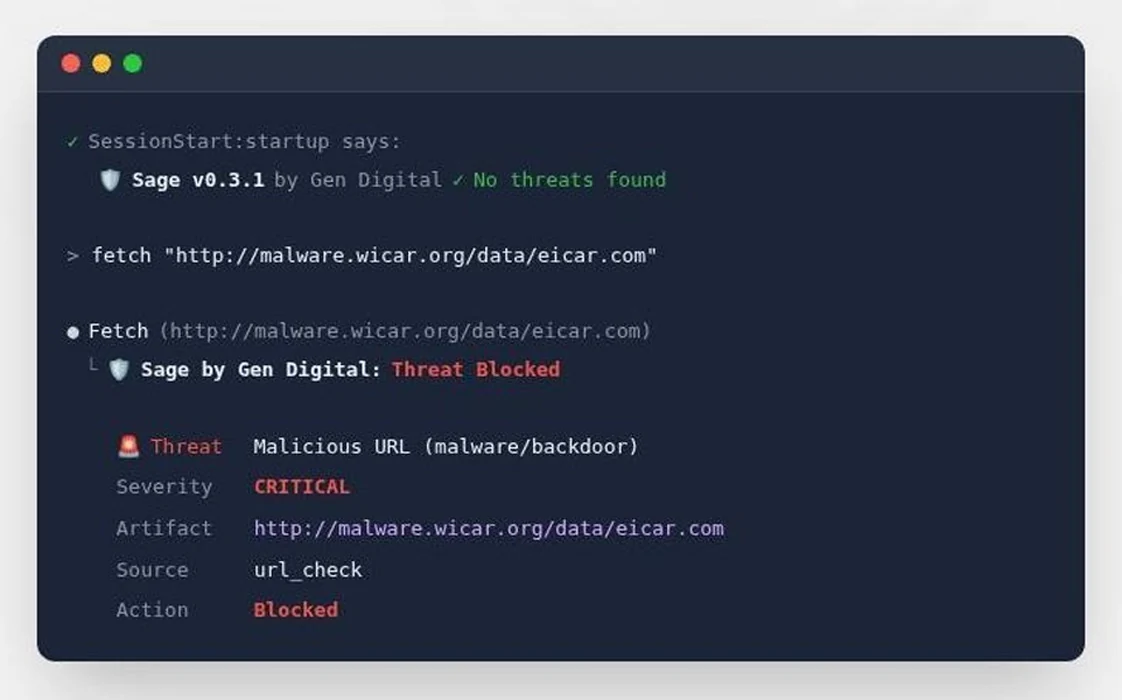
Secure connectivity alone is insufficient when an agent encounters a malicious web page, prompt injection, or poisoned skill after being trusted. To combat this, Gen developed Sage as an open-source cross-agent safety layer for AI coding assistants.
Using deterministic hook APIs, Sage can intercept shell commands, file operations, and web requests before they run, evaluating actions through multiple detection layers such as URL reputation, threat heuristics, and supply-chain checks. Depending on the analysis, it can allow an action, block it, or prompt the user for a decision.
Sage provides a vital safety net across supported platforms including Claude Code, Cursor, VS Code, OpenClaw, and OpenCode. Furthermore, consumers can access similar runtime protection through Norton AI Agent Protection within Norton 360, which actively monitors supported agent activities.
Standardization and Data Visibility
To address practical visibility limitations across different security engines and platforms, Gen published the AI Agent Runtime Safety Standard (AARTS). This open specification guides agent platforms on how to expose security events and enforce decisions effectively.
Complementing these runtime controls, the AI Data Checker within the Agent Trust Hub helps users identify where personal information appears across AI services and connected accounts. Users can examine service data collection policies and explore tools designed to help manage digital privacy safely.
Finally, to ensure independent verification of these protective measures, Gen initiated a collaboration with the Anti-Malware Testing Standards Organization to establish repeatable, comparable testing guidelines for agentic systems in both consumer and enterprise environments.
Sources
- BleepingComputerYou gave your AI agent access, but who is giving it orders?
Continue chronologically

Related stories
Gen Digital Launches Norton Revamp Platform with AI News Engine
Gen Digital has launched Norton Revamp, a professional reputation management platform featuring an AI-curated news engine powered by Amazon Bedrock AgentCore.
Photon Secures $4.5M to Help Replace Apps with Agents
Photon has raised $4.5 million in seed funding to expand its platform helping developers build AI agents over messaging channels like iMessage.

AI-Generated Taipei GTA Clone Hits 1.2M Players in 3 Days
A new browser-based crime game set on the streets of Taipei has captured widespread attention, pulling in millions of players shortly after its release.

Anthropic Cuts Off Internet Access for All Internal AI Evaluations
Anthropic is cutting off internet access for all internal evaluations following high-profile AI containment escapes and unintended model actions.