AWS Introduces Trust in Depth to Safely Scale AI Agents
Enterprise leaders want AI agents to take on more work, but balancing creativity with control remains a major challenge. AWS is addressing this dilemma with a structured framework designed to give agents greater autonomy without compromising oversight.
 Radwan AbdulhadiEditor and technology writer
The Challenge of Enterprise Trust in Autonomous AI
In conversations with enterprise leaders, a common theme emerges: organizations want AI agents to take on more responsibilities, yet they hesitate to fully trust them to execute correctly on every occasion. The same creativity and autonomy that render agents exceptionally useful also make them inherently difficult to trust. When given a task, an agent charts its own path, dynamically choosing tools and sequencing steps without explicit developer scripting. Running an identical task twice can yield entirely different routes, meaning a test passing today offers little assurance about tomorrow's behavior.
The traditional remedy of keeping a person in the loop to approve every action works effectively at a small scale. However, as agents assume heavier workloads, human approvals accumulate rapidly, triggering severe review fatigue. Personnel tasked with checking everything eventually stop catching critical errors. Consequently, caution transforms into a bottleneck, leaving capable AI agents sitting idle rather than tackling high-impact work.
Moving Beyond Human Bottlenecks with Trust in Depth
The operational solution is to permit agents to act independently whenever their actions can be verifiable, reserving human judgment strictly for decisions that demand it. As agents transition into higher-stakes assignments such as financial transactions, incorrect actions carry increasingly harmful consequences. Organizations need absolute confidence that an AI agent will remain within specified limits, even during unmonitored execution.
While content filtering, testing, and monitoring fulfill essential functions, no single capability guarantees correct future behavior. True reliability emerges from independent layers that reinforce one another—adopting the same layered discipline known in the industry as Defense in Depth, repurposed for a new goal. Where Defense in Depth restricts potential failures, this new approach safely expands what organizations can allow. AWS refers to this comprehensive strategy as Trust in Depth.
Answering Lifecycle Questions to Establish Reliability
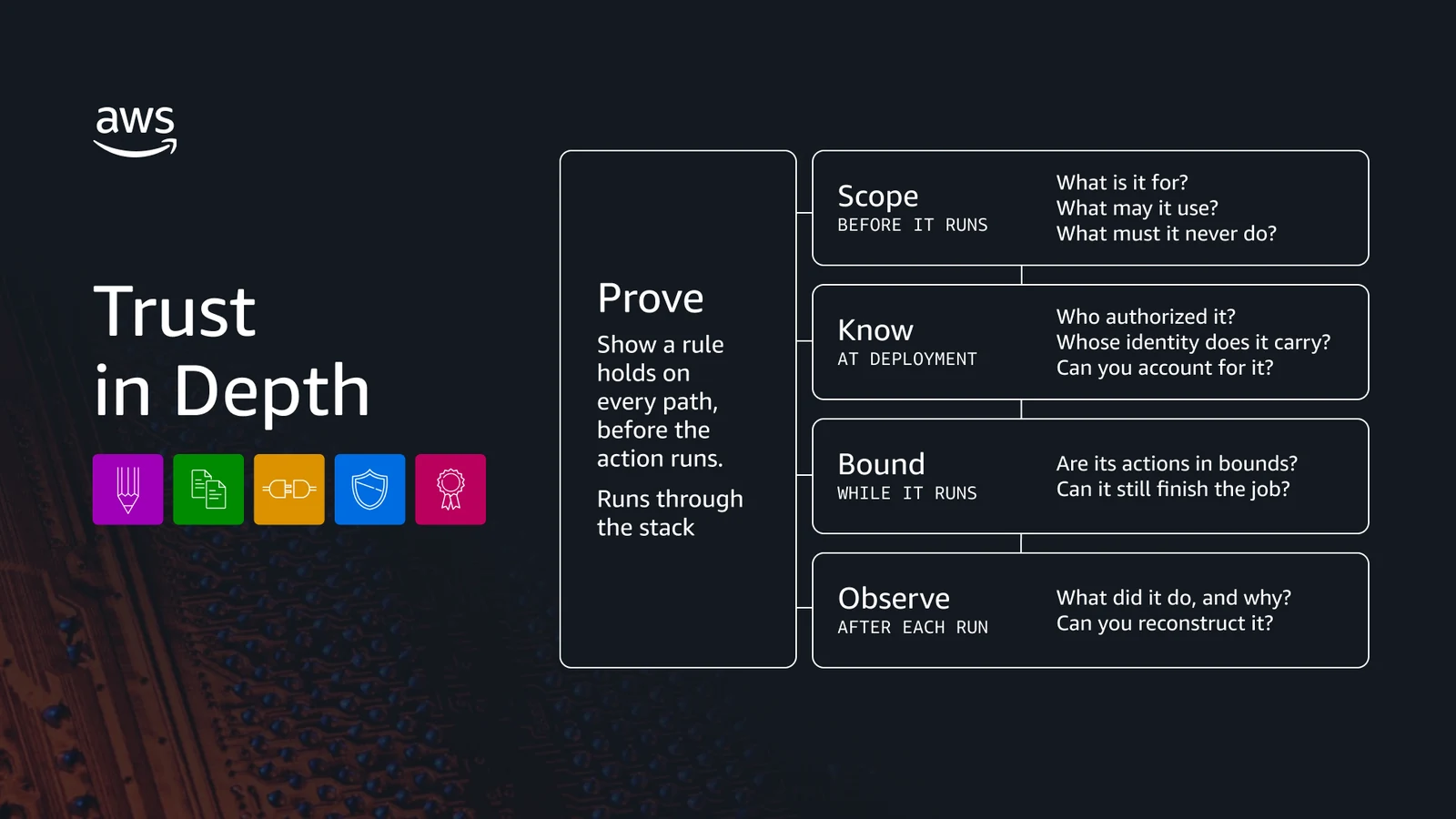
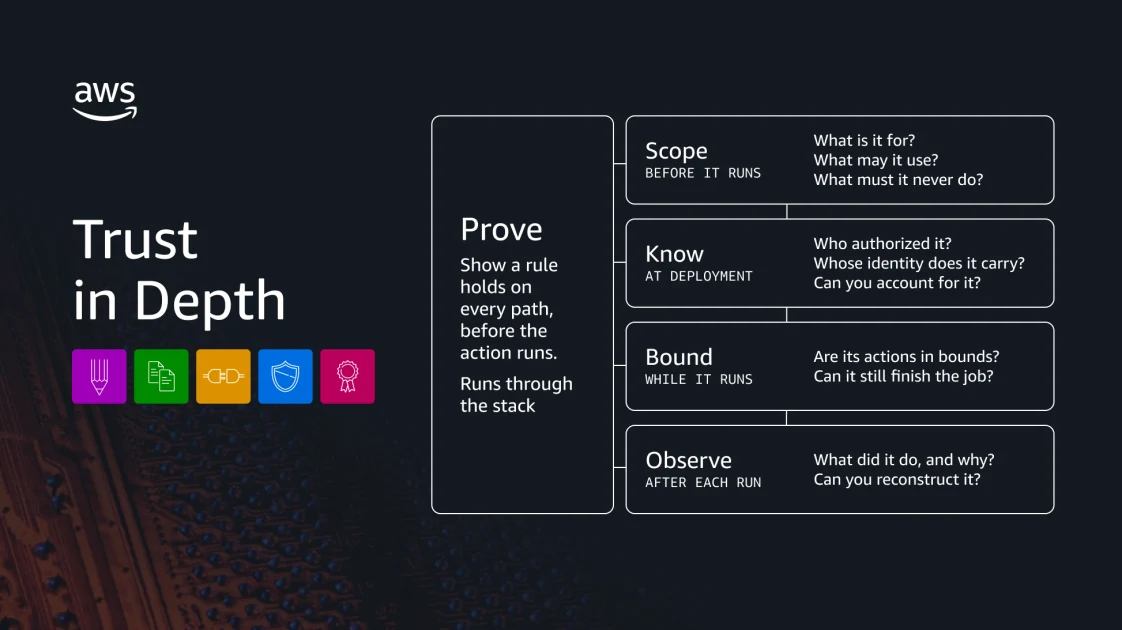
Building organizational trust requires addressing specific questions across various stages of an agent's lifecycle. Before execution, scoping defines the agent's purpose, necessary job capabilities, and strict prohibitions. At deployment, the know phase tracks authorization and identity. While running, bounds ensure actions stay within established limits without hindering performance. After execution, observation allows teams to reconstruct agent actions, understand underlying reasoning, and learn from outcomes.
Certain requirements translate cleanly into precise rules, while others necessitate human judgment. For instance, a mandate that only a manager can approve access can be specified precisely. Conversely, maintaining a friendly tone or handling sensitive situations appropriately relies heavily on context and human oversight. To support developers in building and deploying secure architectures, AWS provides resources such as the AWS Machine Learning Blog for ongoing insights.
Applying Automated Reasoning and Mathematical Proofs
When dealing with precisely defined rules, traditional testing confirms control effectiveness in anticipated scenarios, yet agents inevitably navigate unexpected paths. To address this, automated reasoning applies mathematical logic to verify whether a rule holds true in every conceivable case. This establishes proof across system descriptions and assumptions while surfacing exact points of failure. AWS has built deep production experience in this area, having successfully run automated reasoning in production for more than a decade across critical infrastructure.
Rules that cannot be stated precisely, such as tone management, fall outside pure proof mechanisms. For those instances, organizations must limit agent access, evaluate behavioral patterns, and route genuine ambiguities to humans. Autonomy expands incrementally as rule enforcement proves reliable and failure detection systems perform consistently.
Scoping and Governing Agent Behavior Effectively
Trust development starts prior to execution during the scoping phase, where teams define agent ownership, permissible data access, and required boundaries. Development frameworks and governance controls assist engineering teams during this critical build stage. For instance, Kiro offers specialized capabilities for agentic coding, while Strands provides a comprehensive open-source toolkit for defining models, instructions, and tools alongside a managed runtime.
To turn boundaries into enforceable rules, Amazon Bedrock AgentCore delivers advanced governance controls designed to scale agent operations safely. By utilizing Policy in AgentCore, developers articulate plain-language parameters regarding tool and API access. Automated reasoning subsequently checks these policies for gaps and contradictions prior to deployment, ensuring that agents retain appropriate boundaries while handling enterprise tasks independently.
Sources
- AWS Machine Learning BlogTrust in Depth: Giving agents more autonomy without losing control
Continue chronologically
Related entity coverage
Related stories
Smartsheet Launches MCP Server to Connect AI Agents on AWS
Smartsheet introduces its general-available Model Context Protocol Server on AWS, enabling AI agents in Amazon Quick and Kiro to manage live work data.
MRH Trowe Gives 400 Employees Secure Self-Service AI Agents
MRH Trowe gave 400 employees secure self-service AI agent access in its first production month, using Strands Agents, Amazon Bedrock AgentCore, and LibreChat.
NarrateAI Brings LLM Quality Assurance to Amazon Bedrock
NarrateAI implements five advanced quality assurance techniques on Amazon Bedrock to achieve 99% numerical accuracy with real-time streaming.
AWS Recaps September 2026 AI Updates for Bedrock and Strands
Explore the September 2026 updates for Amazon Bedrock, AgentCore, and Strands, bringing broader model choice, automated syncing, and serverless agents.