Train Qwen3 on AWS Trainium with torchtitan
A comprehensive walkthrough details how to leverage torchtitan on AWS Trainium to train and fine-tune Qwen3 models utilizing standard PyTorch interfaces and specialized hardware recipes.
 Radwan AbdulhadiEditor and technology writer
Introduction to Training Qwen3 on AWS Trainium
Using torchtitan on AWS Trainium means utilizing the framework the exact same way developers always have. TorchNeuron registers Trainium as a native PyTorch device, which enables torchtitan to interact with the hardware seamlessly through standard PyTorch interfaces. Developers can leverage these configurations to either pre-train models from random initialization or fine-tune already published weights directly.
Furthermore, engineering teams can customize both the underlying model implementation and specialized kernels to match their specific workload requirements. In this architectural walkthrough, developers train the Qwen3 model across three unique approaches on a single trn2.48xlarge instance.
The primary environments required for this process include either the AWS Deep Learning AMI for Neuron or an equivalent Neuron PyTorch training container. Both available environments supply the necessary Neuron driver, runtime, and compiler needed to successfully execute training workflows on Trainium hardware.
The Three Training Configuration Paths
The first available training method utilizes Transformers v5 as a modeling backend directly inside torchtitan. It runs Hugging Face Hub models through AutoModelForCausalLM while reading and writing published safetensors without friction. Developers can reference the official documentation for further guidance on deployment patterns and ecosystem integration.
The second method transitions smoothly to torchtitan's native Qwen3 configuration by simply modifying the config.model_spec parameter. Meanwhile, the third approach integrates Neuron Kernel Interface mixture-of-experts kernels sourced directly from the torchtitan-neuron recipes, allowing custom kernel attachments via the override registry.
Importantly, all three distinct configuration paths maintain structural consistency by utilizing the exact same torchrun launch pattern and configuration structure, streamlining the transition between backends.
Transformers v5 Backend and Checkpoint Handling
In the first configuration setup, Transformers v5 builds the Qwen3 model through AutoModelForCausalLM. The Hugging Face Hub model definition supplies the specific implementation required for executing forward and backward passes. Developers select the target model simply by assigning its Hub ID within the configuration file.
To fine-tune models from published weights, engineers enable checkpoint loading and assign initial_load_path appropriately. A state-dictionary adapter effectively adjusts the leading model. prefix and manages tied token embeddings, ultimately saving the final output checkpoint as standard Hugging Face safetensors.
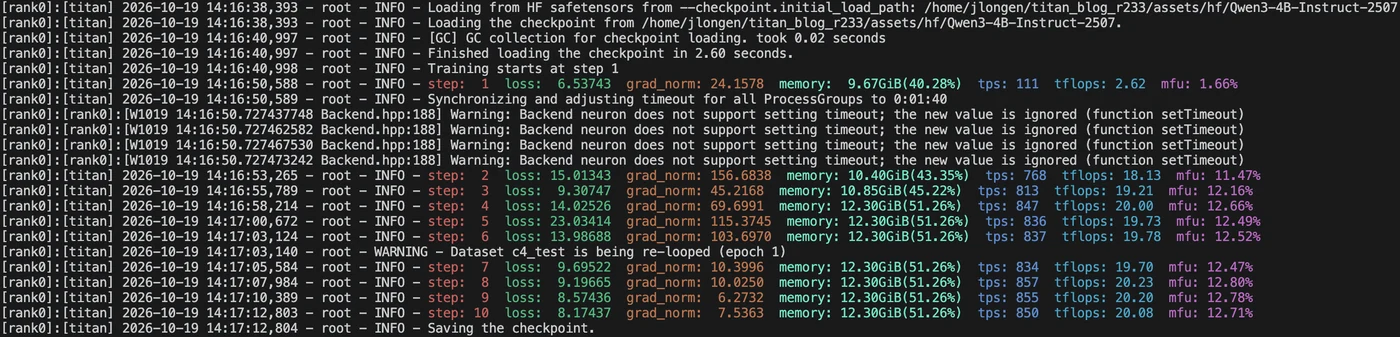
Verifying the initial training-step loss serves as a helpful checkpoint check to confirm that torchtitan successfully loaded the published weights. For instance, verified runs produce distinct loss metrics between published weights and random initialization.
Native Qwen3 Models and Torchtitan Integration
Moving to the second configuration approach, torchtitan constructs its native Qwen3Model directly. This approach typically begins from established configurations because the testing build establishes clear parameter specifications for the model architecture.
The model specification parameter strictly defines the target model class, dictates how torchtitan shards the model parameters across cores, and handles the mapping of checkpoint keys. Selecting torchtitan's native Qwen3 implementation with scaled dot product attention ensures optimized execution on the hardware.
When torch_neuronx is properly installed, TorchNeuron registers Trainium as the primary neuron device, allowing torchtitan to detect it seamlessly upon startup.
Mixture-of-Experts and NKI Kernel Customization
The third configuration approach empowers torchtitan to execute mixture-of-experts layers utilizing custom kernels written in NKI, which serves as the specialized Neuron kernel language. This particular setup implements data parallel sharding across available ranks while maintaining flexible expert configurations.
TorchNeuron fully supports registered NKI operators in both eager execution mode and standard torch.compile workflows. When torch.compile is enabled, developers can add specific components to compile gradient-norm clipping operations effectively.
Specialized kernel wrappers and registration functions allow NKI kernels to become directly callable from PyTorch, attaching essential backward passes using routing metadata captured during forward execution.
Optimizing Tensor Shapes and Layouts
In advanced scenarios, developers may choose to optimize specific operations tailored directly to the unique tensor shapes present in their model architecture. Specialized kernels optimize tiling and data movement patterns to enhance computational efficiency across the network layers.
Engineers can write custom kernels or adopt existing solutions from core libraries, ensuring that tensor layouts—such as transforming query and key dimensions between different structural expectations—are handled correctly inside the operator implementation.
Readers interested in more technical deep dives, tutorials, and machine learning updates can explore additional resources published across the official platform channels.
Sources
- AWS Machine Learning BlogTrain Qwen3 on AWS Trainium with torchtitan
Continue chronologically

Related entity coverage
Related stories
Hugging Face Launches Space to Check AWS Trainium Support
Discover which Hugging Face models run on AWS Trainium using the new torch-neuronx model support space, checking compatibility, scripts, and more.

TorchNeuron Brings Native PyTorch Support to AWS Trainium
TorchNeuron arrives as a public beta, introducing a native PyTorch backend for AWS Trainium with eager execution and torch.compile support.
Fine-Tuning GPT-OSS-20B for Multilingual Reasoning
Learn how developers fine-tuned GPT-OSS-20B for multilingual reasoning on Amazon SageMaker HyperPod using SFT and GRPO techniques.
AWS Details Distributed Training on Amazon EKS with Ray Train
Learn how to use Ray Train Deep Learning Containers and EFA on Amazon EKS for distributed PyTorch model training without custom images.