Train Microduck Robot With NVIDIA Isaac Lab 3.0
Pollen Robotics and Hugging Face have introduced Microduck, a newly released affordable open-source bipedal robot that can now be trained using NVIDIA Isaac Lab and Newton before real-world deployment.
 Radwan AbdulhadiEditor and technology writer
Training Bipedal Locomotion in Simulation
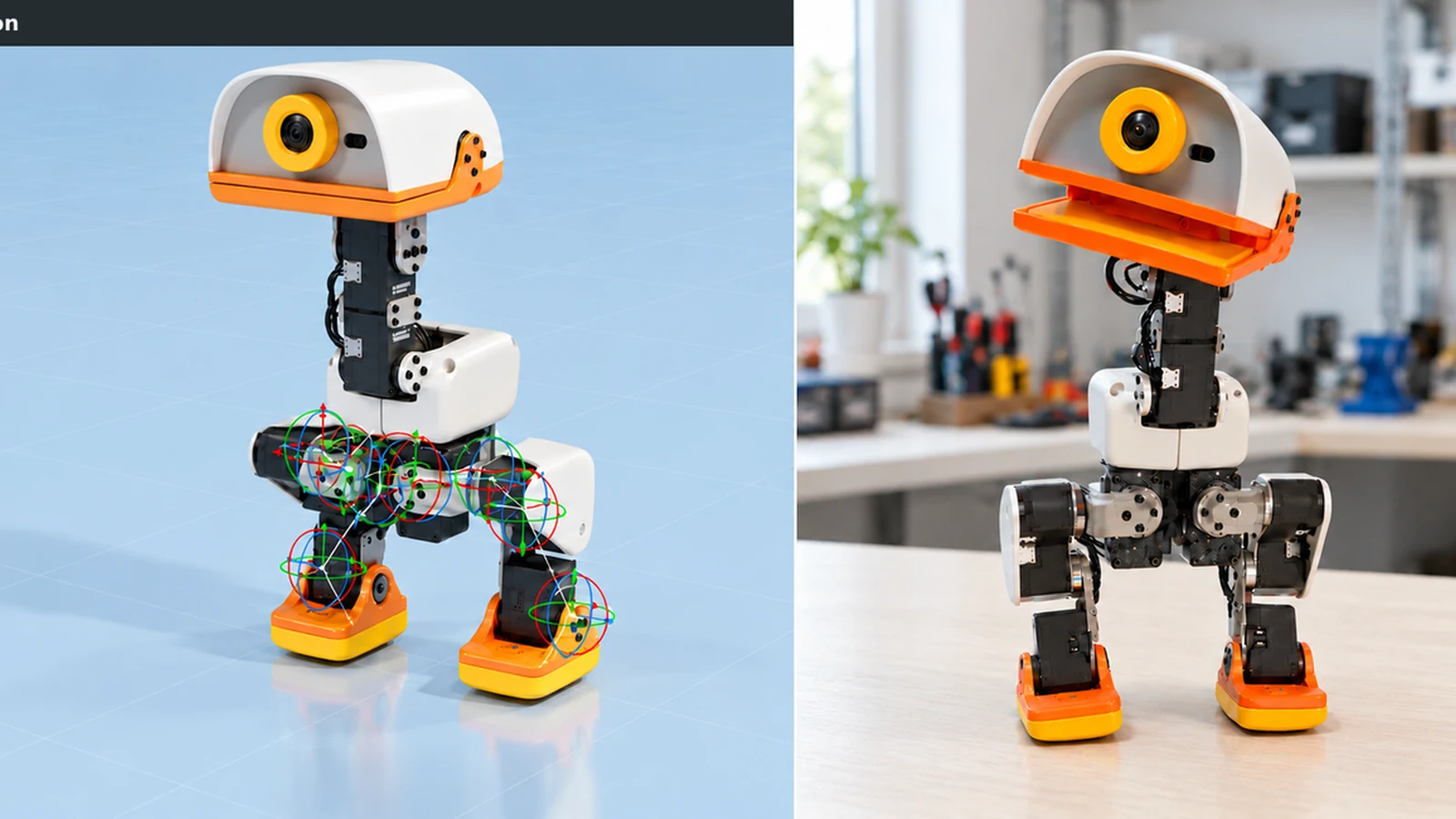
Microduck is a newly released affordable open-source bipedal robot by Pollen Robotics and Hugging Face. Developers can now train Microduck to walk using the NVIDIA Isaac Lab framework, test the resulting policy, export it as an ONNX file, and deploy it directly onto a real robot. Completed models can also be shared on the Hugging Face Hub or validated for competition in the Microduck Arena.
Designing a walking policy in simulation requires accounting for the friction, delays, and mechanical play inherent in physical robot servos. NVIDIA Isaac Lab provides an open-source framework for training policies across thousands of GPU-parallel simulations. By combining this framework with advanced actuator modeling and domain randomization, developers can better prepare their policies for real-world hardware deployment.
Environment Setup and Configuration
To begin the simulation and training workflow, operators require a Linux workstation equipped with a supported NVIDIA GPU and driver, alongside proper onboard robot software and a control interface like a paired gamepad. Once the environment is prepared, developers can confirm that the necessary Microduck tasks and presets are fully available within their workspace.
Isaac Lab provides the complete robot model, scene, observations, actions, rewards, and domain randomization presets out of the box. Users can start with a flat-walking task or transition to a rough variant that introduces stairs, slopes, and uneven terrain. The underlying policy evaluates 61 observation values to output 14 joint-positions, maintaining strict consistency across observation orders, normalization, and action scaling during export.
Accelerating Training With Parallel Simulations
Locomotion training is heavily accelerated by running simulated environments in parallel directly on the GPU. Developers can also configure distributed training across multiple devices—such as utilizing 16 GPUs—to speed up training times and increase model robustness. In optimized configurations, teams can reach up to 1.25 million steps per second on rough terrain with backlash enabled.
The workflow utilizes Newton alongside the MJWarp solver and Newton-based Better Actuator Models to accurately simulate servo responses, electrical limits, friction, and delays. To ensure policies transfer smoothly to physical hardware, domain randomization is applied across mass, center of mass, ground friction, joint inertia, encoder offsets, battery voltage, and command latency.
Exporting Policies and Hardware Deployment
Once a walking policy has been thoroughly evaluated in simulation, it must be exported to an ONNX format for physical deployment. The playback workflow in Isaac Lab automatically generates both TorchScript and ONNX files. Operators can then use the policy.onnx file with the robot's onboard runtime, ensuring that observation orders and action scaling match the original training parameters.
After validating the policy in the simulation visualizer and completing interface checks, the ONNX file can be transferred to a configured Microduck robot. Detailed deployment steps guide users through copying the policy to the hardware and initiating the onboard runtime execution for real-world walking tests.
Community Collaboration and Arena Competitions
Developers looking to test their models against shared challenges can submit compatible policies to the Microduck Arena. This designated space allows researchers to evaluate model performance and compare leaderboard results. Eligible models must adhere to specific constraints, including the required observation and action values alongside a maximum file size limit.
Additionally, creators can publish their completed models directly to the Hugging Face Blog and wider ecosystem so that other community members can discover, download, and build upon their work. Including a clear model card and training configuration helps others reproduce experimental results successfully.
Sources
- Hugging Face BlogTrain in Simulation, Deploy on a Real Robot: Microduck with Isaac Lab 3.0
Continue chronologically
Related entity coverage
Related stories
Train Qwen3 on AWS Trainium with torchtitan
Learn how to train Qwen3 on AWS Trainium using torchtitan across three distinct configuration approaches on a single trn2.48xlarge instance.
NVIDIA and UW Introduce RFD4-Proteina for Programmable Protein Design
Explore RFD4-Proteina, a new BioNeMo open model co-developed by NVIDIA and the University of Washington to streamline programmable protein design.
NVIDIA Expands Nemotron 3.5 with New Retrieval Models
NVIDIA expands its Nemotron collection with open models for embedding, reranking, and document parsing to enhance enterprise agent workflows.
NVIDIA and AI4Bharat Launch Indic Pretraining Corpus
NVIDIA and IIT Madras lab AI4Bharat introduce Nemotron-pretraining-Indic-v1, featuring 2.8 trillion tokens and an open data generation pipeline.