
Multiverse Computing Applies Ising Physics to LLM Pruning
Researchers at Multiverse Computing have developed a physics-inspired approach to large language model (LLM) pruning. By treating transformer block removal as an Ising optimization problem, the team has successfully improved compression efficiency and model performance.
 Radwan AbdulhadiEditor and technology writer
The Challenge of LLM Depth Pruning
The rapid expansion of large language models has led researchers to explore increasingly efficient ways to minimize computational overhead. One of the most direct methods is block removal, or depth pruning, which reduces the model's footprint by deleting entire transformer blocks. While this approach offers predictable inference speedups and stacks well with quantization, determining which specific blocks to remove remains a significant challenge. According to the recent [Hugging Face Blog](https://huggingface.co/blog/MultiverseComputingCAI/pruning-llms-what-is-the-physics-of-spin-systems) post, the interaction between blocks means that removing the wrong components can lead to catastrophic model collapse.
Mapping LLMs to Spin Systems
Traditional pruning methods often rely on mean-field heuristics, which evaluate each block's importance independently. Multiverse Computing argues that this approach ignores the crucial coupling—the impact that the removal of one block has on another—that defines the model's structural integrity. Their research, detailed in [LLM Compression by Block Removal with Constrained Binary Optimization](https://huggingface.co/papers/2602.00161), redefines block selection as a constrained binary optimization (CBO) problem. By mapping these dependencies onto an Ising glass, the team captures the all-to-all interactions inherent in a disordered spin system.
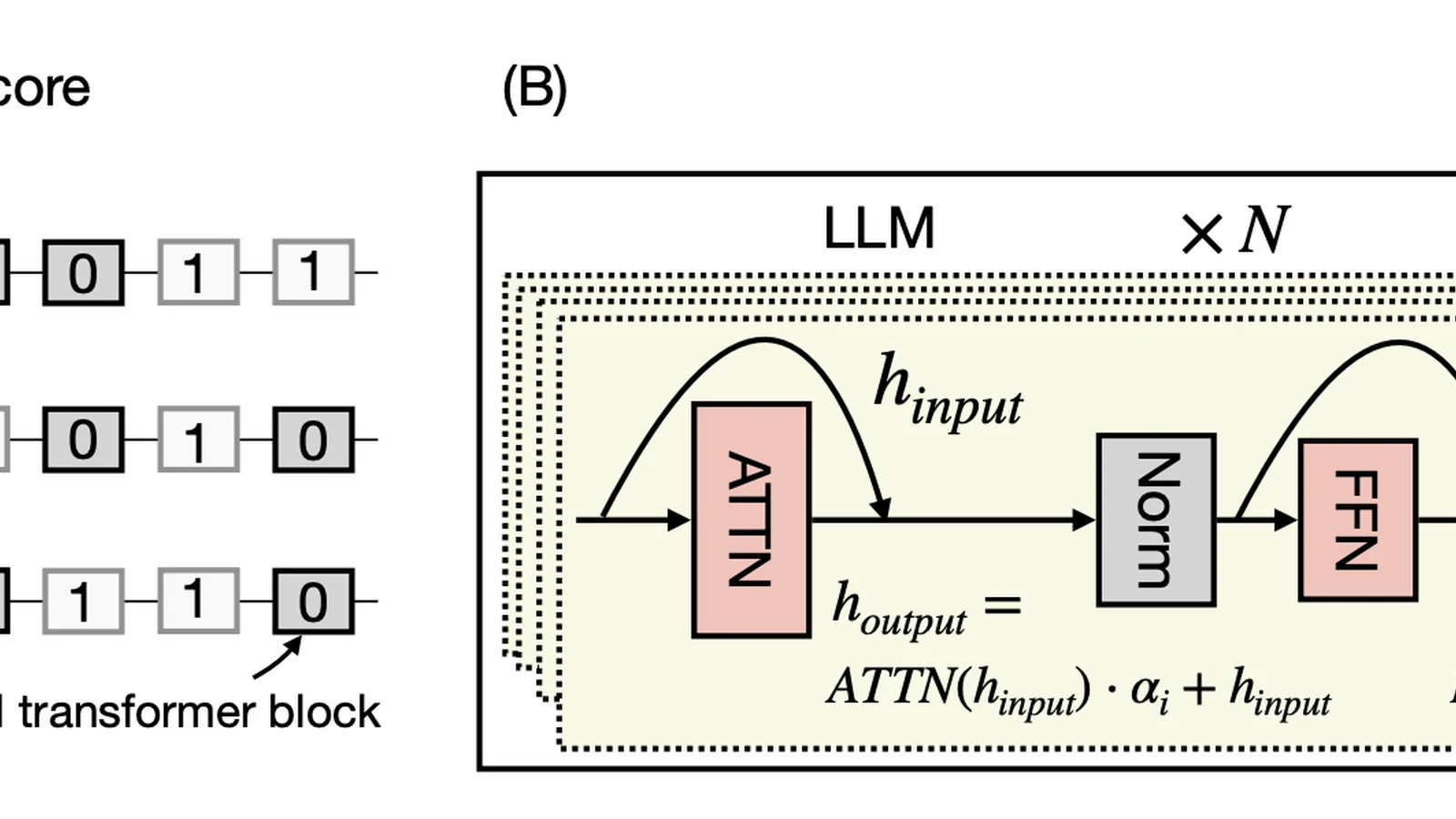
In this framework, each transformer block is assigned a binary variable, representing 'keep' or 'remove' states, analogous to 'up' or 'down' spins. By performing a second-order Taylor expansion of the model's loss, the researchers derive a Hessian matrix. The diagonal entries quantify individual block importance, while off-diagonal entries represent the pairwise couplings between blocks. This physics-based formulation allows for the calculation of an energy score that serves as a high-fidelity proxy for downstream performance, enabling the selection of optimal block configurations without the need for extensive retraining or benchmarking.
Efficiency and Performance Gains
The primary advantage of this [block removal](https://huggingface.co/papers/2602.00161) strategy lies in its computational efficiency. The Hessian matrix is computed once using a small calibration dataset, after which testing thousands of potential pruning configurations becomes a matter of simple energy calculations. This allows practitioners to explore vastly larger configuration spaces than brute-force methods would otherwise permit. When applied to Llama-3.3-70B-Instruct at 50% compression, the method reportedly yielded a 23 percentage point improvement on the MMLU benchmark compared to existing competitive pruning techniques.
Leveraging Quantum-Inspired Solvers
While simple configurations can be solved via brute force on a single GPU, more complex scenarios require more robust mathematical machinery. The research team leverages the equivalence between their CBO problem and Quadratic Unconstrained Binary Optimization (QUBO) to utilize a variety of classical, quantum, and quantum-inspired solvers. Tools such as tabu search and specialized branch-and-bound algorithms can identify low-energy states in seconds, even for the most difficult model configurations. This flexibility allows the researchers to scale the pruning process to depths that were previously computationally prohibitive.
Rather than seeking a single 'perfect' ground state, the team emphasizes the utility of finding a spectrum of low-energy configurations. Because the energy function provides such a strong approximation of quality, these low-lying excited states offer a set of high-performing candidates for final deployment. This strategy mitigates the risk of overfitting to a single model variation and provides a more resilient approach to deep compression in large-scale AI systems.
Sources
- Hugging Face BlogPruning LLMs Like a Physicist: Block Removal as an Ising Optimization Problem