
Use Open Weight Models With Amazon Bedrock for Coding
Developers can now combine open-source terminal-native coding agents with managed open weight models on Amazon Bedrock to build secure, flexible, and cost-effective workflows.
 Radwan AbdulhadiEditor and technology writer
Introduction to AI Coding Agents on AWS
AI coding agents have become a core part of how software engineers write, debug, and refactor codebases. By pairing open-source tools like OpenCode with open weight models on Amazon Bedrock, development teams can operate secure, flexible, and pay-per-use coding assistants while keeping data within their own AWS environments and avoiding separate infrastructure management.
Many standard coding assistant solutions require teams to send proprietary code to third-party APIs, enforce rigid per-seat subscriptions, or lock users into a single provider. These constraints can conflict with internal data residency mandates or cost-sensitive workloads. Running open weight options through fully managed services addresses these operational hurdles.
Shifting Industry Trends Toward Open Weight Models
The broader technology industry is experiencing a notable shift toward open weight alternatives. According to McKinsey’s Open-source technology in the age of AI report (2025), roughly 76 percent of organizations expect to increase their usage of open source artificial intelligence, with leading adopters being significantly more likely to utilize open weight models.
Performance parity and cost efficiency drive much of this adoption. For instance, CrowdStrike’s fine-tuned NVIDIA Nemotron achieved high valid query accuracy in specific testing domains, outperforming several well-known proprietary alternatives. Furthermore, Gartner’s 2026 analysis indicates that agentic workflows can multiply token consumption significantly, making efficient cost-per-token pricing models critical for large-scale operations.
Enterprise Security and Compliance Capabilities
Using open weight models via Amazon Bedrock provides robust enterprise security controls. Code, prompts, and responses remain securely stored within the user's AWS account. Models inherit standard AWS Identity and Access Management policies, AWS CloudTrail logging, AWS PrivateLink connectivity, and encryption mechanisms without requiring a separate security stack.
Additionally, Bedrock is included in the scope of several common compliance programs, including HIPAA, SOC 2, ISO 27001, FedRAMP, and GDPR. Crucially, the platform ensures that input data and model outputs are never used to train or improve the underlying foundation models.
Supported Models and Multi-Model Workflows
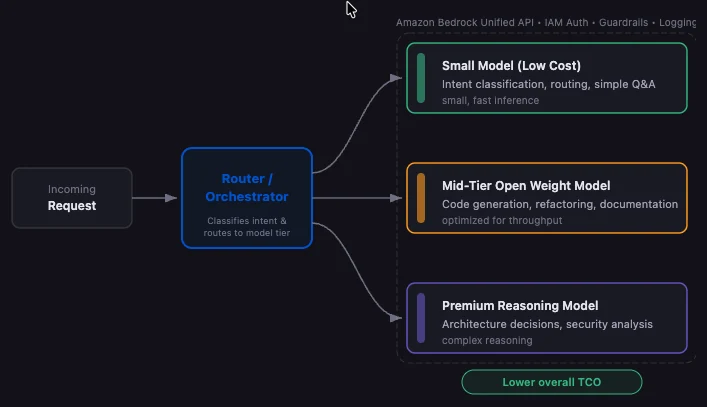
Different software engineering tasks require distinct model capabilities. Teams can configure multi-model workflows to route specific tasks to optimal engines, utilizing options such as Moonshot AI Kimi K3 for deep reasoning and massive context windows, OpenAI GPT-OSS 120B for general tasks, and NVIDIA Nemotron 3 Super 120B for rapid generation speeds.
Early enterprise adopters are already leveraging these patterns in production environments. For example, Ethara.AI deploys this exact architecture utilizing multi-agent orchestration to successfully power large-scale engineering and research workflows.
Architecture and Pricing Structure
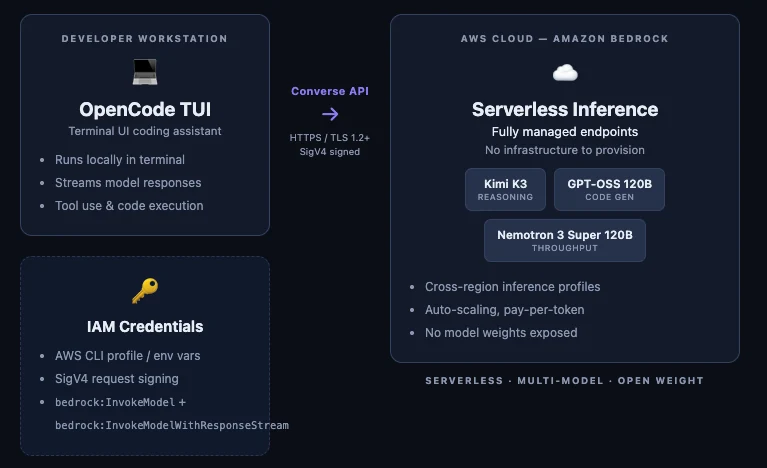
The solution architecture relies on OpenCode operating as a terminal user interface directly on a local developer machine, which subsequently calls the Amazon Bedrock Converse API for secure model inference. Because Amazon Bedrock manages the underlying endpoints in a serverless manner, teams do not need to provision dedicated GPUs or oversee underlying infrastructure.
Flexible pricing options help organizations align costs directly with specific workloads. Users can choose among Priority tiers for latency-sensitive production needs, Standard tiers for on-demand token-based inference, and Flex tiers offering lower costs for variable-latency tasks.
Sources
- AWS Machine Learning BlogUse open weight models as your AI coding agent with Amazon Bedrock