Meta Details PrivacyLib for Data Access Boundary Controls
Meta has detailed PrivacyLib, a unified client-side library designed to enforce and monitor privacy policies at the data access boundary across its backend infrastructure.
 Radwan AbdulhadiEditor and technology writer
A Unified Approach to Data Access Boundary Enforcement
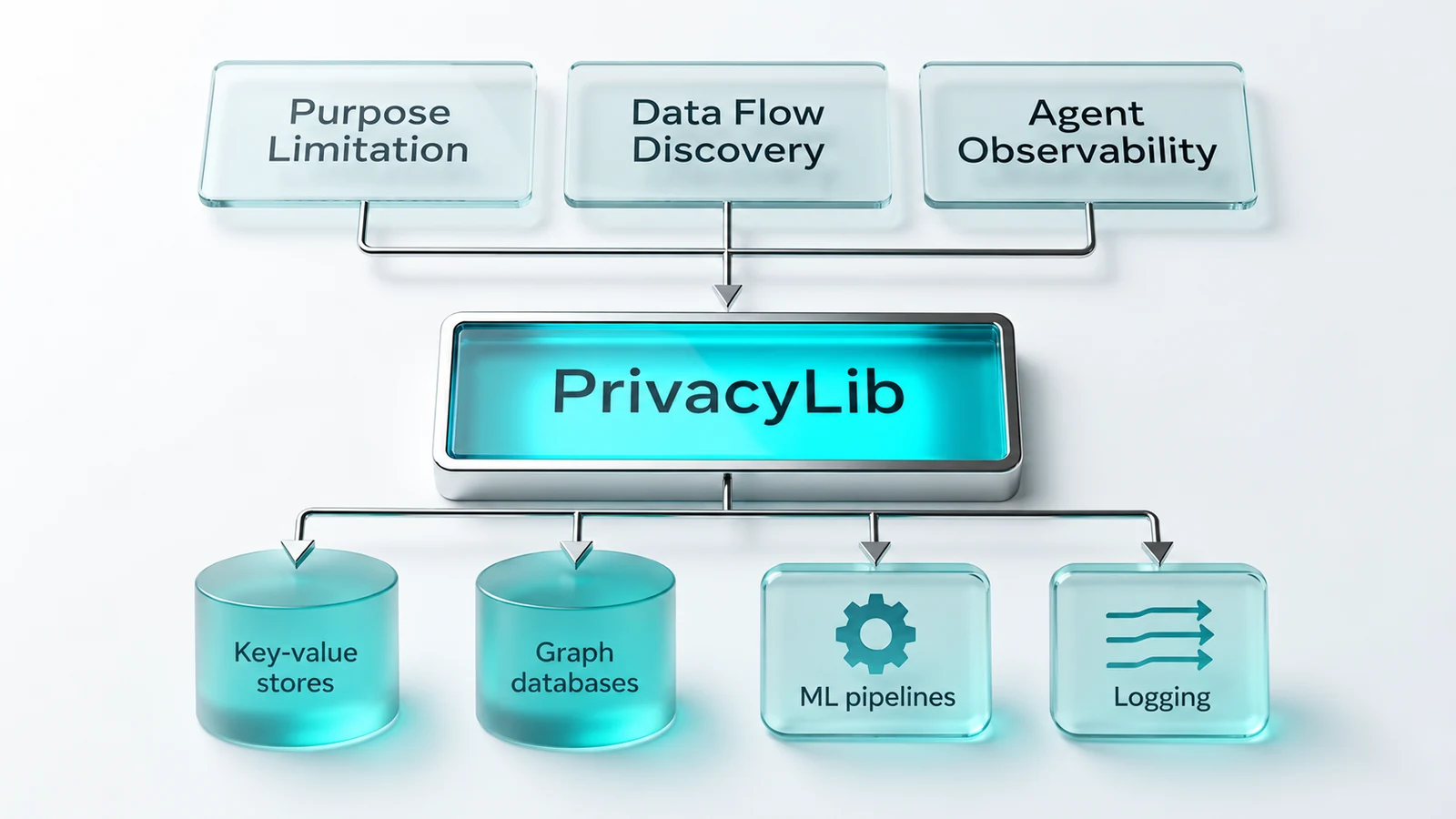
Meta has detailed the inner mechanics of PrivacyLib, a core component of its broader Privacy Aware Infrastructure (PAI) framework designed to continuously monitor and enforce privacy requirements across its technical ecosystem. According to Meta Engineering, PrivacyLib embeds directly into client libraries across hundreds of data and processing systems at the exact point where data access occurs.
Rather than relying on manual privacy audits that can drift out of sync as software evolves, Meta developed infrastructure-level constructs to prove that user data travels only where permitted. PrivacyLib operates at the final stage of this workflow by executing continuous enforcement and monitoring. The unified library performs billions of checks every second across Meta's server fleet while preventing latency degradation.
Decoupling System Integration from Requirement Implementation
Prior to PrivacyLib's introduction, implementing a new privacy requirement across Meta's environment required engineering teams to build custom enforcement logic separately into the client software of each data system. Supporting a new mandate across every storage engine and processing pipeline could take months of effort.
PrivacyLib resolves this inefficiency by separating system integration from policy implementation. Systems integrate with PrivacyLib once, and new privacy capabilities plug in as modular additions that automatically reuse that single integration. Consequently, engineering teams can deploy fleet-wide enforcement changes in weeks rather than months without taking services down.
Modular Architecture for Enforcing and Observing Data Flows
Modules in PrivacyLib fall into two primary categories: enforcing modules and observing modules. Enforcing modules have the authority to block data access operations that violate policy. For example, Policy Zones functions as an enforcing module to uphold purpose limitation by verifying whether data is permitted to flow to a given destination.
Observing modules record access events without blocking traffic. Tools such as Privacy Probes gather runtime signals to discover data flows across backend infrastructure. To address internal AI agents whose access paths cannot be fully mapped in advance, Meta introduced an Agent Observability module. Tool calls on supported access paths carry agent session context into PrivacyLib, enabling modules to inspect agent behavior and block non-compliant operations.
Technical Implementation in Messaging Metadata Workflows
Meta illustrated PrivacyLib's practical application through the processing of non-content messaging metadata. While messaging applications like Messenger employ end-to-end encryption for message content, backend services handle metadata—such as delivery timestamps—to improve service performance, detect abuse, and prevent harm under applicable laws.
Backend services use an internal logging client named Logger to record this metadata into data warehouse tables. Each destination table defines a single configuration schema, known as LoggerConfig, which annotates the data policy traits of the records written to it. Because annotations are defined at the destination rather than within individual writer services, all writing systems share a consistent policy description.
Logger's code-generation pipeline translates these declarations into PrivacyLib-compatible artifacts. For services written in Hack, Meta's typed PHP dialect, generated classes pass destination identity and privacy traits directly to PrivacyLib. For C++ and Python environments, PrivacyLib loads equivalent generated artifacts using catalog metadata.
Scaling Across Fleet-Wide Client Libraries
Deploying PrivacyLib at scale requires managing integrations across more than one hundred distinct client libraries—spanning key-value stores, logging tools, and AI feature frameworks—deployed across thousands of production microservices. PrivacyLib handles these checks directly inside the application process at runtime.
By combining access-boundary enforcement with existing foundation technologies such as data understanding and data lineage, Meta aims to maintain automated policy validation across its global software footprint.
Sources
- Meta EngineeringPrivacyLib: Privacy Controls at the Data Access Boundary
Continue chronologically


Related entity coverage
Related stories
Meta Launches Muse AI Agent Amid Data Privacy Concerns
Meta’s new AI assistant, Muse, is gaining popularity for automating personal tasks, but critics warn the app prioritizes aggressive data collection.

Meta and OpenAI Wrap New AI Agents in Cute Avatars
Tech companies are launching muppet-like AI agents with cute mascots, masking the real privacy risks of granting them deep digital access.

Meta Brings Private Processing Infrastructure to AI Glasses
Meta expands its Private Processing confidential computing infrastructure to AI glasses, enabling secure cloud-based AI processing without exposing user data.

Meta’s Muse AI Faces Scrutiny Over Creepy Data Explanations
Meta’s Muse assistant is causing concern after misidentifying how it accesses user data, raising questions about AI transparency and functionality.