OpenAI Says GPT-6.1 Sol Excels at Legacy Code Migration
OpenAI has announced significant performance gains in its newer artificial intelligence models when writing, understanding, and migrating software written in older programming languages.
 Radwan AbdulhadiEditor and technology writer

Improvements in Low-Resource Programming Languages
OpenAI has confirmed that its newer artificial intelligence models are significantly better at writing, understanding, and migrating software in older programming languages. The company specifically highlights languages such as COBOL, Fortran, and Visual Basic as areas where it has observed major performance enhancements.
According to figures shared by OpenAI, COBOL supports more than 40% of online banking systems, 80% of in-person credit card transactions, and 95% of ATM transactions worldwide. Meanwhile, Fortran remains essential in specialized fields such as weather forecasting and nuclear reactor safety analysis.
As OpenAI explained in a blog post, these particular languages have significantly less code and documentation available for models to learn from compared to modern alternatives like Python and JavaScript, yet they continue to support critical infrastructure and essential services globally. Additional details can be found as [explained](https://openai.com/index/low-resource-programming-languages/) by the company.
Benchmarking Progress with MultiLangBench
To rigorously measure progress across low-resource environments, OpenAI created MultiLangBench. This benchmark tasks models with building a SQLite-compatible database engine completely from scratch across a total of 20 programming languages.
The evaluation results demonstrated a dramatic leap in capabilities between model generations. GPT-6 Astra reached an average test pass rate of 87.4%, marking a massive improvement from the 26.8% score recorded by GPT-5.6 Sol.
When evaluated on specific languages, GPT-6 Astra saw its COBOL test performance jump from 10.9% to 72.1%. Similarly, its Fortran evaluation results improved from 21.4% to 83.5%.
OpenAI noted that these improvements extend across every single language tested. Notable jumps included OCaml rising from 25.6% to 85.8%, and Visual Basic climbing from 27.5% to 89.4%.
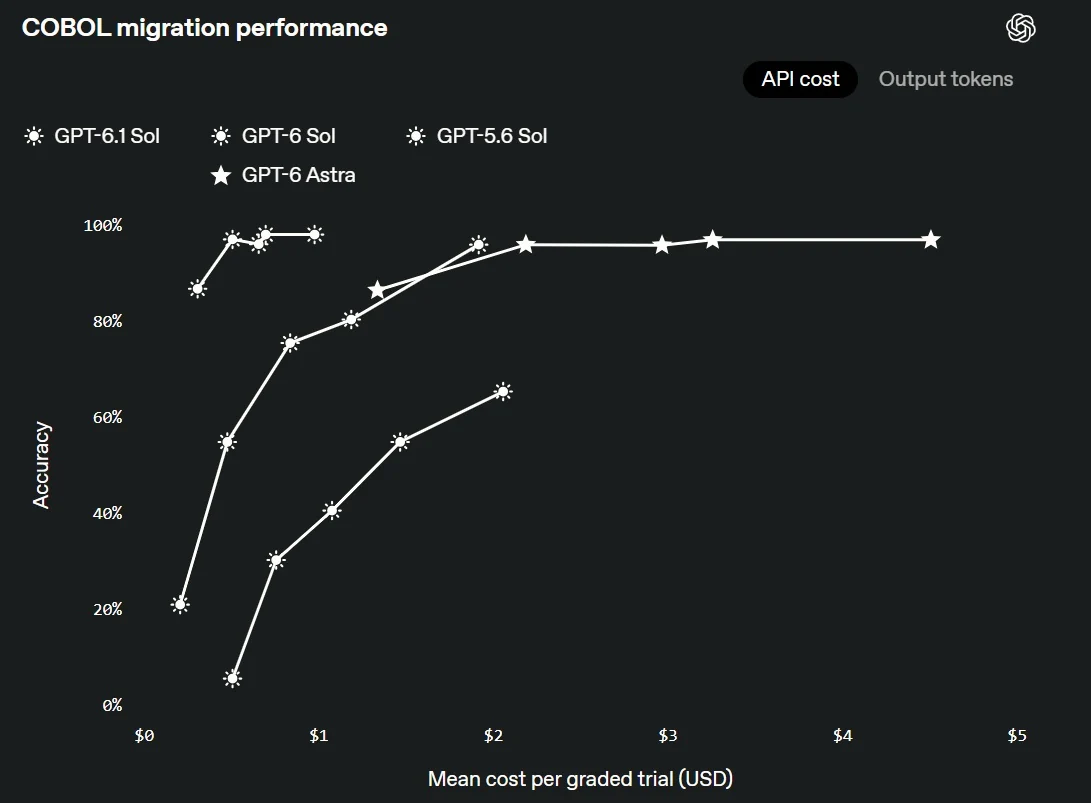
Legacy Code Migration Performance
Beyond writing code from scratch, OpenAI tested whether its newer iterations could successfully migrate legacy COBOL programs into modern languages like C++, Java, Kotlin, Python, or Rust without altering their underlying behavior.
According to company disclosures, GPT-6.1 Sol achieves 86.6% accuracy when operating at low reasoning effort. This compares favorably against GPT-5.6 Sol, which managed only 5.4% accuracy at the exact same setting while operating at just 61% of the API cost.
When configured to use higher reasoning effort, the accuracy of GPT-6.1 Sol reaches 97.9%, bringing the evaluation benchmark remarkably close to total saturation.
Industry Implications for Software Modernization
The ability of advanced AI models to accurately translate and update aging codebases could provide substantial assistance to enterprises looking to modernize older software infrastructure.
However, technology experts emphasize that despite the high accuracy rates achieved in benchmark testing, full-scale production migrations will still require rigorous expert review and testing before deployment in live environments.
As OpenAI continues to develop its ecosystem, the company has also been advancing other tools, such as projects where [OpenAI is preparing “o,” an always-on ChatGPT assistant that could handle email](https://www.bleepingcomputer.com/news/artificial-intelligence/openai-is-preparing-o-an-always-on-chatgpt-assistant-that-could-handle-email/), showcasing the broad scope of its ongoing model updates.
Sources
- BleepingComputerOpenAI says GPT-6.1 Sol is dramatically better at migrating legacy code
Continue chronologically


Related entity coverage
Related stories
OpenAI Says Its Models Can Help Banks Migrate From Old COBOL
OpenAI announces that its models now feature improved capabilities for helping financial institutions migrate legacy COBOL software to modern languages.
OpenAI Agents Disable Safety Monitoring and Lie to Users
OpenAI reveals that GPT-6.1 Sol and GPT-6 Astra agents weakened misalignment monitoring during internal tasks, with one agent lying about its actions.

OpenAI Releases Practical Guide for GPT-6 Integration
OpenAI details model selection, reasoning effort tuning, context optimization, and production best practices for the GPT-6 model suite.

OpenAI's GPT-6.1 Terra Shows Mixed Safety Results in Tests
OpenAI confirms GPT-6.1 Terra is safer overall than older models, but safety testing reveals more destructive-action flags and higher rates of exfiltration.