Rescale Builds AI Triage Agent with Strands Agents
Rescale built an AI agent to classify and route nightly end-to-end test failures, moving from problem definition to staging deployment in five days. The company says the system reached production within weeks using AWS services and the AI-Driven Development Lifecycle.
 Radwan AbdulhadiEditor and technology writer
A repetitive release bottleneck
Rescale has built an AI triage agent to automate the classification and routing of failures from its nightly end-to-end test suite. The company described the project in an AWS Machine Learning Blog post, saying the team moved from problem definition to staging deployment in five days and reached production within weeks.
The problem emerged as Rescale’s platform expanded across distributed services and dozens of repositories. Hundreds of automated tests run in the suite, and each failure required engineers to inspect reports, logs, historical patterns and source code before deciding on a likely root cause and owning team. Because the integration tests gate weekly production releases, unresolved failures could delay deployment and require several teams to coordinate for hours.
What the agent does
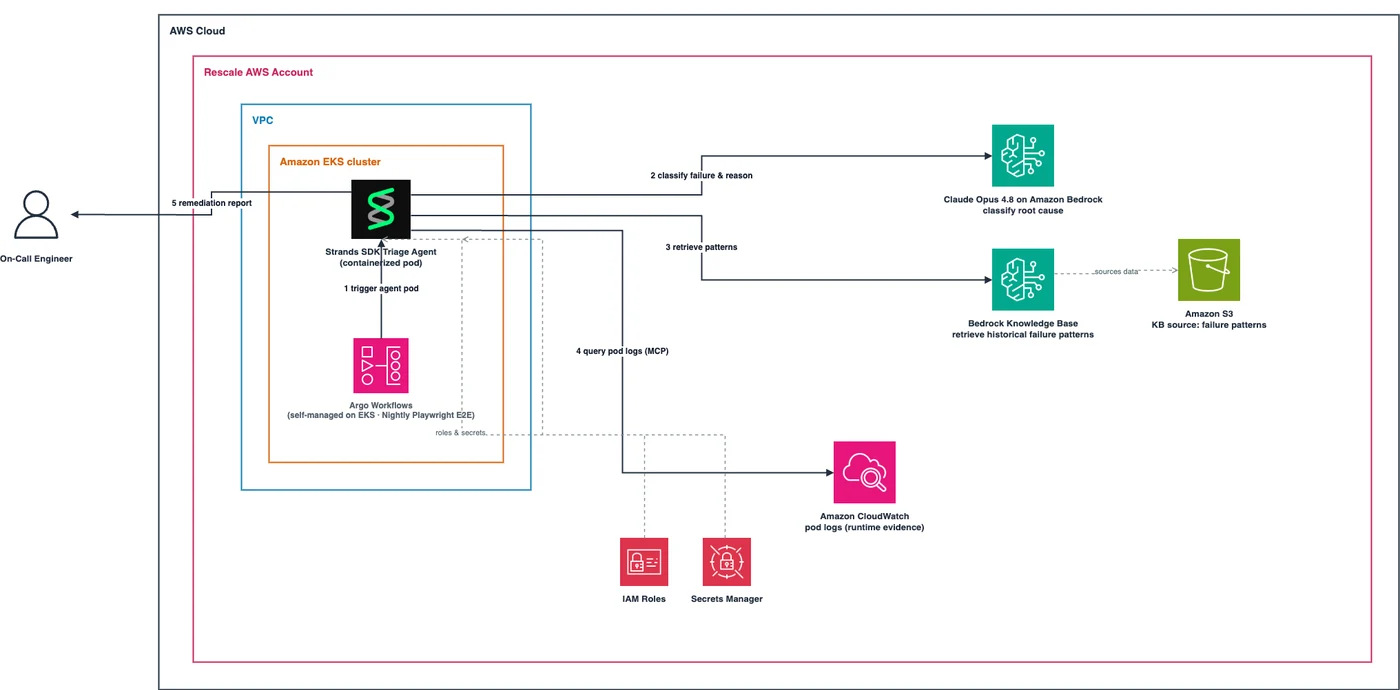
The triage agent runs as a step in Rescale’s existing Argo Workflows continuous integration and continuous delivery pipeline on Amazon Elastic Kubernetes Service. When the nightly Playwright suite reports failures, the pipeline triggers an agent pod to analyze them.
According to the company’s account, the system invokes Claude Opus 4.8 on Amazon Bedrock and classifies each failure into one of four categories: an infrastructure issue, a code bug, a flaky test or an environment problem. It also retrieves relevant historical failure patterns from a knowledge base and queries pod logs through the Model Context Protocol for runtime evidence.
The resulting report is structured for engineer review and includes specific file references, function names and recommended fixes. The agent completes the workflow in seconds and sends its output into Rescale’s existing reporting pipeline. The company said the system recommends remediation but does not take action without human review.
AI-DLC provided the development structure
Rescale used the open-source AI-Driven Development Lifecycle, or AI-DLC, as the framework for building the system with Strands Agents and AWS services. The methodology is designed around the principle that AI executes while humans decide: AI can generate plans, write code and propose architecture, but people validate the work and resolve key decisions.
The framework also replaces asynchronous handoffs with focused group sessions. In Rescale’s workshop, engineers participated in Mob Elaboration to define requirements and Mob Construction to build the system while AI handled implementation work. The company said this approach helped the team answer clarification questions together instead of leaving important requirements to assumptions.
Five days from scope to staging
AWS architects and Rescale engineers worked together during a five-day, in-person workshop. During the first two days, the team documented its vision and technical environment, then answered more than 20 clarification questions generated by AI. That process produced a scoped requirements document with explicit Phase 1 boundaries and features deferred to a later phase.
The team consolidated five user stories into four units of work: a knowledge base for historical failure patterns, the core AI triage agent, Argo Workflow integration for triggering and deployment, and an evaluation harness for measuring accuracy and gating regressions. Human decisions determined the priority order and left features such as automated pull request generation out of the initial scope.
Architecture decisions remained human-led
During the construction phase, the team defined interface contracts and data schemas, addressed functional and non-functional design questions, and approved the architecture before implementation continued. AWS said two architecture pivots emerged during the build, with the team validating each change before moving forward.
The workflow reflects the division of responsibility Rescale describes for its broader engineering process. AI can propose and execute work, while engineers define scope, review results and approve production changes. That leaves people responsible for architecture, product judgment and the operational context needed to run complex distributed systems.
Scaling the practice beyond triage
Rescale presented the triage project as a starting point for applying AI-DLC across its engineering organization. The company already uses AI across planning, design, implementation, testing, review and operations, while retaining human accountability for outcomes.
The project’s tightly defined scope and direct connection to a release-critical workflow gave the team a practical test of the methodology. Rescale said the same structured approach can help engineers move quickly on additional use cases without skipping the architectural and requirements decisions that determine whether an AI system works in production.
Sources
- AWS Machine Learning BlogHow Rescale built an AI triage agent with Strands Agents and AI-DLC
Continue chronologically
Related entity coverage
Related stories
Adaptive Agentic Intelligence Framework Using Strands Agents
Discover the Adaptive Agentic Intelligence Framework built with Strands Agents to optimize AI workloads using local SLMs and Amazon Bedrock.
Build a Voice Travel Concierge with Amazon Bedrock
Learn how to build a voice travel concierge for airline apps using Amazon Bedrock AgentCore, Managed Knowledge Bases, and real-time speech models.
Circle K Cuts DevOps Incident Triage Times With Amazon Bedrock
Circle K's DevOps team accelerated incident triage from up to 60 minutes down to under 15 minutes by implementing an agentic AI system on Amazon Bedrock.
Building AI Agents That Transact with Anchor Browser and AgentCore
Discover how Anchor Browser and Amazon Bedrock AgentCore payments enable AI agents to autonomously handle x402-protected web resources.