Adaptive Agentic Intelligence Framework Using Strands Agents
The Adaptive Agentic Intelligence Framework (AAIF), built with Strands Agents, routes routine tasks to local small language models and complex requests to cloud models.
 Radwan AbdulhadiEditor and technology writer
Introduction to the Adaptive Agentic Intelligence Framework
Organizations building AI agents frequently encounter a standard architectural hurdle where every single request, from simple status checks to deeply complex analysis, is routed directly to a single large, expensive language model. According to the AWS Machine Learning Blog, this one-size-fits-all approach often drives up API expenses, introduces unpredictable latency, and entirely eliminates the possibility of offline operation. Routine queries that could easily be resolved locally end up requiring a full network round-trip to a cloud-hosted LLM.
To solve these inefficiencies, the Adaptive Agentic Intelligence Framework (AAIF), built with Strands Agents, adopts a completely different methodology. Instead of sending all requests to a single massive model, AAIF relies on small language models to manage routine tasks locally. Meanwhile, more complex requests are routed to cloud-hosted models through Amazon Bedrock. This architecture builds directly upon foundational research from Belcak et al. at NVIDIA, who argue that small language models are sufficiently powerful, inherently more suitable, and necessarily more economical for numerous agentic invocations.
The Three-Layer Processing Architecture
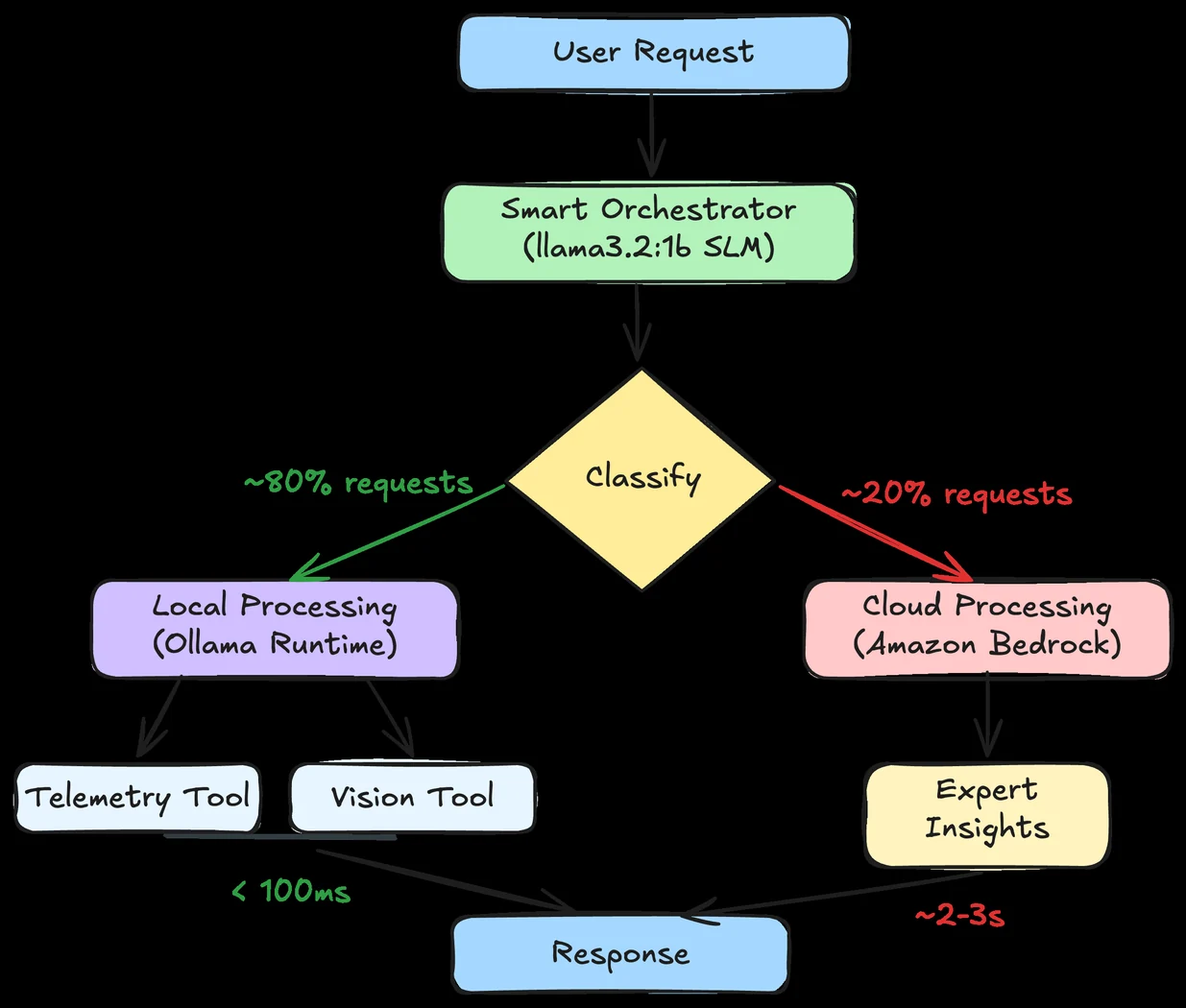
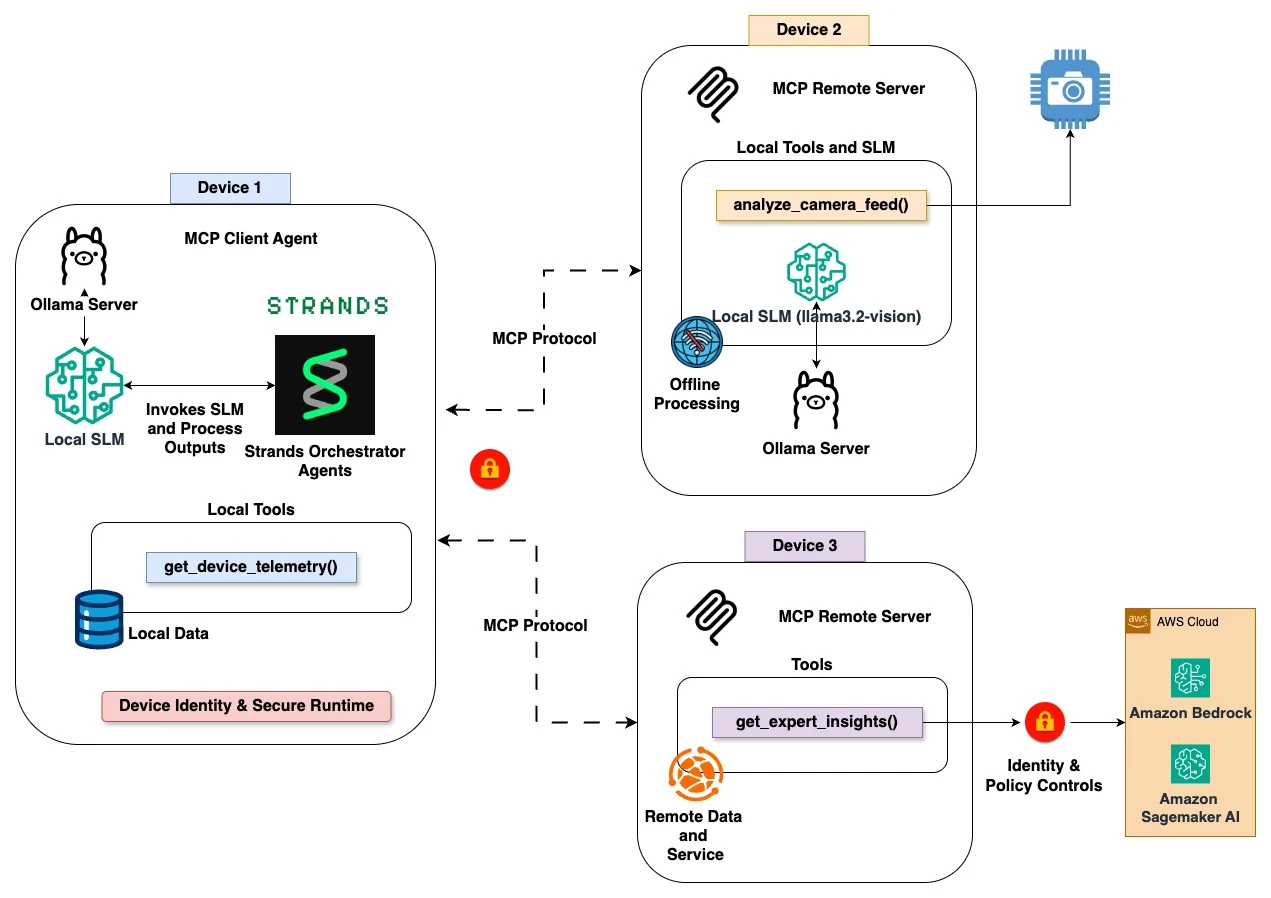
The framework organizes AI processing into three distinct layers, each carefully optimized for specific types of tasks. The first layer is smart orchestration, which utilizes a lightweight small language model as the primary decision-making component. This orchestrator classifies incoming user requests and routes them to the correct processing tier without depending on rigid, hardcoded rules.
The second layer focuses on local processing, managing routine duties such as device telemetry retrieval and image analysis. These tasks execute on local hardware via Ollama, completing with minimal latency and zero cloud dependency. Finally, the third layer handles cloud processing for complex pattern analysis and strategic recommendations through advanced frontier models, addressing scenarios where multi-step reasoning and broader context are mandatory.
System Implementation and Tooling
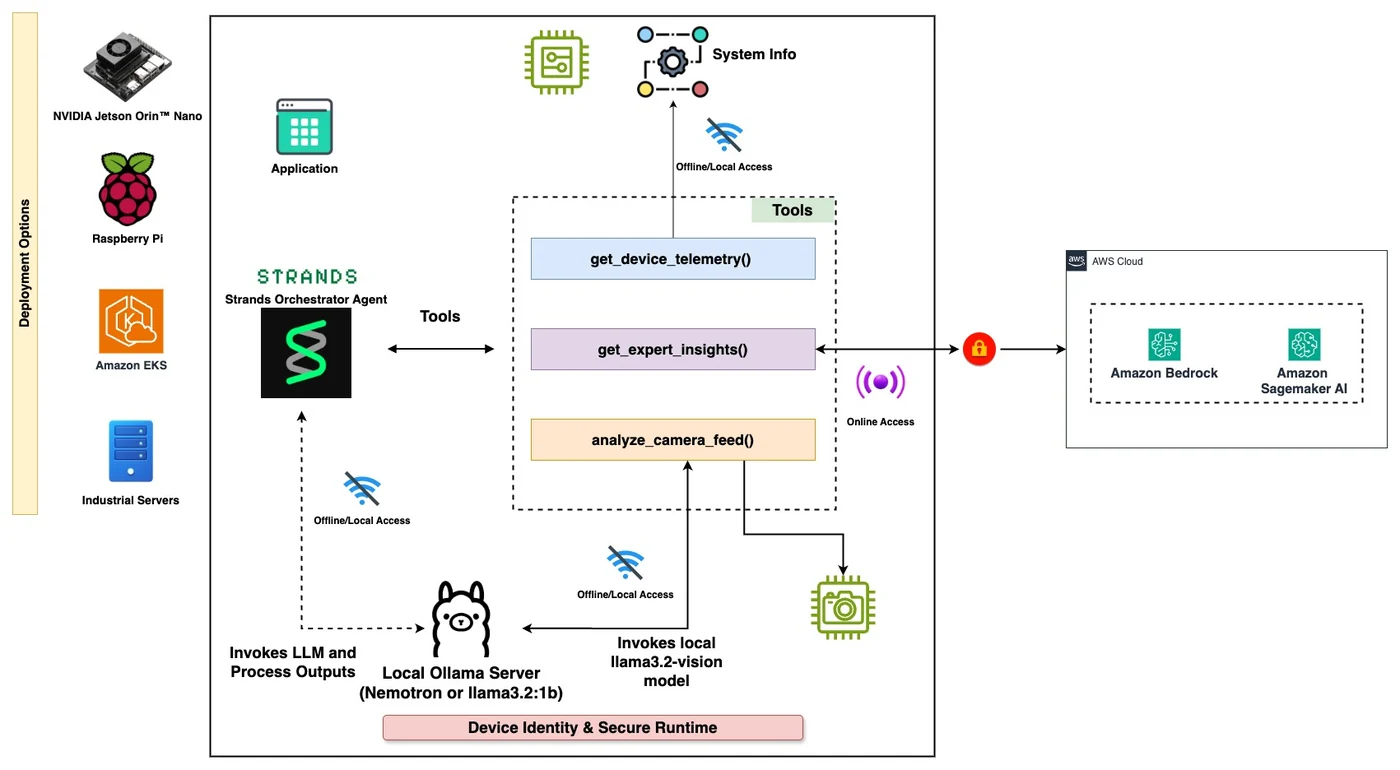
At the core of the system architecture sits the Strands agent, which connects directly to an Ollama runtime hosting both a 1-billion-parameter orchestrator model and a dedicated vision model. The agent exposes multiple distinct tools, including functions for retrieving simulated device telemetry, analyzing camera feeds locally to keep sensitive visual data on-device, and calling cloud endpoints for advanced insights.
Developers looking to test or deploy this reference implementation need specific prerequisites configured within their environment. This setup involves ensuring appropriate model access is granted, installing Ollama with the required local models, and utilizing package managers to configure the necessary software components. Teams can also leverage the AWS Command Line Infrastructure and related libraries to facilitate seamless cloud interactions.
Deployment Flexibility and Configurations
The framework is explicitly designed to adapt to specific deployment constraints rather than forcing teams to restructure their underlying infrastructure. The architecture can scale down to edge devices like a Raspberry Pi equipped with 8 GB of memory, operate entirely in the cloud where all inference hits managed endpoints, or function as a hybrid setup combining local operational speed with robust cloud reasoning.
In a standard hybrid configuration, the local small language model orchestrator remains completely intact while cloud models handle requests that exceed local capabilities. Organizations often achieve significant cost savings in this arrangement because a substantial majority of routine traffic avoids paid API endpoints entirely. Conversely, fully air-gapped environments can swap out cloud dependencies for larger local models to strictly satisfy strict data sovereignty requirements.
Sources
- AWS Machine Learning BlogAdaptive agentic intelligence framework using Strands Agents
Continue chronologically
Related entity coverage
Related stories
Use Open Weight Models With Amazon Bedrock for Coding
Pair open weight models with Amazon Bedrock and OpenCode for a secure, flexible, pay-per-use AI coding assistant without managing infrastructure.
Amazon Bedrock Prompt Caching for OpenAI Models
Discover how prompt caching patterns on Amazon Bedrock help AI agents cut input costs and reduce latency by eliminating redundant context processing.
Claude Haiku 5.5 Launches on Amazon Bedrock and AWS
Anthropic's Claude Haiku 5.5 is now available on Amazon Bedrock and Claude Platform on AWS, offering high efficiency for subagents.
Claude Opus 5.5 Arrives on Amazon Bedrock and AWS
Anthropic's Claude Opus 5.5 model is now available on Amazon Bedrock and Claude Platform on AWS, bringing advanced capabilities for agentic coding and knowledge work.