Postman Details Agent Mode Scale on Amazon Bedrock
Postman and AWS have outlined the core architectural patterns behind scaling Agent Mode to support a massive developer community using Amazon Bedrock.
 Radwan AbdulhadiEditor and technology writer
Scaling AI for Millions of Developers
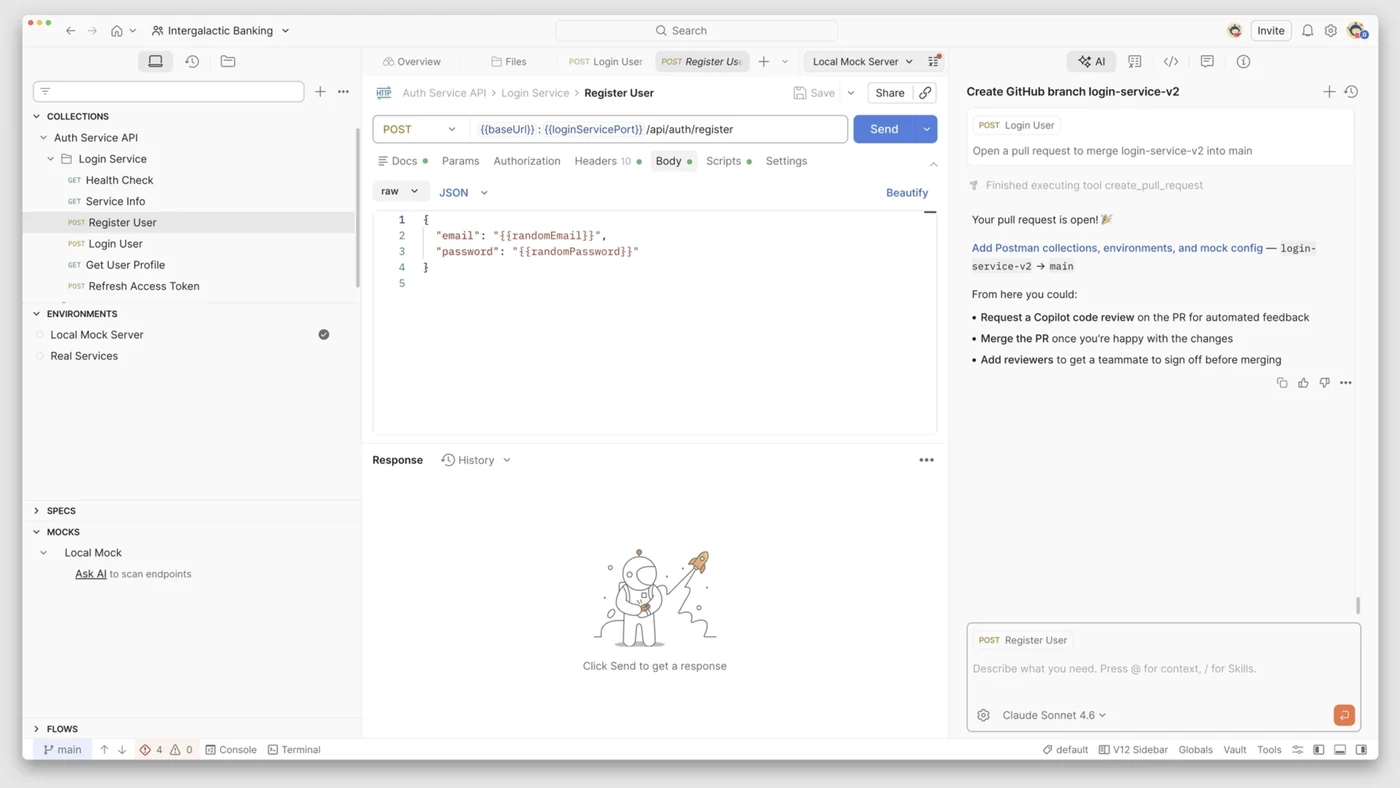
Building an AI agent for a limited demonstration differs significantly from operating one reliably at production scale. Postman developed [Agent Mode](https://learning.postman.com/docs/postman-ai-developer-tools/agent-mode/) to offer an AI-native way to work across [API testing](https://learning.postman.com/docs/sending-requests/response-data/test-responses/), [documentation](https://learning.postman.com/docs/publishing-your-api/documenting-your-api/), discovery, and implementation. While the engineering team initially expected model quality and prompt design to present the greatest hurdles, deeper challenges emerged when integrating an agent into a mature product built on years of interface-driven assumptions.
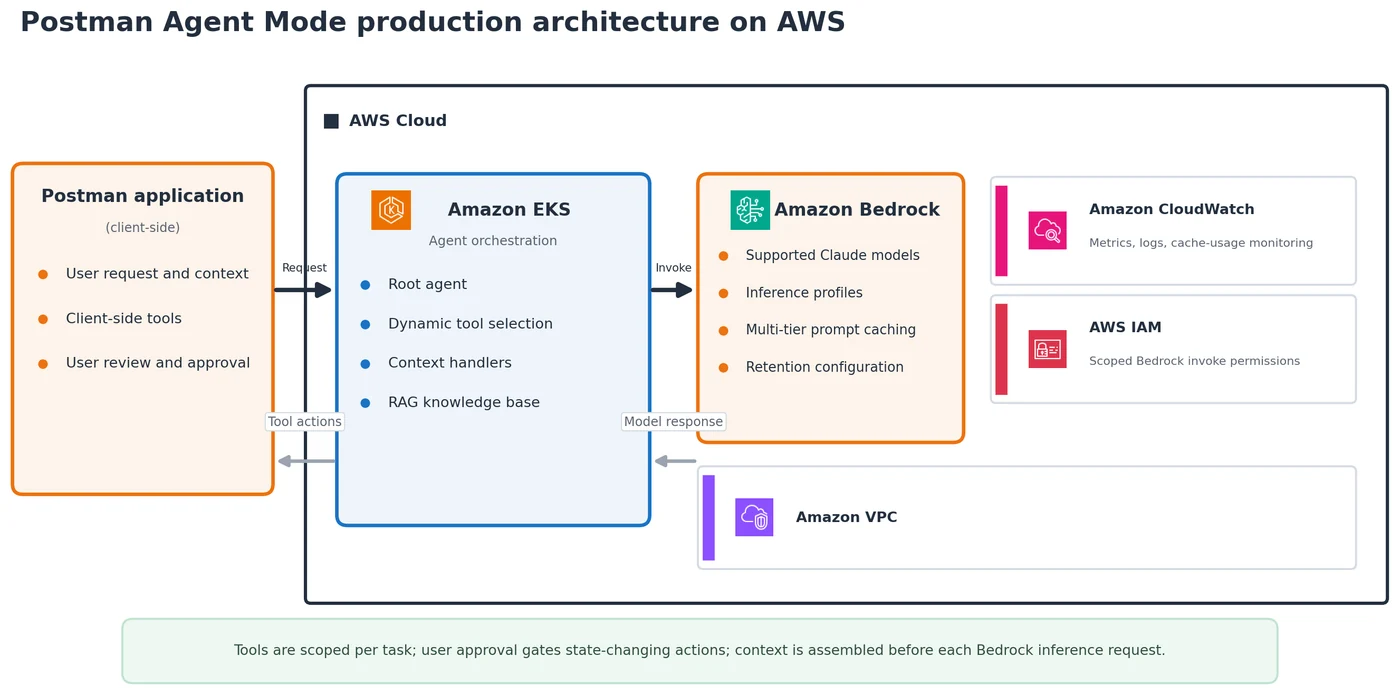
To support its global base of [40 million developers](https://www.postman.com/company/about-postman/), Postman relies on [Amazon Bedrock](https://docs.aws.amazon.com/bedrock/latest/userguide/what-is-bedrock.html) for managed access to foundation models. This deployment allows the platform to handle variable, latency-sensitive demand and sharp traffic bursts without managing separate model-serving infrastructure, while retaining flexibility in model selection and control over throughput and geographic processing.
Architectural Patterns and Production Controls
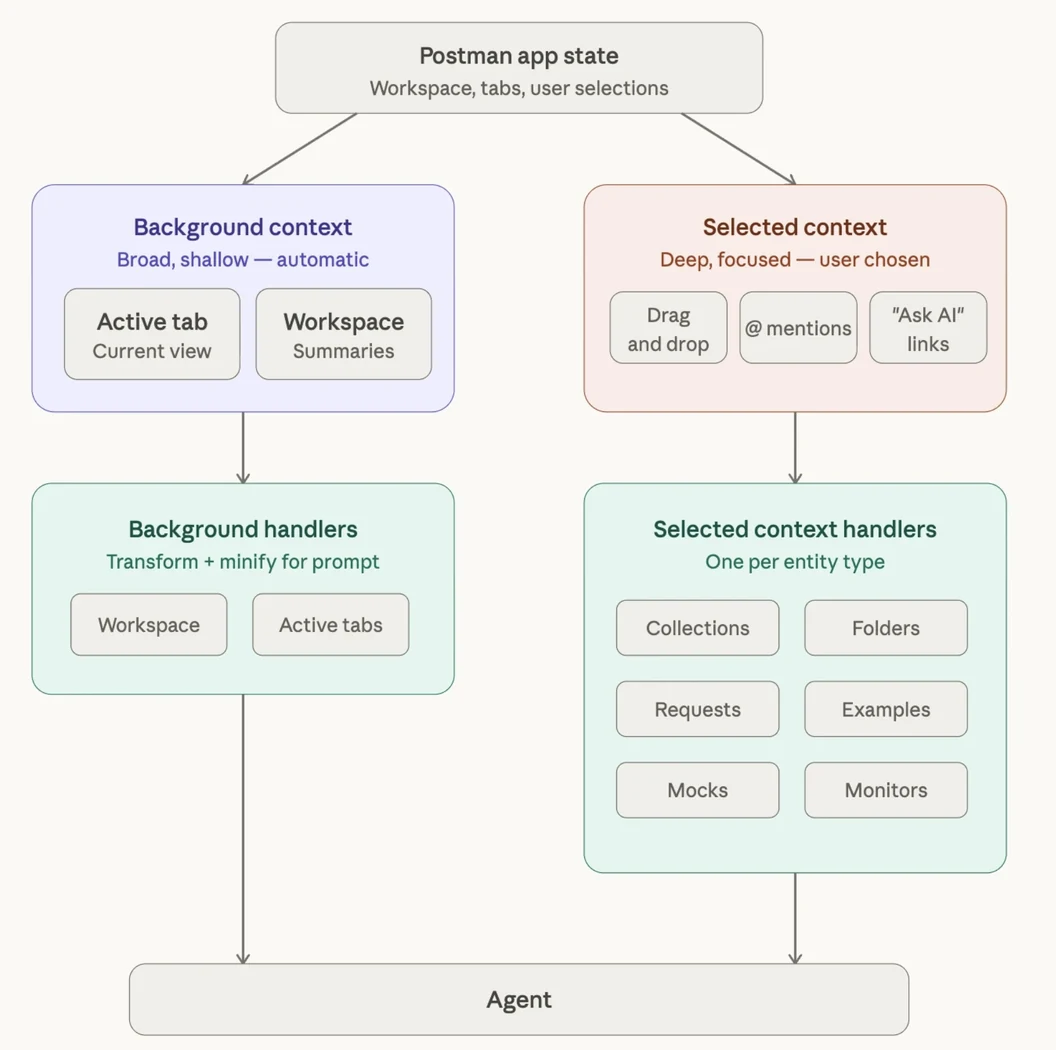
Operating production workloads requires strict safeguards to protect user data and ensure predictable behavior. Postman integrates human oversight into the design by requiring explicit user approval before executing actions that modify application state. In addition, the system scopes available tools to specific tasks, selects purpose-built context, and applies model-dependent data-retention settings to minimize unintended actions.
As part of its responsible AI controls, Postman uses [Amazon Bedrock Guardrails](https://aws.amazon.com/bedrock/guardrails/) to redact personally identifiable information prior to sending data to the underlying large language model. Enterprise administrators can easily enable this capability directly through the guardrail settings within [Agent Mode](https://learning.postman.com/docs/getting-started/basics/about-agent-mode/).
Managing Tool Sprawl and Context Bottlenecks
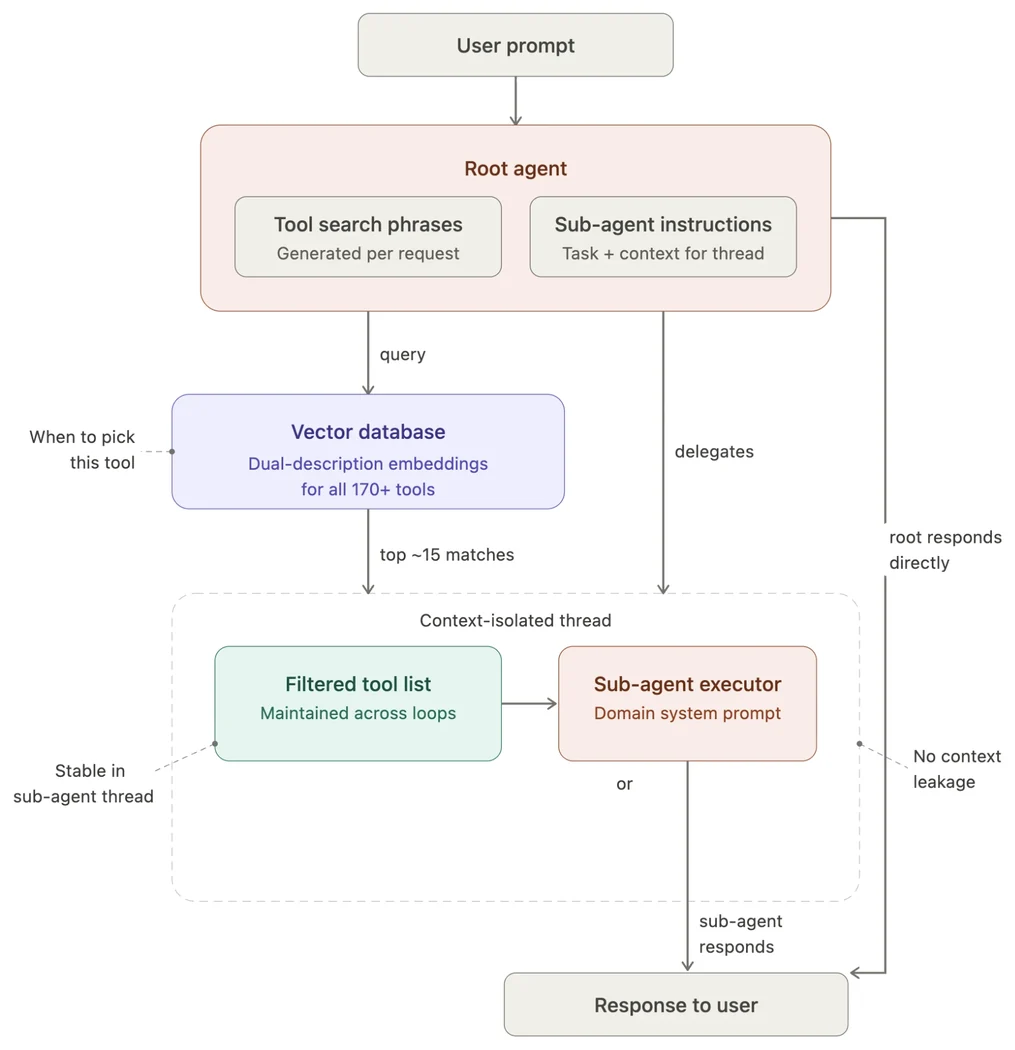
Early iterations of the agent utilized highly atomic tools designed to handle small, precise actions. However, testing revealed that tool-selection errors increased noticeably once the visible toolset exceeded approximately 40 tools, leading the model to call non-existent functions or pass incorrect arguments. To solve this, the current architecture uses dynamic tool selection, querying a vector database of tool embeddings to narrow down more than 170 potential tools to a relevant subset for a context-isolated sub-agent.
Furthermore, engineers found that many client APIs were implicitly coupled to interface state, requiring requests to be open in tabs. Postman has worked to decouple tools from tabs, a practice heavily utilized by features like [Native Git](https://www.postman.com/product/native-git/), enabling background actions without an open user interface element.
Schema-Aware Reads and Infrastructure Inference
Rather than relying on an explosion of single-purpose read tools for structured products like the API Catalog, Postman consolidated multiple views into a single query tool. By exposing structured data schemas from underlying database tables, the agent can autonomously generate complex queries, reducing the overall tool count while maintaining extensive analytical capabilities.
Behind the scenes, the deployment leverages [Amazon Bedrock model inference APIs](https://docs.aws.amazon.com/bedrock/latest/APIReference/welcome.html) to handle model execution dynamically. These architectural strategies collectively enable the platform to maintain reliable performance across its widespread user community.
Sources
- AWS Machine Learning BlogHow Postman runs Agent Mode for 40 million developers on Amazon Bedrock
Continue chronologically

Related entity coverage
Related stories
Grok 4.7 Arrives on Amazon Bedrock for Long-Horizon Agents
SpaceXAI's Grok 4.7 is now available on Amazon Bedrock, bringing configurable reasoning effort, tool calling, and a 500K context window to developers.
Build a Voice Travel Concierge with Amazon Bedrock
Learn how to build a voice travel concierge for airline apps using Amazon Bedrock AgentCore, Managed Knowledge Bases, and real-time speech models.

AWS Details Enterprise Agentic AI Platform Blueprint
Discover how enterprises can build a governed, multi-account Agentic AI Platform using Amazon Bedrock and AgentCore reference architecture.
AWS Details Multi-Account AI Agents with AgentCore and MCP
Learn how to build multi-account AI architectures using Amazon Bedrock AgentCore Gateway, MCP, and IAM for secure cross-account data queries.