Google rolls out improved SynthID AI content detector globally
Google has expanded its SynthID watermarking technology, launching a dedicated global website that allows users to check media files for AI generation from multiple major tech partners.
 Radwan AbdulhadiEditor and technology writer

Global Expansion of SynthID Detection
Every piece of AI content generated by Google's Gemini models contains a hidden SynthID label, which makes it very difficult to pass the content off as authentic. Previously, checking for these invisible watermarks required a convoluted process that relied on asking Gemini directly. Google has now [announced] that its improved SynthID detector is available globally on a new dedicated website.
According to Google, Gemini alone has integrated SynthID with over 180 billion images and videos, alongside 240,000 years of audio. Until now, individuals outside of Google's trusted tester program had to rely on Gemini to check for the watermark, a method that could sometimes yield confusing outputs when users simply wanted a straightforward "yes" or "no" answer.
Multi-Partner Support and Accessibility
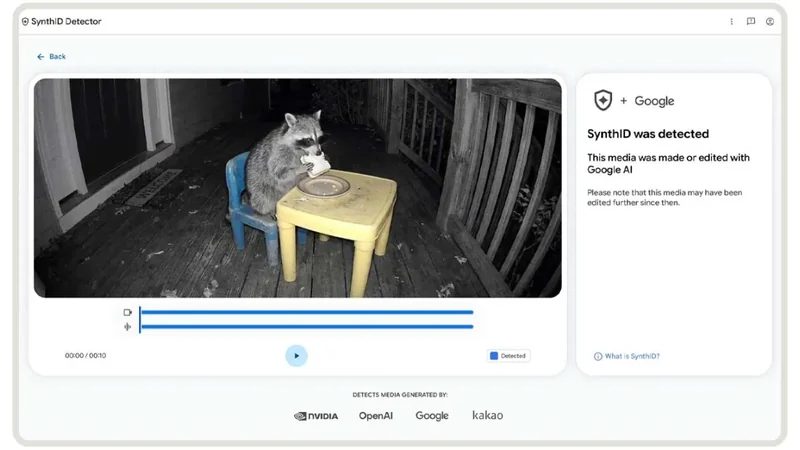
Users can now bypass Gemini entirely by visiting [SynthID.com] to verify whether a piece of content contains an AI watermark. A significant limitation of Google's previous detector was its restriction to Google's own version of SynthID, meaning images generated by platforms like ChatGPT would not be flagged. The updated platform resolves this issue by supporting distinct watermarks across multiple major artificial intelligence systems.
The expanded detector supports distinct watermarks from all designated SynthID partners, including OpenAI, Nvidia, Kakao, and upcoming support for Apple. Rather than accessing individual detectors for each ecosystem, users can check a single file at this centralized location. While internal tools provide granular details such as highlighted regions containing SynthID pixels, the public website simply returns a message indicating whether SynthID was utilized to produce or edit the media.
Usage Quotas and Security Measures
To utilize the tool, individuals must log in using a Google, OpenAI, or Apple account. Although the detector is accessible to the general public, the login requirement enforces a strict usage limitation. Google states that each user is granted a daily usage quota of approximately 10 image, video, and audio checks.
Previous detection tools maintained a similar restriction. Google engineers explained that limiting access is necessary to prevent malicious actors from using the verification mechanism to develop SynthID removal tools. The exact numerical limit may vary and could lock users out sooner if they submit multiple highly similar images, a pattern that might indicate an attempt to tune a bypass workflow.
Limitations of Proactive Watermarking
While expanding access to SynthID detection offers a convenient single destination to check media for popular AI tool signatures, Google's partners represent only a portion of the broader artificial intelligence landscape. Alternative model providers utilize different watermarking technologies, such as Meta, while others deploy no watermarks at all.
Furthermore, open-weight models allow individuals to run software on personal hardware to generate increasingly realistic AI content without basic metadata labeling. Consequently, the SynthID tool will feature a disclaimer noting that plenty of AI-generated content will evade identification. Despite these challenges and the ongoing risk that individuals may eventually find ways to remove the watermark, proactive watermarking remains a prominent approach for navigating the rapid proliferation of artificial intelligence media across the internet.
Sources
- Ars TechnicaGoogle rolls out improved SynthID AI content detector, now available globally
Continue chronologically


Related entity coverage
Related stories
Google's SynthID AI Detector Goes Public for Everyone
Google's SynthID Detector is now available globally for regular users, offering a simple way to check if images, videos, or audio files are AI-generated.
Google Expands SynthID Detector Globally with Apple Support
Google has rolled out its expanded SynthID AI content detector globally, introducing support for models from OpenAI, Nvidia, Kakao, and Apple.
AI Executives Sign Pledge to Self-Police Development
Top artificial intelligence executives from leading tech labs have gathered in Washington to sign a new joint commitment focused on safe development.

Google Pixel 10 Exploits Earn Hackers $560,000 at Pwn2Own
Participants at Pwn2Own Ireland 2026 secured over $1.2 million, with Google Pixel 10 exploits earning hackers more than $560,000 across three teams.