Evaluating Multi-Agent Systems With Amazon Bedrock AgentCore
As enterprises move multi-agent systems into production, new evaluation approaches using Amazon Bedrock AgentCore help ensure accuracy, helpfulness, and decision explainability.
 Radwan AbdulhadiEditor and technology writer
Moving Multi-Agent Systems From Experimentation to Production
A critical challenge that emerges as multi-agent systems move from experimentation to production is making sure that these systems are consistently helpful, accurate, and explainable in real-world scenarios. Enterprises are increasingly adopting multi-agent systems to solve complex, real-world problems that require reasoning across data sources, tools, and business constraints. From supply chain planning to financial analysis and customer operations, these systems go beyond simple question answering by coordinating multiple specialized agents to make decisions, execute workflows, and generate actionable recommendations.
While large language models can generate fluent responses, enterprise applications require much deeper guarantees. Agents must follow instructions reliably, select the right tools, respect constraints, and provide clear reasoning behind their outputs. To address these demands, organizations are leveraging modern development and evaluation frameworks such as Amazon Bedrock AgentCore to build, connect, and optimize agents at scale.
Comprehensive Evaluations With Amazon Bedrock AgentCore
Traditional evaluation approaches that focus only on model response quality are insufficient for agentic systems, where correctness depends heavily on tool selection, workflow execution, and adherence to business constraints. To solve this, Amazon Bedrock AgentCore Evaluations serves as a fully managed capability for assessing agent performance across both development and production lifecycles.
In addition to evaluations, production deployments require robust safety controls. While evaluations assess agent quality after execution, Amazon Bedrock Guardrails provides configurable safeguards such as content filtering, denied topic detection, and grounding validation that enforce safety constraints during execution.
The evaluation framework supports both built-in and custom evaluators. Built-in evaluators offer pre-defined assessments for common quality dimensions like helpfulness, task success, and instruction following. Meanwhile, custom evaluators allow development teams to define domain-specific, business-aware checks to validate operational logic.
Implementing a Multi-Agent Supply Chain Decisioning System
To demonstrate these concepts in a practical setting, a reference architecture uses a fictitious multinational retail company called AnyCompany Retail, which operates ecommerce channels, regional fulfillment centers, distribution hubs, and physical stores. AnyCompany faces common inventory imbalances and transportation hurdles, prompting the need for an intelligent agentic assistant that can optimize inventory allocation, recommend distribution adjustments, analyze inventory health, and simulate routing scenarios.
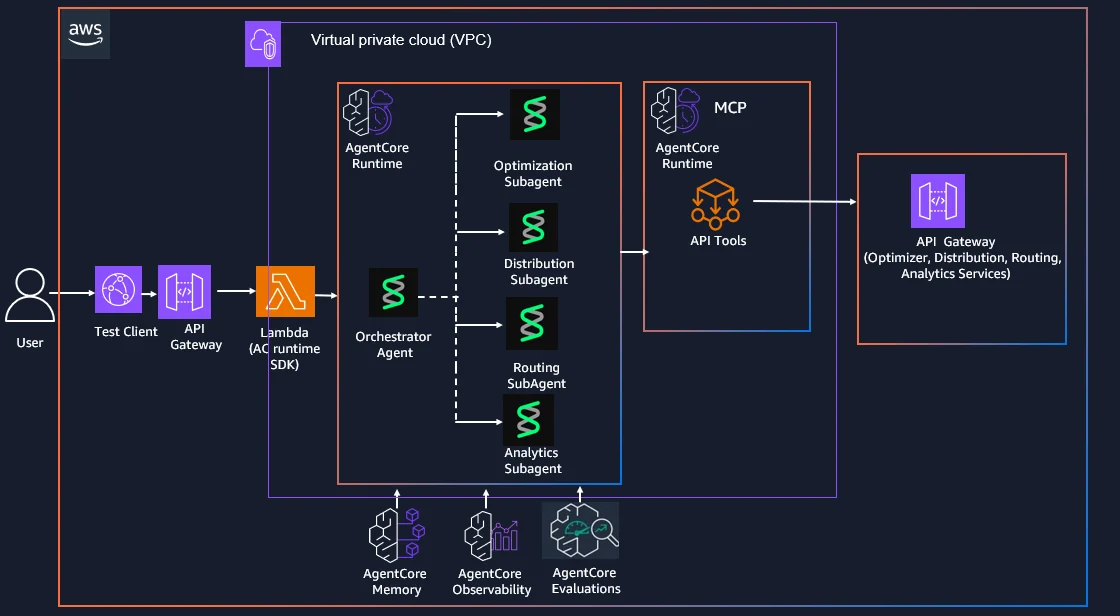
This reference solution is built using the Strands Agents SDK alongside the Amazon Bedrock AgentCore MCP Server. The system relies on an orchestrator agent that receives requests from a supply chain planner and delegates work to four specialized sub-agents: an optimization agent, distribution agent, routing agent, and analytics agent.
Each agent operates on the Amazon Bedrock AgentCore runtime, utilizing built-in platform capabilities such as Amazon Bedrock AgentCore memory and Amazon Bedrock AgentCore Observability. The optimization agent invokes tool interfaces backed by mock Amazon API Gateway REST endpoints to execute workflow decisions.
Evaluating Explainability and Business Logic
Explainability is treated as a first-class evaluation dimension within the framework. While built-in evaluators assess general response clarity, custom evaluators verify whether agents explicitly articulate their decision rationale, properly reference supporting data or tool outputs, and thoroughly explain operational tradeoffs such as cost versus service levels.
By combining these layers, development teams move beyond surface-level response checks to gain structured, measurable insights into how and why multi-agent systems arrive at specific business decisions. The evaluation framework utilizes a progressive three-layer approach: starting with built-in evaluators for general quality, incorporating custom evaluators for business accuracy, and layering explainability evaluators to build long-term enterprise trust and auditability.
On-Demand and Online Operational Modes
The evaluation platform supports both on-demand and online operational modes. On-demand mode is intended for development benchmarking, regression testing, and continuous integration and continuous delivery pipelines. In contrast, online mode enables continuous production monitoring by automatically reading traces from observability tooling, scoring them against configured evaluators, and streaming results directly to dashboards and alarms.
Sources
- AWS Machine Learning BlogEvaluating multi-agent systems for explainability and helpfulness with Amazon Bedrock AgentCore
Continue chronologically

Related entity coverage
Related stories
Build Multi-Agent Pipelines with Amazon Bedrock AgentCore
Learn how to build a multi-agent music production pipeline on Amazon Bedrock AgentCore Runtime Instances using shared sessions and GPU infrastructure.
Agentic Retrieval with LangChain and Amazon Bedrock
Explore building Retrieval Augmented Generation applications using LangChain and Amazon Bedrock Managed Knowledge Base for complex multi-part questions.
Query Claims in Natural Language With Amazon Bedrock
Learn how to build a conversational claims assistant using Amazon Bedrock Knowledge Bases to answer natural-language queries with citations.
GPT-6.1 Sol Now Available on Amazon Bedrock
GPT-6.1 Sol is now generally available on Amazon Bedrock, bringing near-Astra intelligence and advanced reasoning to everyday professional workflows.