
Deploying Real-Time Voice Cloning on Amazon SageMaker AI
Developers can now deploy the Qwen3-TTS-12Hz-1.7B-Base text-to-speech model from Amazon SageMaker JumpStart to a fully managed real-time inference endpoint for personalized speech generation.
 Radwan AbdulhadiEditor and technology writer
Overview of Qwen3-TTS on AWS
Voice cloning allows applications to generate new speech in a target speaker's voice using only a short reference recording, eliminating the need to retrain a model. Users can deploy the publicly available Qwen3-TTS-12Hz-1.7B-Base text-to-speech model directly from Amazon SageMaker JumpStart to a fully managed real-time inference endpoint. For more details, developers can refer to the AWS Machine Learning Blog.
This text-to-speech family was developed by the Qwen team at Alibaba Cloud and covers 10 languages: Chinese, English, Japanese, Korean, German, French, Russian, Portuguese, Spanish, and Italian. The models utilize the Qwen3-TTS-Tokenizer-12Hz speech tokenizer and support streaming generation for low-latency, interactive scenarios. The base variant performs voice cloning from only a few seconds of user audio.
Capabilities and Use Cases
Voice cloning reproduces the vocal identity of a specific speaker by analyzing a short recording along with its transcript, allowing the system to synthesize new text in that same voice. Media teams, educators, and application developers can use this capability to create personalized voice experiences and localize multilingual content. Additionally, the Qwen3-TTS-12Hz-1.7B-CustomVoice variant generates speech from a fixed set of predefined speakers rather than a user-supplied reference clip.
The model also supports cross-lingual cloning, enabling a voice captured from a reference in one language to generate speech in another while maintaining the speaker's vocal identity. Common applications include content localization, consistent brand voices for virtual assistants, e-learning narration, creative prototyping, and real-time conversational AI workflows.
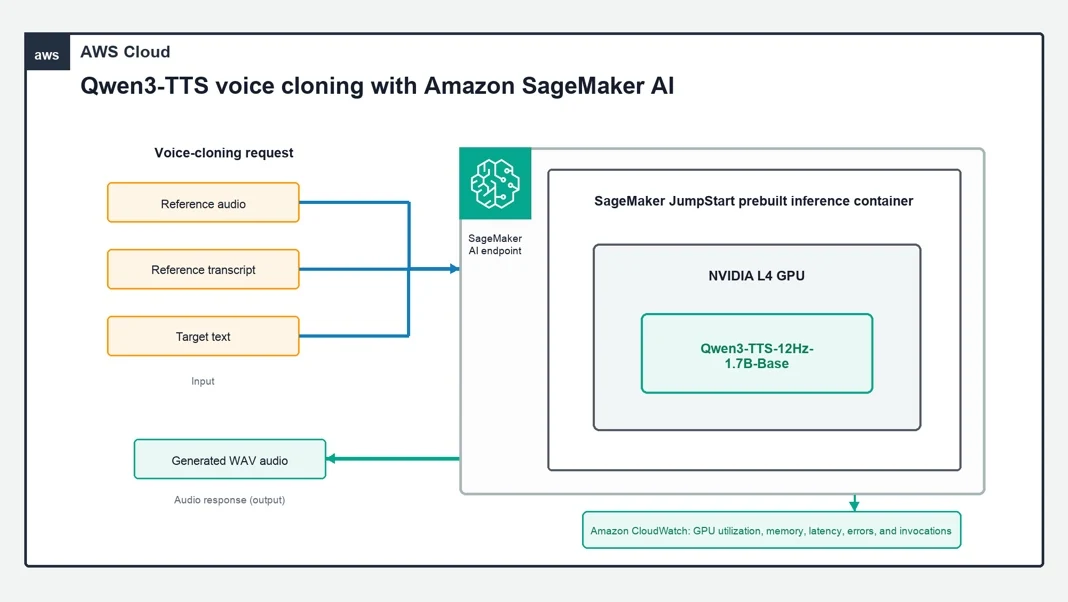
Deployment Architecture on Amazon SageMaker AI
Running a self-hosted voice cloning model allows organizations to control costs and keep audio data securely inside their AWS environment. Utilizing Amazon SageMaker AI, engineering teams can run the model on a fully managed real-time endpoint that handles infrastructure provisioning, health monitoring, and automatic scaling without requiring direct management of underlying GPU servers.
The deployment follows standard real-time inference patterns where clients send HTTP requests containing target text, base64-encoded reference audio, and transcripts. Amazon SageMaker AI then routes these requests to the vLLM-Omni serving container running on a GPU instance, such as an ml.g6.4xlarge instance featuring an NVIDIA L4 GPU.
Prerequisites and Implementation
To get started, administrators need an AWS account with access to Amazon SageMaker AI and Amazon Simple Storage Service (Amazon S3), along with appropriate AWS Identity and Access Management (IAM) permissions. Developers can execute the deployment via Amazon SageMaker Studio or a local environment using the Amazon SageMaker Python SDK.
The JumpStart container manages model artifacts and provides a pre-built serving container, eliminating the need to write a custom inference handler. Users construct a JumpStartModel object, call its deployment methods, and invoke the resulting endpoint using the Amazon SageMaker runtime client.
Sources
- AWS Machine Learning BlogDeploying real-time personalized speech with Qwen3-TTS on Amazon SageMaker AI