Fine-Tune Search Agents with Multi-Turn RL on SageMaker AI
AWS explores how fine-tuning an LLM-powered search agent with multi-turn reinforcement learning on Amazon SageMaker AI can achieve frontier-model reliability at a lower latency and cost.
 Radwan AbdulhadiEditor and technology writer
Introduction to Multi-Turn Search Agents
Search agents powered by large language models are transforming how enterprises retrieve information by autonomously deciding search strategies across multiple rounds of interaction. However, achieving reliable multi-step behavior can be challenging. While small models lack awareness of custom environments, frontier models often introduce higher latency and costs. Fine-tuning offers a balanced solution, yielding a smaller model's speed and cost efficiency with enhanced reliability. According to the [AWS Machine Learning Blog](https://aws.amazon.com/blogs/machine-learning/), traditional approaches such as supervised fine-tuning and single-turn reinforcement learning fall short because they fail to capture interdependent decisions across a full sequence of steps.
Understanding Amazon SageMaker AI MTRL
To address optimization across full multi-turn trajectories, developers can leverage [Amazon SageMaker AI MTRL](https://docs.aws.amazon.com/sagemaker/latest/dg/model-customize-mtrl.html) to fine-tune LLMs using reinforcement learning in multi-turn interaction settings. The platform frames agentic tasks as sequences of decisions, uses multi-turn rollouts to generate training data, and optimizes models with policy gradient algorithms. Key architectural features include a modular agent-environment interface, serverless execution at per-token pricing, asynchronous rollout and trajectory collection, and a native algorithm library featuring algorithms like PPO and CISPO.
Enterprise Search Setting and Tool Integration
In practical implementations on Amazon SageMaker AI, engineers configure an enterprise search setting where an LLM-powered system autonomously utilizes search tools to answer questions and complete tasks. The agent integrates two distinct search mechanisms: lexical search utilizing BM25 for exact keyword matches, and vector search employing embedding vectors for semantic and conceptual queries. Limiting the total number of turns helps prevent excessively long responses and encourages efficient search behavior during rollouts.
Datasets and Reward Configuration
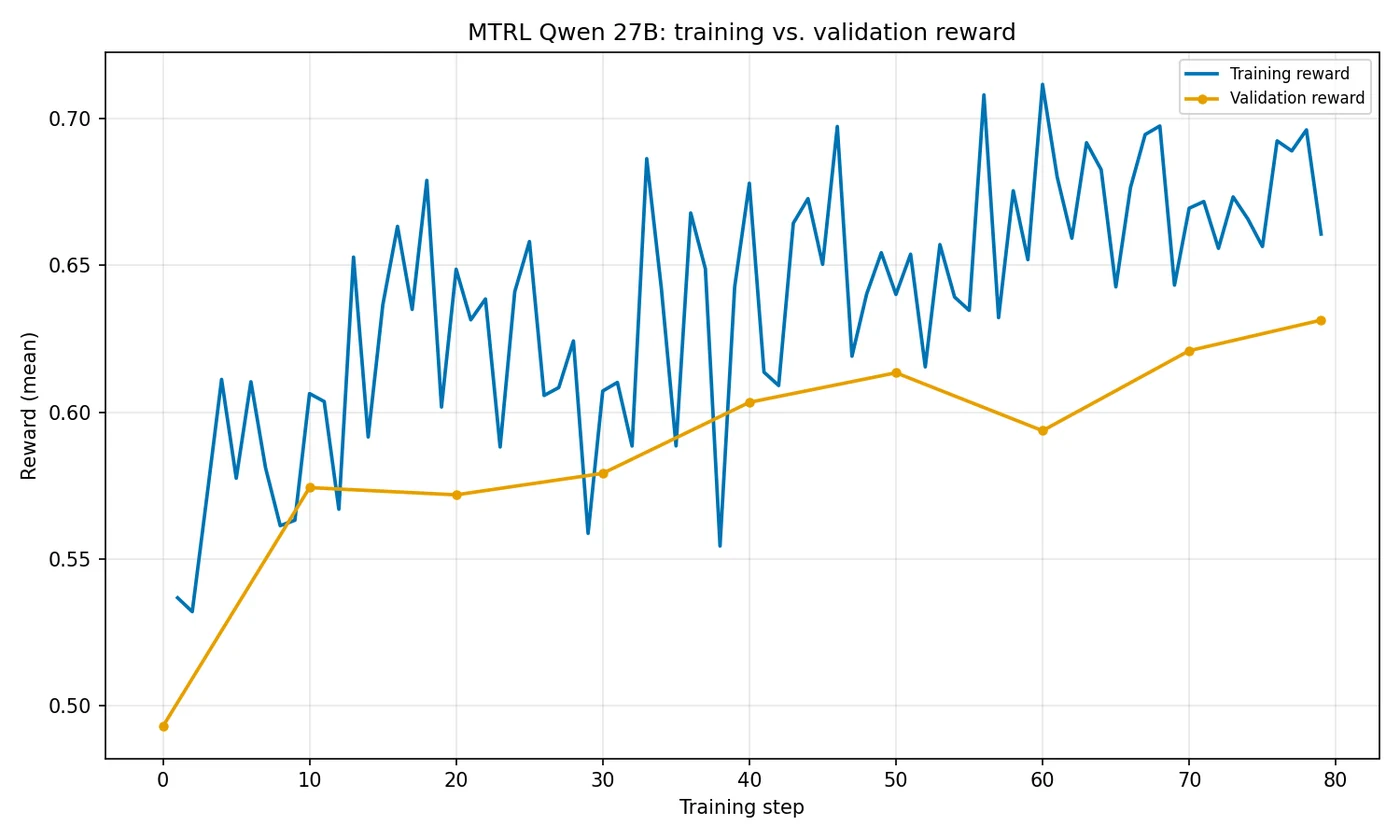
The training methodology relies on preprocessed datasets formatted specifically for the service, with five percent of instances reserved for validation. The primary evaluation and reward metric used is nDCG@10, which measures how well the top retrieved documents match ideal rankings. When agents reach maximum turn limits or token thresholds, a negative reward penalty is applied to discourage undesirable behaviors without requiring complex intermediate rewards.
Training Job Configuration and SDK Usage
Configuring training jobs requires minimal adjustments to default settings using the MultiTurnRLTrainer SDK. Developers define hyperparameters such as max_epochs to control passes over the training data and global_batch_size to specify prompts per training step. This streamlined approach enables efficient fine-tuning of models like Qwen3.6-27B directly within supported AWS regions.
Sources
- AWS Machine Learning BlogFine-tune a search agent with multi-turn RL on Amazon SageMaker AI
Continue chronologically


Related entity coverage
Related stories
Deploying Real-Time Voice Cloning on Amazon SageMaker AI
Learn how to deploy the Qwen3-TTS-12Hz-1.7B-Base text-to-speech model on Amazon SageMaker AI for real-time voice cloning and cross-lingual synthesis.
Hugging Face Skills Automate SageMaker Model Deployments
Hugging Face and AWS release open-source agent skills, letting coding agents automate production-ready model deployments on Amazon SageMaker AI.
Generate Images and Video with vLLM-Omni on SageMaker AI
Deploy FLUX.2-klein and Wan2.1-VACE models using AWS vLLM-Omni Deep Learning Containers on Amazon SageMaker AI for text-to-image and video generation.
uniopen Customizes Amazon Nova for Retail Content Moderation
Learn how retail platform uniopen used supervised fine-tuning and prompt optimization to adapt Amazon Nova 2 Lite for production moderation.