Qlik Builds Grounded Enterprise AI With Amazon Bedrock
Qlik has detailed the architectural framework behind Qlik Answers, leveraging Amazon Bedrock to provide grounded, sourced insights across structured and unstructured data for its global customer base.
 Radwan AbdulhadiEditor and technology writer
Tackling Enterprise Data Gaps With Qlik Answers
Organizations frequently struggle with a common operational roadblock: employees have access to vast amounts of enterprise data, but lack a fast method to query it and receive trustworthy results. While analysts spend hours wading through documents, dashboards, and institutional memory, implementing generative AI solutions often presents hurdles such as unverified answers, a lack of verifiable sources, and difficulties deploying tools in highly regulated environments.
To address these challenges, Qlik developed Qlik Answers to serve its more than 40,000 customers worldwide. Since achieving general availability in February 2026, the offering has advanced into daily operational use, with specialized tools like Qlik’s Discovery Agent surfacing over 100,000 discoveries for customers since its launch. More details and demonstrations can be found directly through the Qlik Answers product page.
Scaling Multi-Agent Architecture and Regional Compliance
When bringing Qlik Answers to production across its global customer base, Qlik identified three core engineering challenges: orchestrating specialized reasoning without adding latency, meeting diverse data sovereignty requirements across Europe, Asia Pacific, and the Americas, and forecasting model capacity months ahead of surging enterprise demand. Rather than relying on a single general-purpose assistant that slows down as capabilities expand, the company structured its architecture around clear, distinct boundaries.
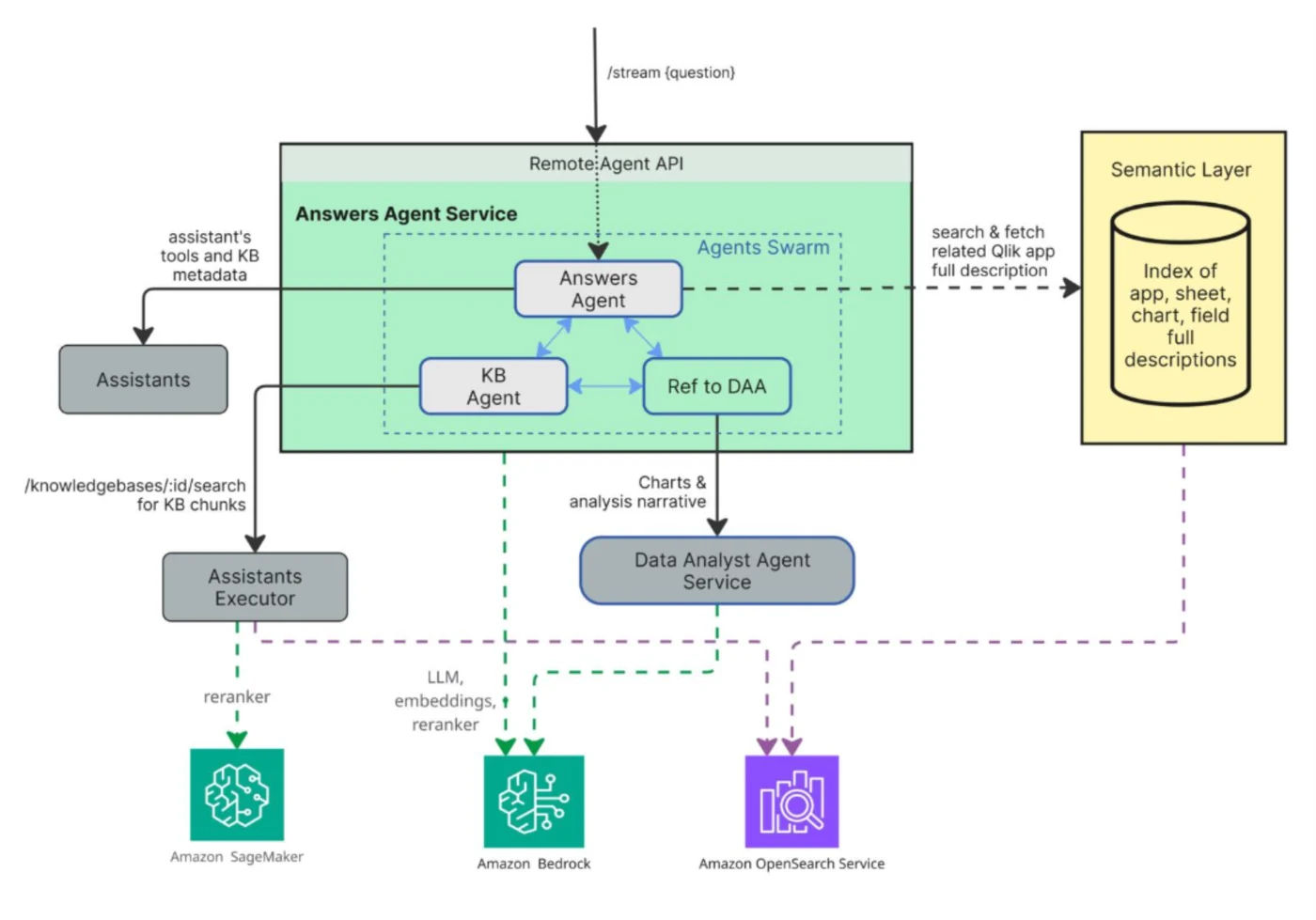
The architecture features an entry layer within Qlik Cloud, a lightweight routing layer that directs user messages, an answer layer coordinating response generation, and a specialist agent layer utilizing a shared swarm runtime. Additionally, a dedicated conversational analytics layer handles structured data queries, while unstructured document indexing and retrieval run on Amazon OpenSearch Service. Further information regarding foundational model integrations and regional support can be referenced via Amazon Bedrock.
Model Access Layer and Advanced Bedrock Guardrails
At the core of the system is the model access layer, which connects to Amazon Bedrock for chat, streaming, embeddings, and reranking via Qlik's proprietary large language model gateway. To ensure enterprise-grade safety and compliance, Amazon Bedrock Guardrails are applied to every incoming request and outgoing response, offering comprehensive content filtering against prompt injection, personally identifiable information, secrets, and denied topics.
Beyond basic content filtering, the framework executes a rigorous grounding-validation check on every generated answer, comparing the output directly against the source content from which it was drawn. When specific customer-reliant models are not yet natively available in a given region through Bedrock, workloads temporarily utilize Amazon SageMaker AI as an in-region fallback before returning to Bedrock once regional availability catches up.
Real-World Enterprise Implementations and Customer Impact
Several prominent customer deployments demonstrate the practical value of the architecture in production environments. Bystronic, a global sheet-metal processing specialist, successfully deployed an AI chatbot in 15 minutes, empowering employees to query real-time operations data across multiple departments. More insights into this implementation are detailed in Bystronic’s 15-minute chatbot deployment.
Additional deployments highlight significant productivity gains across different industries. Lintech International indexed more than 17,000 technical documents into the platform, cutting manual research time and boosting response speeds by 75 percent to return up to seven hours a week to business managers. Meanwhile, TouchPoint Support Services utilizes the tool to deliver fast, compliance-aligned guidance to 15,000 staff members operating across 650 healthcare sites.
Technical Insights From the AWS Machine Learning Blog
The full technical breakdown of how these components interact at scale was originally outlined on the official AWS Machine Learning Blog. The documentation details how cross-region inference and layered multi-agent orchestration collaborate to maintain consistent performance and strict data governance across global enterprise deployments.
Sources
- AWS Machine Learning BlogHow Qlik built grounded, enterprise-scale AI with Amazon Bedrock
Continue chronologically
Related entity coverage
Related stories
Amazon Payments Boosts Funnel Conversion with AWS AI
Amazon Payments applied multi-objective contextual bandits on Amazon SageMaker AI to personalize acquisition funnels and drive conversion lifts.
Condé Nast Builds Multimodal Video Discovery with AWS
Condé Nast partnered with the AWS Generative AI Innovation Center to build an AI-powered multimodal video discovery solution on Amazon Bedrock.
uniopen Customizes Amazon Nova for Retail Content Moderation
Learn how retail platform uniopen used supervised fine-tuning and prompt optimization to adapt Amazon Nova 2 Lite for production moderation.
AWS Details Multi-Agent Cloud Migrations on Bedrock AgentCore
AWS Professional Services details a multi-agent framework on Amazon Bedrock AgentCore to automate enterprise cloud migrations and reduce IaC time.