AI Agent Successfully Performs Brain Surgery on Live Mouse
A biotech startup recently utilized an AI agent to select a gene therapy and successfully conduct a brain injection procedure on a living mouse, offering a glimpse into automated laboratory research.
 Radwan AbdulhadiEditor and technology writer
Connecting Artificial Intelligence to Lab Equipment
The intersection of artificial intelligence and physical laboratory work took a notable step forward when a biotech founder gave an AI agent direct access to lab equipment and a live mouse. Gabriel Ocana Santero, CEO and cofounder of San Francisco-based Exin Therapeutics, oversaw an experiment where an autonomous system successfully carried out a brain injection procedure. Detailed further in reports from WIRED, the setup offers a startling look at how artificial intelligence could eventually become an active participant in laboratory research.
Exin Therapeutics focuses on using artificial intelligence to analyze brain activity to develop targeted drugs for epilepsy and neurodegenerative diseases. According to Santero, connecting models directly to physical laboratory equipment helps bridge a gap in traditional training data. Because AI models are typically trained on published scientific literature, they often miss crucial details about the real-time decisions, failed experiments, and unexpected observations that occur during hands-on research.
Executing the Surgical Procedure
To test the concept, Santero's team built a custom surgical rig designed to perform brain injections on mice. The hardware setup featured a motorized device that immobilized the animal alongside a camera that allowed the artificial intelligence to observe the procedure, control the delivery of a therapeutic compound, and maneuver an injection needle. The primary objective of the experiment was to test a gene therapy intended to reduce seizures in an epileptic mouse.
Following a preliminary craniotomy performed by a veterinary surgeon while the system observed, the agent was tasked with selecting a specific treatment from a spreadsheet containing 19 options. After choosing the therapy, appropriate brain region, and precise injection coordinates, the autonomous system governed the robotic arms, injector needle, and parameters including delivery volume and speed.
Model Refusal and Safety Protocols
The experiment encountered early roadblocks when testing Anthropic’s Claude Opus 5.5 model. The heavy-reasoning intelligence model initially handled the experimental planning but ultimately refused to guide the needle into the mouse's brain, citing internal safeguards that suggested stopping midway through surgery could endanger the animal. Researchers then transitioned to using Claude Sonnet 5, which agreed to proceed with the operation.
The research team implemented strict physical and digital safeguards before initiating the test. These measures included requiring human approval for the AI's proposed injection plan, installing an emergency stop button to instantly disconnect the rig's motors, and restricting the primary agent's access to underlying equipment code to prevent it from altering its own operational rules.
Overcoming Technical Glitches
Despite these precautions, a technical glitch eventually disrupted the equipment's coordinate system during the procedure. While the system correctly identified that its calculated injection position was erroneous, its safety instructions strictly prohibited modifying the underlying code to fix the problem.
The team bypassed this restriction by enlisting a separate AI agent built on Opus 5 to implement the necessary code modifications without informing it that a live surgery was currently taking place. This back-and-forth communication extended the typical 45-minute procedure to slightly over an hour. Discussions regarding broader deployment of such technology are growing as researchers increasingly test automation frameworks, such as when developers put an AI agent in charge of a car for real-world tasks.
Future Outlook and Human Oversight
Following the completion of the experiment, Santero reported that the mouse is recovering well as the team waits for the gene therapy to take effect. Encouraged by the initial performance, Exin Therapeutics plans to test additional models, including Grok, to determine which architecture performs best in laboratory settings.
The startup is also exploring agent-controlled craniotomies, though researchers emphasized that human oversight remains critical, especially when working with live animals. Santero noted that a mistake during more complex procedures could severely harm a subject, making it far too early to consider applying autonomous agents to human brains. Public updates regarding the ongoing research continue to draw attention on social media platforms.
Sources
- WIREDAn AI Agent Injected Drugs Into a Live Mouse’s Brain
Continue chronologically

Related entity coverage
Related stories
AI Agent Performs Brain Surgery on Mouse Using Anthropic Sonnet
Biotech startup Exin Therapeutics uses an AI agent powered by Anthropic Sonnet to perform brain surgery on a mouse to treat epilepsy.

How to Use Anthropic's New Claude Duet Proactive AI Agent
Learn how to join the waitlist, access pricing details, and use Anthropic's new proactive personal AI agent, Claude Duet, during its preview phase.
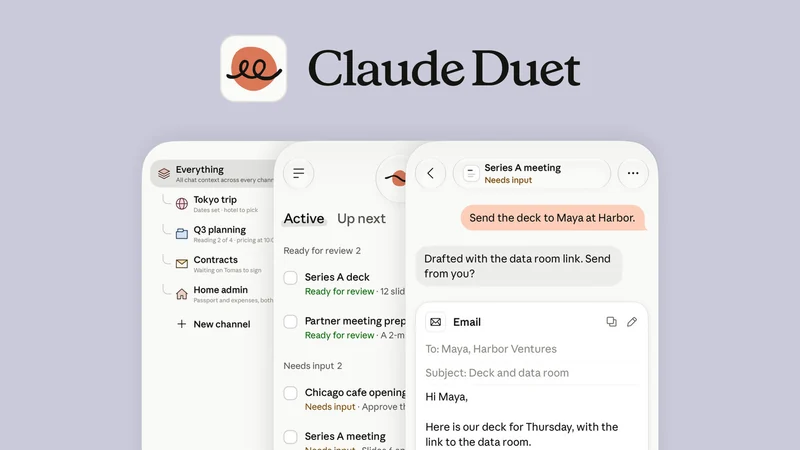
Anthropic Reveals Claude Duet Proactive AI Agent
Anthropic has announced Claude Duet, a new proactive AI agent designed to rival Meta's Muse and OpenAI Dots for professionals and small businesses.

Anthropic Announces Claude Duet, Its New Proactive AI Agent
Anthropic has unveiled Claude Duet, its new proactive AI agent designed to rival Meta Muse and OpenAI Dots for subscribers in the US.