AWS Details Agentic Engineering Assistant for Aerospace
AWS has outlined a multi-agent engineering assistant designed to reduce the manual work involved in evaluating replacement aerospace components. The system assembles evidence for review while leaving approval decisions with engineers.
 Radwan AbdulhadiEditor and technology writer
AWS presents a multi-agent engineering workflow
AWS has described a multi-agent engineering assistant intended to compress aerospace component substitution evaluations from days to minutes. The system brings together Amazon Nova Multimodal Embeddings, Amazon Bedrock AgentCore and the open-source Strands Agents SDK to assemble evidence from technical sources and prepare draft assessment documents.
The workflow addresses a problem AWS says engineers face when a qualified aerospace component becomes obsolete or develops a long lead time. Engineers may need to cross-reference vendor datasheets, interface control documents, qualification records and other material before preparing a substitution justification. The resulting evidence can otherwise be distributed across email and undocumented institutional knowledge, making review less repeatable.
Engineers remain responsible for the decision
The central design rule is that the engineer remains the decision-maker while the system gathers and organizes supporting evidence. AWS says the assistant drafts justification memos and Integration Impact Assessments for engineering review, but it does not recommend or approve a substitution on its own.
The architecture separates model-driven tasks from deterministic evaluation. Python tolerance-rule code scores candidate parts against a reference part and stated engineering requirements. Because identical inputs produce consistent pass or flag results, AWS positions those outputs as suitable for inclusion in a formal engineering review. Each evaluation also writes an audit-trail entry aligned with sections 8.4 and 8.5.6 of AS9100, according to the company.
Nova embeddings connect text and visual evidence
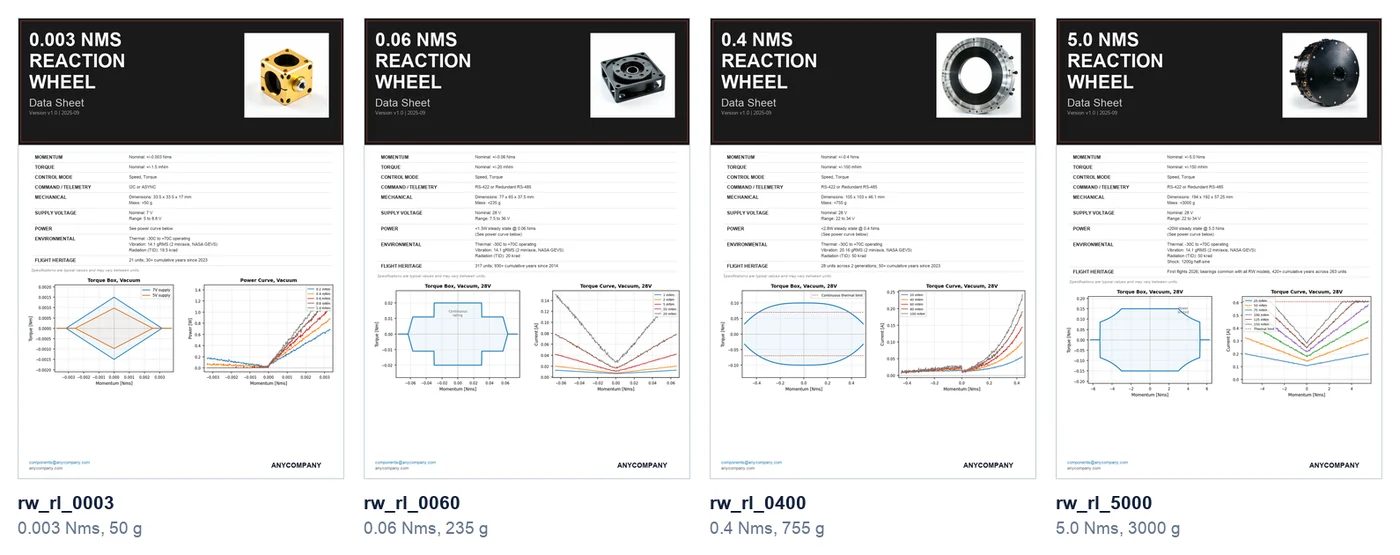
Amazon Nova Multimodal Embeddings serves two roles in the design. First, it supports multimodal retrieval by placing text and visual content from datasheets, interface documents and performance charts in a shared semantic space. An engineer can search for a torque curve or upload a chart image, with retrieval returning relevant material and source attribution.
The embeddings also support visual similarity scoring between candidate parts. The system calculates a quantitative cosine similarity between product photos, while Claude analyzes physical differences such as mounting patterns, connector placement and housing geometry. AWS says the visual score supplies additional evidence, but the fit verdict is based on the deterministic specification comparison.
Three specialists handle the investigation
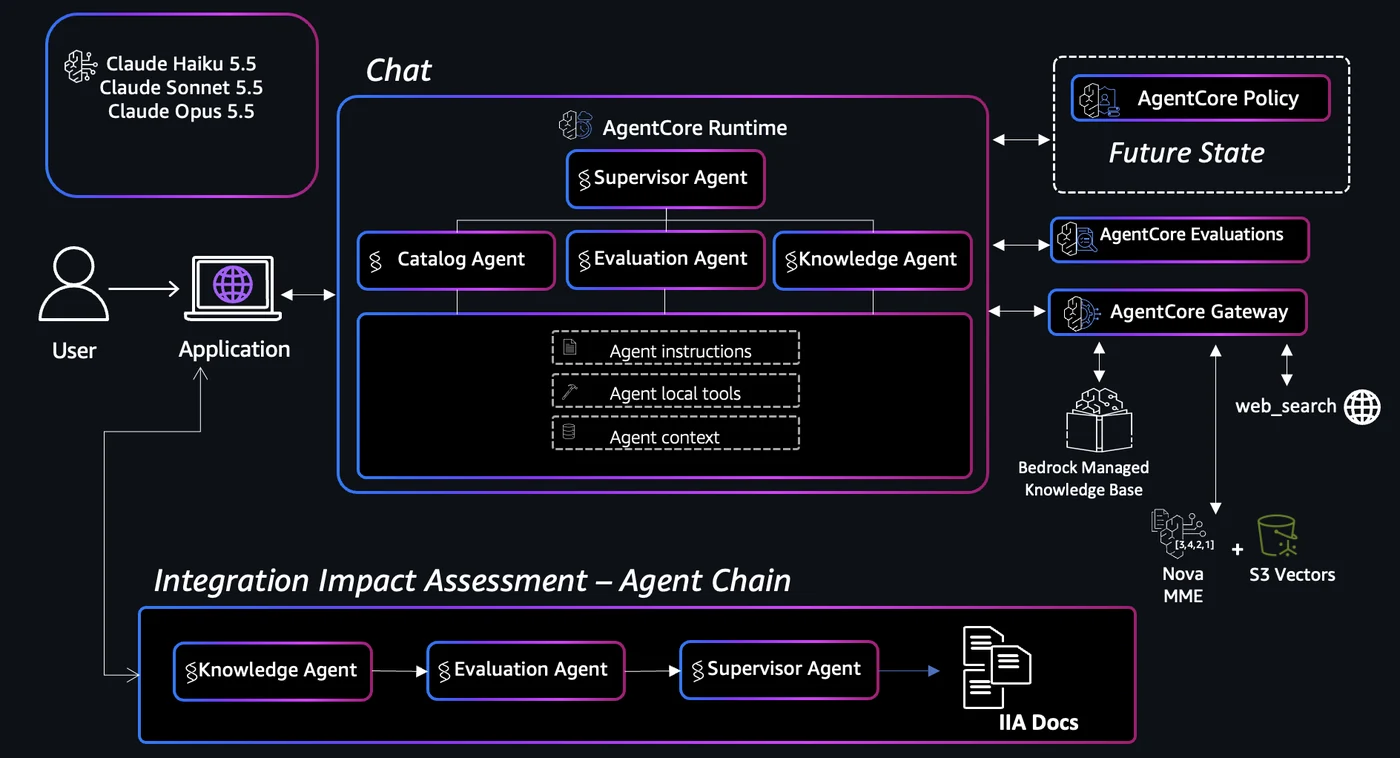
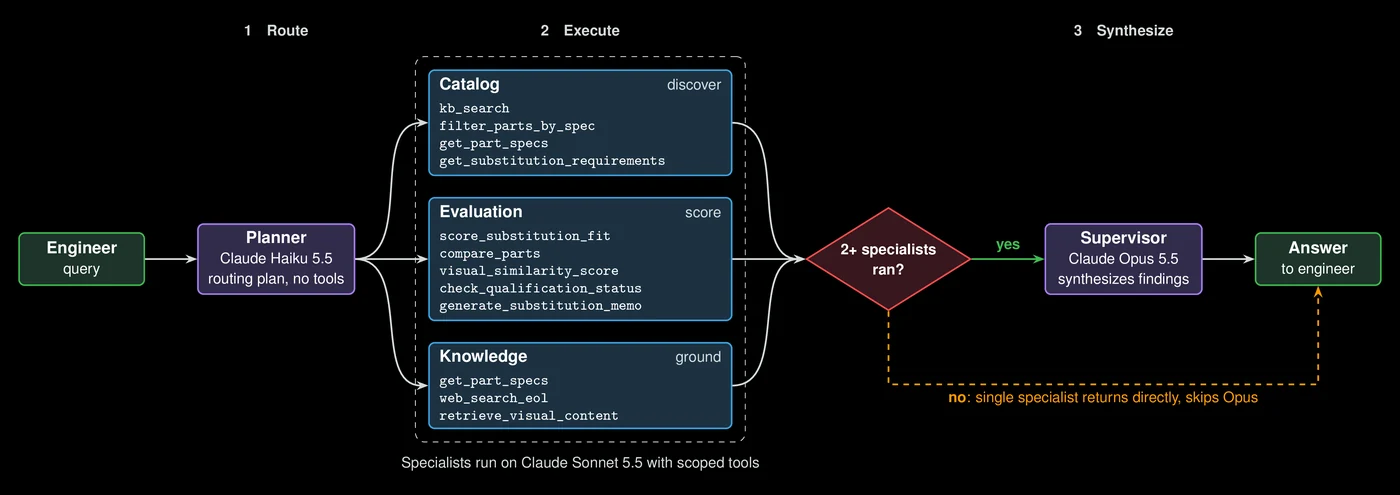
A lightweight planner routes each request to one or more specialist agents: Catalog, Evaluation and Knowledge. A supervisor combines their findings when multiple specialists contribute. A request to determine whether a wheel is approaching end of life, identify alternatives and score those alternatives can therefore move through all three specialists in sequence.
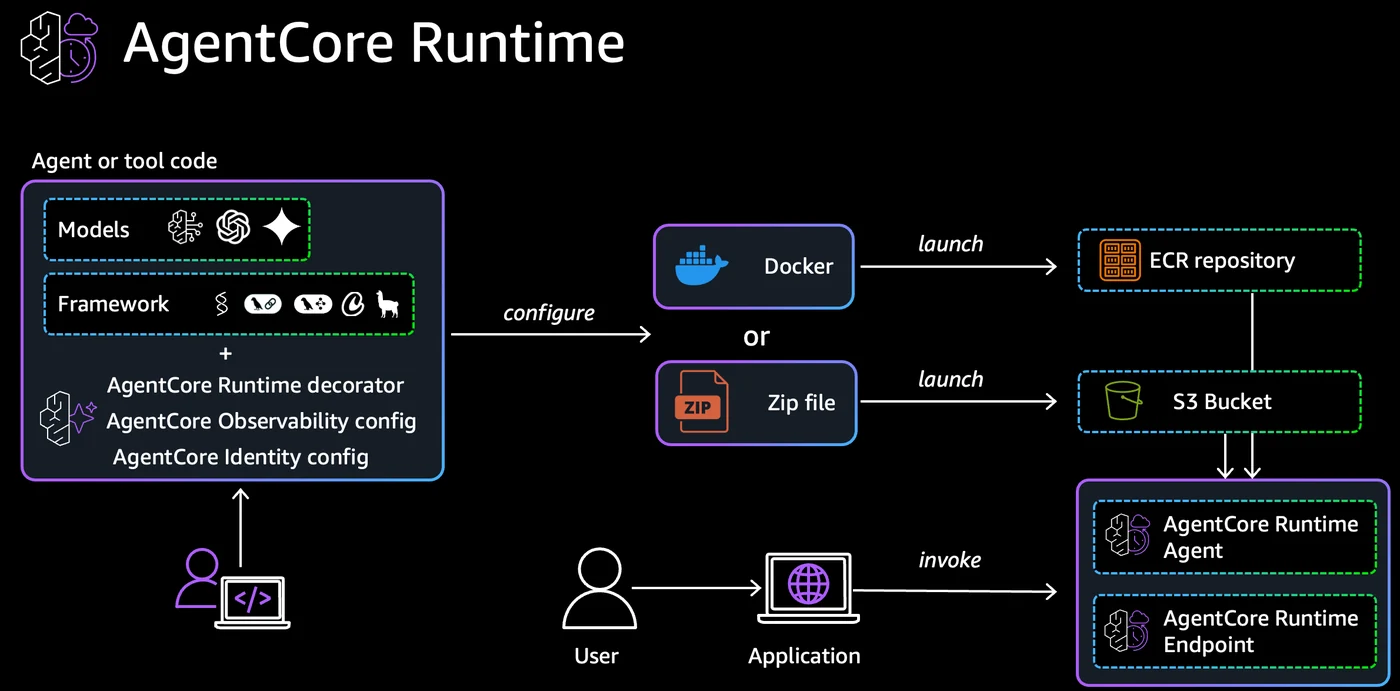
In the described deployment, engineer requests enter a multi-agent graph hosted on AgentCore runtime. AWS says Claude Haiku 5.5 produces the routing plan, Claude Sonnet 5.5 executes specialist tools, and Claude Opus 5.5 synthesizes results when required. A separate fixed chain runs Knowledge, Evaluation and Supervisor in order to produce a formal Integration Impact Assessment.
Knowledge bases and live web data support the agents
The specialist agents retrieve information from a managed knowledge base created with Amazon Bedrock Managed Knowledge Bases and Nova Multimodal Embeddings. That knowledge base is accessed through an AgentCore Gateway alongside a Web Search connector for live web information, allowing lifecycle claims to be grounded in current external data.
For image-as-query requests, such as uploading a chart to identify a part, the assistant calls an Amazon S3 Vectors index directly. AWS says this separate path is necessary because the managed knowledge base retrieval API does not accept image input. The index contains part photos and crops of datasheet charts.
AWS sample focuses on reaction-wheel substitutions
AWS provides the complete code sample as five Jupyter notebooks in a public GitHub repository. Each notebook runs independently, imports from a self-contained copy of the agent and tool modules, and includes the sample parts data, chart crops and evaluation queries.
The sample corpus contains seven fictional AnyCompany reaction wheels spanning 0.003 to 5.0 Nms of momentum storage. Each part folder combines structured data with the documents an engineer would read, including a specs.json file, an interface control document, a product photo and a rendered datasheet page. AWS lists access to Amazon Bedrock in the US East (N. Virginia) Region, supported model access, Python 3.10 or later and Jupyter among the stated requirements. Docker is needed if the deployment recipe is adapted to host the agent on AgentCore runtime.
Sources
- AWS Machine Learning BlogAgentic engineering intelligence with Amazon Nova Multimodal Embeddings and Amazon Bedrock AgentCore
Continue chronologically
Related entity coverage
Related stories
AWS Details Multi-Agent Cloud Migrations on Bedrock AgentCore
AWS Professional Services details a multi-agent framework on Amazon Bedrock AgentCore to automate enterprise cloud migrations and reduce IaC time.
AWS Introduces Agentic Conversational Video Intelligence
Amazon Web Services details a new agentic conversational video intelligence solution using Amazon Bedrock, Rekognition, and Transcribe.
AWS Details Enterprise Agentic AI Platform Blueprint
Discover how enterprises can build a governed, multi-account Agentic AI Platform using Amazon Bedrock and AgentCore reference architecture.
Building Trust in AI Agents With Amazon Bedrock AgentCore
Discover a nine-stage production evaluation framework built on Amazon Bedrock AgentCore to catch silent AI agent regressions.