Google DeepMind Unveils Antigravity Cheminformatics
Google DeepMind has introduced a new suite of Cheminformatics Skills for Google Antigravity designed to streamline complex drug discovery workflows and automate molecular analysis.
 Radwan AbdulhadiEditor and technology writer
Accelerating Drug Discovery Workflows
Designing new medicines traditionally requires curating complex data from charts, figures, and literature, training predictive models, and proposing candidate molecules to synthesize. This intensive workflow typically takes multiple days for a single iteration. To address these hurdles, Google DeepMind has highlighted how Google Antigravity, equipped with new Cheminformatics Skills, can accelerate drug discovery workflows.
Using real-world lung cancer treatments as a baseline, an autonomous agent can search through thousands of compounds, perform matched molecular pair analysis, and propose novel rigidified macrocycles complete with synthetic routes in just an hour. Chemistry remains one of science's richest public records, spanning millions of structures across journal articles and vendor catalogs.
Unifying Complex Molecular Data Sources
Despite decades of progress in cheminformatics, chemists still spend considerable time wrangling data. Molecules can be represented in many formats, ranging from text descriptions to images or data structures. The same molecule might appear as an IUPAC name in a research paper, a Markush structure in a patent, or a structure-data file in a vendor catalog.
Advanced cheminformatics systems must successfully unify these sources while mitigating potential errors. Because altering a single atom or bond describes an entirely different compound, high precision is required to avoid rendering a promising inhibitor or catalyst completely inert. Google DeepMind built these new skills to let scientists focus on core hypotheses rather than manual data formatting.

Collaborative Workbench Architecture
The integration turns the workspace into a collaborative science workbench with full access to local tooling for both computational and experimental bench chemists. A clear division of labor underpins the system: the language model handles workflow orchestration, database navigation, and scientific reasoning, while deterministic chemistry tools execute precise molecular calculations.
These capabilities are grounded in RDKit, a foundational open-source cheminformatics toolkit developed over two decades by a global community of contributors. In addition, the platform features built-in connectors to curated resources from ChEMBL and PubChem, encoding domain best practices directly into the agent's workflow.
Targeting Molecular Rigidity and Potency
A technical walkthrough provided by the team focuses on a classic medicinal chemistry technique used to improve drug potency: molecular rigidification. Drug molecules often link multiple substructures through rotatable bonds, allowing them to twist into many three-dimensional shapes in solution. However, a floppy molecule must lock into a single active shape to bind its target, incurring an entropic penalty that weakens binding affinity.
By adding a second bond to tie substructures together, medicinal chemists can sharply limit spatial movement. Placing this bond correctly locks the molecule into the exact conformation required for target binding. This strategy pays the entropic cost in advance, which can dramatically boost overall drug potency.

Practical Application and Data Analysis
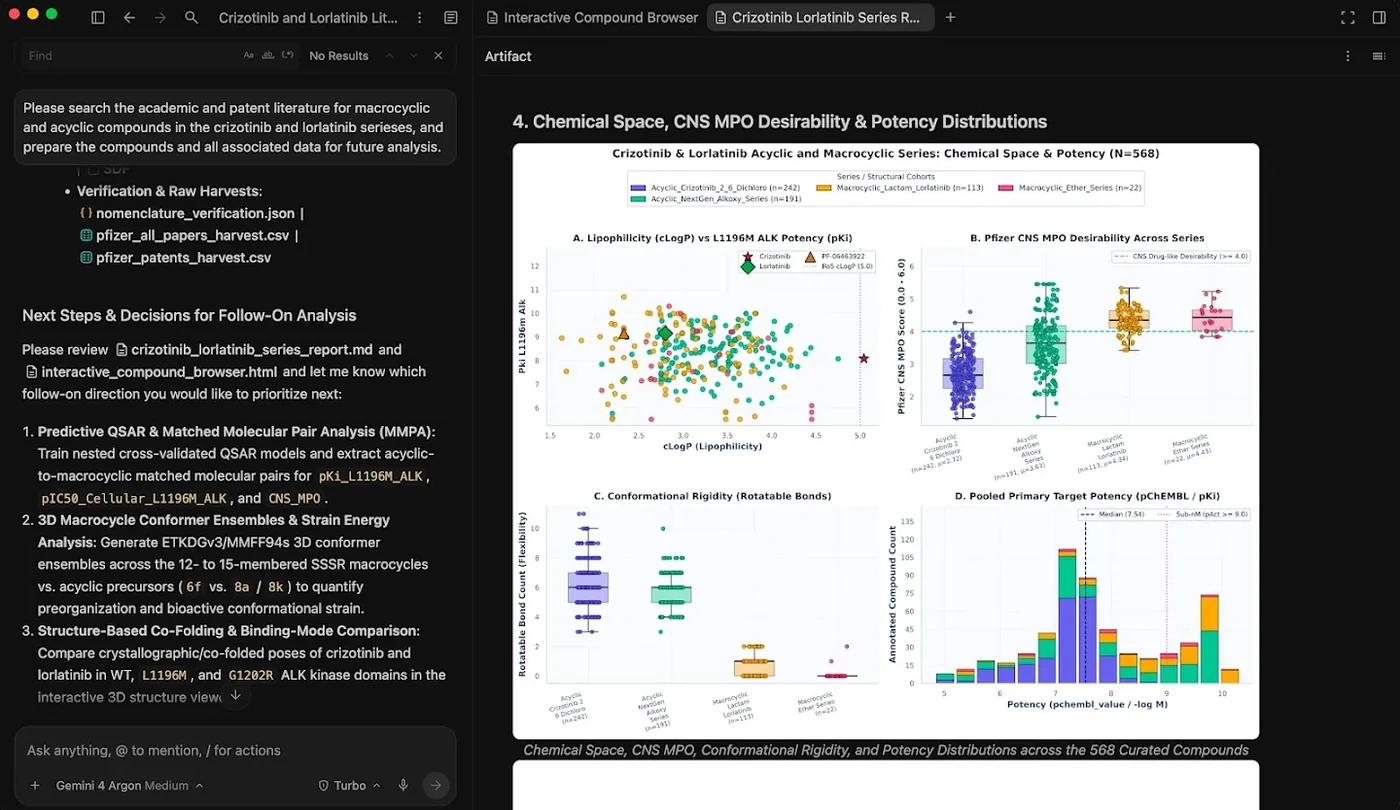
To demonstrate the system, researchers examined crizotinib, a first-generation tyrosine kinase inhibitor with five major rotatable bonds, and compared it with lorlatinib, a third-generation inhibitor that has been cyclized at its end to reduce rotatable bonds to zero. Instructed to search the literature for these drugs and their analogues, the Antigravity agent extracted molecules, associated them with reported data, and prepared them for downstream analysis.
Within minutes, the agent filtered out irrelevant molecules like buffers and solvents, documented their sources, and generated an initial analysis report. The output highlighted that the macrocycles were largely predicted to be brain-penetrant, a crucial characteristic given that lung cancer frequently metastasizes to the brain.
Interactive Exploration and Machine Learning
The platform launches an interactive viewer where scientists can browse curated compounds, inspect metadata, and utilize customizable scatter plots. Plotting cellular potency against rotatable bonds clearly reveals that macrocycles and rigidified compounds achieve higher potency.
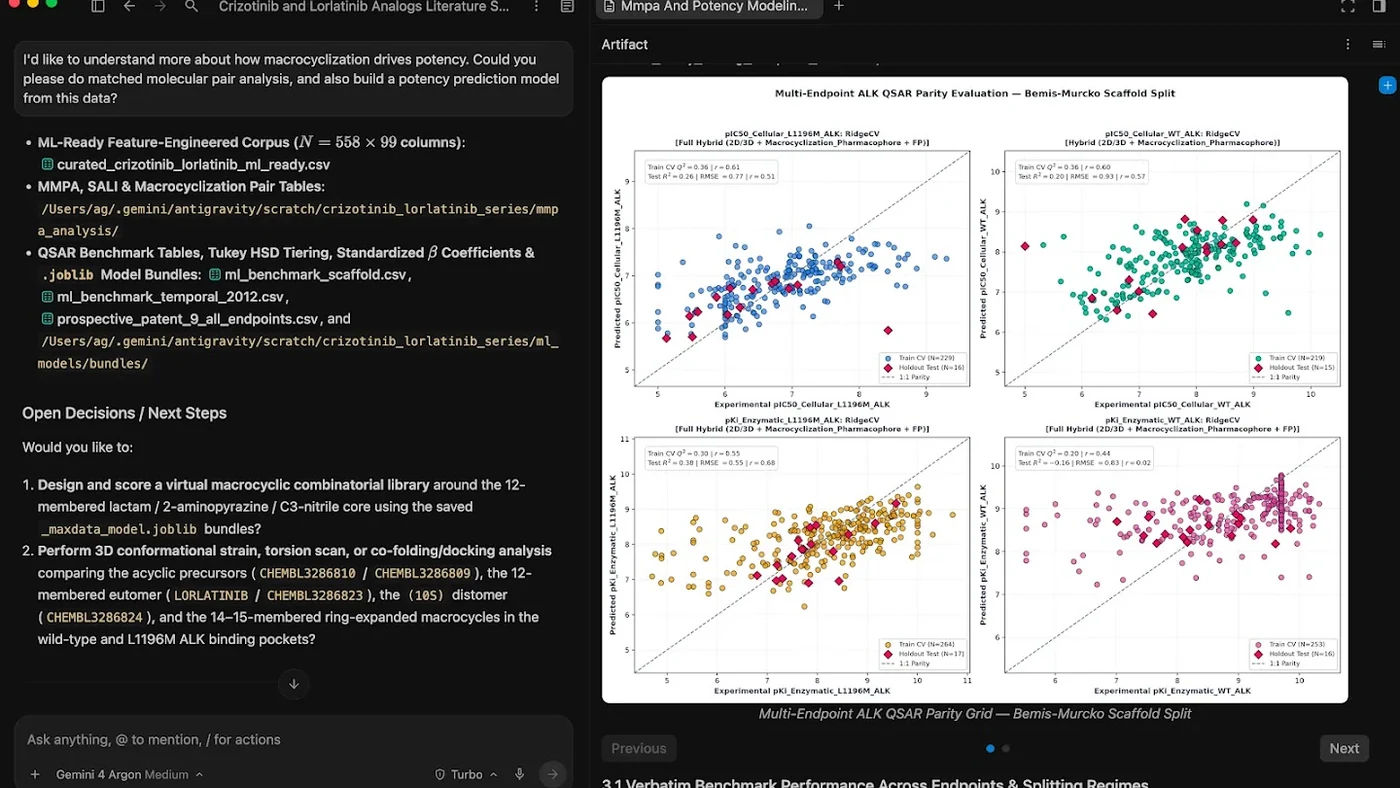
Beyond basic data curation, the agent performs matched molecular pair analysis to isolate discrete structural changes and builds predictive machine learning models. The system guides the agent on best practices—such as using chronological or scaffold splits—to benchmark different architectures across multiple experimental readouts.
Sources
- Google DeepMindAgentic cheminformatics with Google Antigravity
Continue chronologically
Related entity coverage
Related stories
Google Launches Gemini 4 Argon Frontier AI Model
Google has announced the global availability of Gemini 4 Argon, its latest frontier AI model designed for complex real-world tasks and deep work.

Google DeepMind Unveils Antigravity for Science Workbench
Discover how Google Antigravity accelerates antimicrobial peptide discovery, combining UniProt data and ProtNLM models to fight antimicrobial resistance.
Google Introduces Gemini 4 Argon Frontier Model
Google DeepMind launches Gemini 4 Argon, a new frontier model built for complex tasks in coding, science, finance, and legal workflows.

Google DeepMind Unveils Gemini 4 Argon Frontier AI Model
Google DeepMind announces Gemini 4 Argon, a new frontier AI model designed for real-world coding, enterprise workflows, and cyber defense.