Martian Cloud Formation May Reveal Never-Before-Seen Physics
Researchers have successfully modeled a massive, recurring Martian cloud formation, pointing to theoretical ice-forming physics that have never been directly observed in any planetary atmosphere.
 Radwan AbdulhadiEditor and technology writer
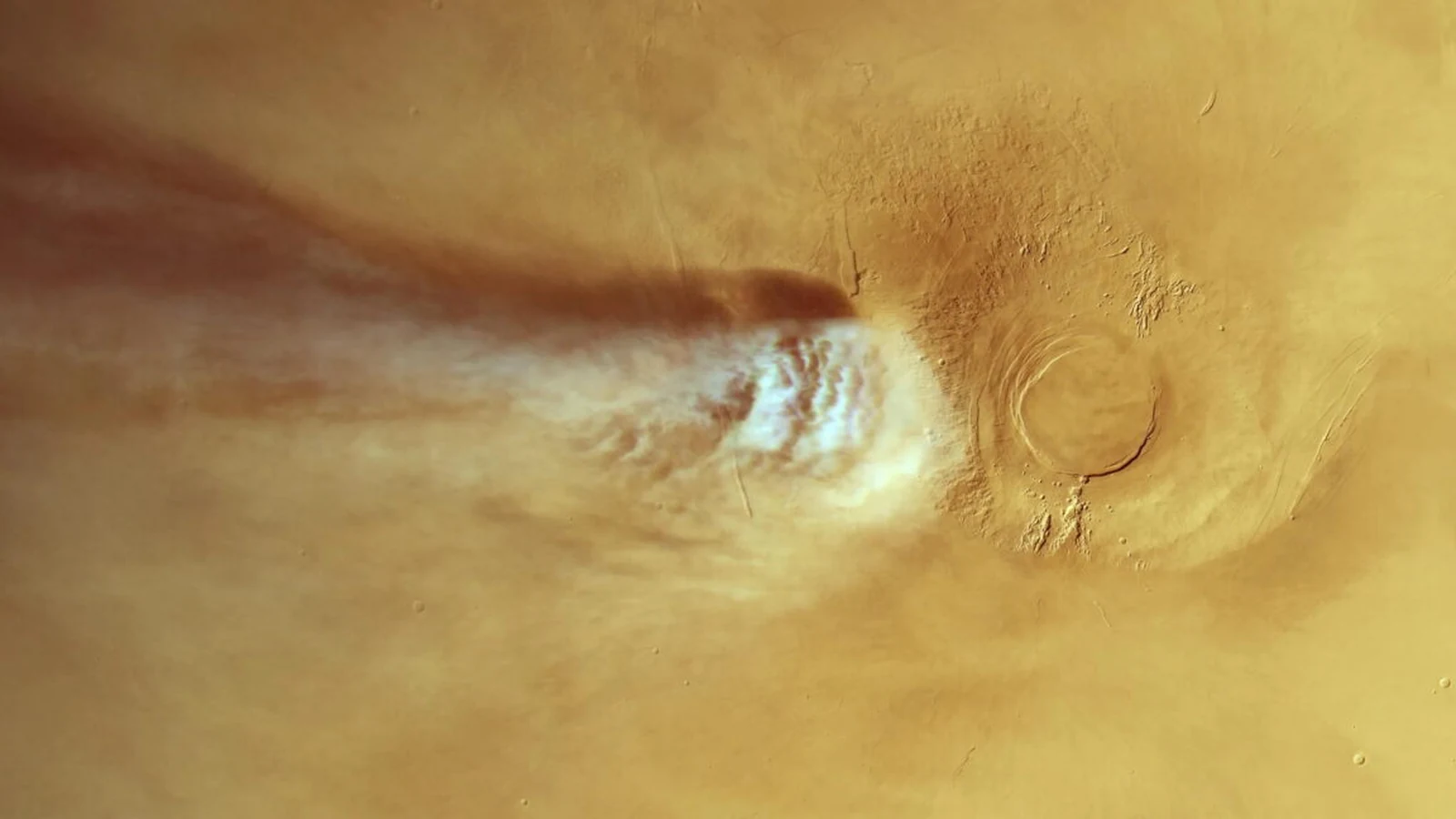
The Mystery of the Arsia Mons Elongated Cloud
Every morning during the Martian spring and summer, a thin and extremely long cloud emerges, only to disappear again. The wispy formation appears near the volcano Arsia Mons and gradually elongates until it reaches over 1,000 miles—about the distance from New York to Kansas City as the crow flies—before dissipating. This cycle then repeats for several months.
Since it was first recorded by a probe in 2018, scientists have been unable to find a plausible explanation for the existence of this cloud, often referred to as the Arsia Mons Elongated Cloud (AMEC). Until now. Recently, researchers successfully modeled the cloud’s formation for the first time, their results suggesting that it may be driven by a physical process that has never been directly observed in any planet’s atmosphere.
Exotic Physics and Homogeneous Nucleation
Jorge Hernández-Bernal, a planetary scientist at Paris’ Sorbonne Université and lead author of the study, noted the unique theoretical requirements needed to replicate the phenomenon in simulations. “We found that we needed to include some exotic physics… physics that, while included in textbooks, is treated as theoretical and usually thought not to happen in nature. It certainly hasn’t been seen in action before,” Hernández-Bernal said in a press release . “Once we included this physics in our simulations, the AMEC emerged just as we hoped.”
On Earth, clouds usually form when water vapor creates droplets or ice crystals in the presence of tiny particles, such as dust or salt. The new study, published in Nature Geoscience , instead suggests AMEC could be forming through so-called homogeneous nucleation, where vapor changes directly into ice crystals on its own without any help from debris.
Explaining the mechanism further, Hernández-Bernal noted, “It’s akin to droplets of condensation appearing in the middle of a room, rather than on a window. It’s wholly unexpected.”
Extreme Conditions and Volcanic Influence
This phenomenon requires extreme conditions—a sharp temperature drop of 30° Celsius within 10 minutes and high relative humidity. The Arsia Mons volcano also plays a key role. When wind current hits the 65,000-foot-tall volcano , it creates a powerful wave that launches moist air high in the atmosphere in a matter of minutes.
Scientists have assumed a similar phenomenon could occur in the upper atmospheres of other planets, including Venus and even Earth, but it has never been observed . That’s not too surprising given the extreme air humidity required for this phenomenon, which is more than 100,000 times greater than any value measured on Earth.
Broader Implications for Planetary Atmospheres
Before this modeling, it was not known that these humidity levels existed on Mars either. “We don’t have nearly as much information about Mars’ atmosphere as we do about Earth’s, so reproducing the AMEC to this degree is a big success,” said Hernández-Bernal, adding, “the result is remarkable.”
Sources
- Ars TechnicaA 1,000-mile cloud on Mars may reveal physics never seen in nature
Continue chronologically

Related stories
Scientists Discover Pink and Green White Dwarf Stars
Astronomers discover that dying white dwarf stars can display vibrant pink, green, and purple hues due to extreme density and absorbed planetary material.
Ancient 4.1-Billion-Year-Old Martian Meteorite Found in Sahara
Discover how a 4.1-billion-year-old meteorite found in the Sahara Desert preserves crucial chemical secrets about Mars' ancient watery past.
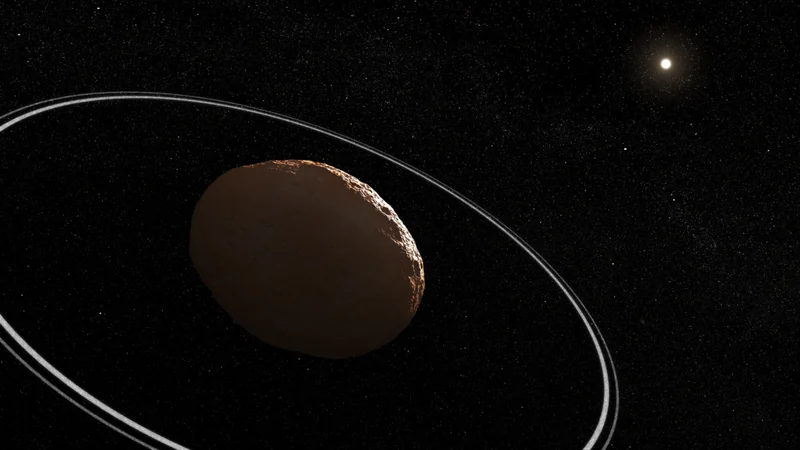
Chariklo’s Ring System Evolving Over Time
Astronomers using the James Webb Space Telescope have observed significant changes in the rings of the small object Chariklo, suggesting dynamic evolution.
Reddit to Require User Login as Search Traffic Drops
Reddit plans to shift to a logged-in-only experience as search referrals decline, starting with tests in select non-US markets.