Scientists Discover Pink and Green White Dwarf Stars
A recent study reveals that stellar density and absorbed planetary debris can cause white dwarfs to shine in unexpected colors like pink and green.
 Radwan AbdulhadiEditor and technology writer
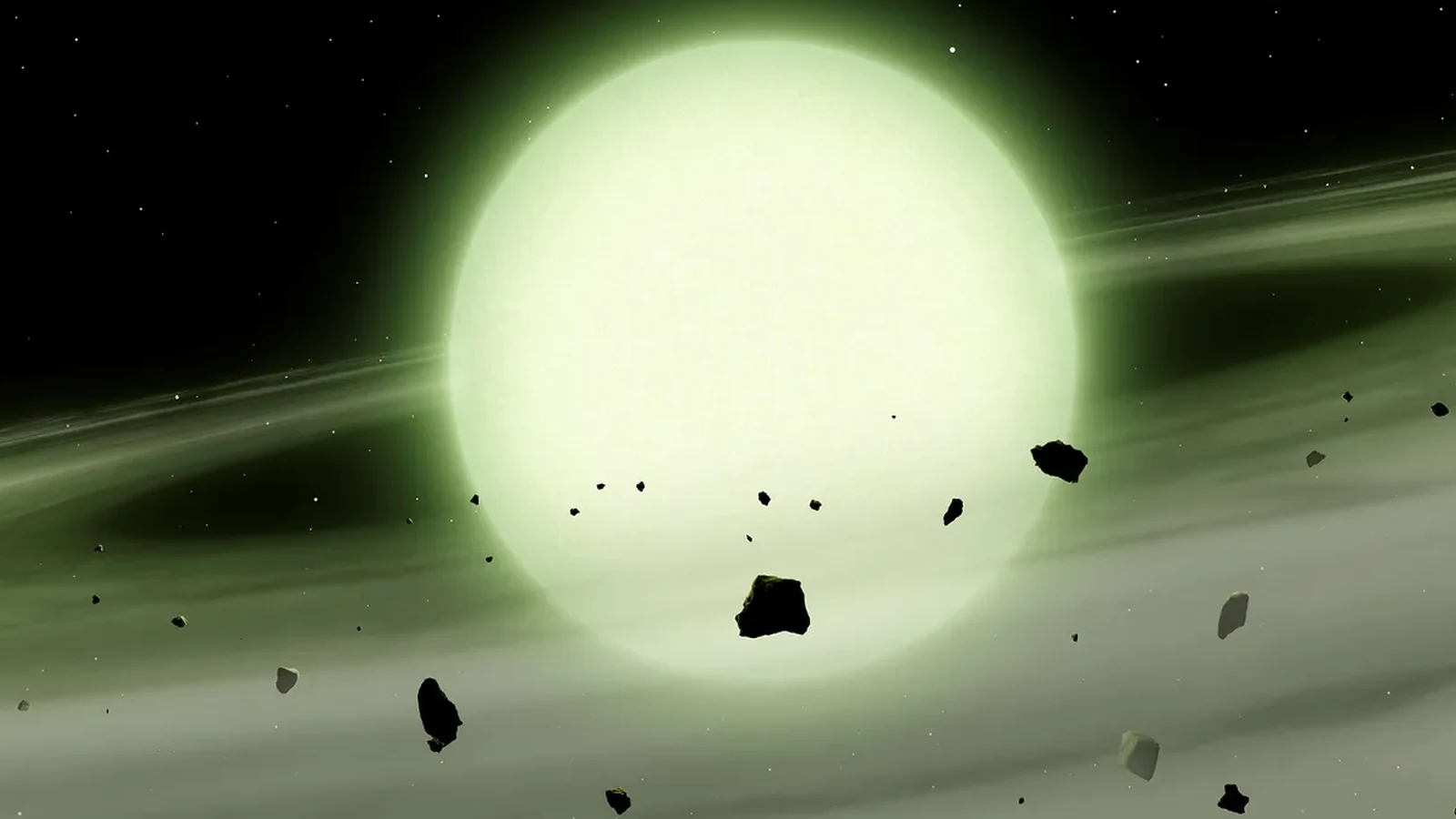
Beyond the Traditional White Dwarf Palette
The realm of stars resembles a fairy tale, featuring giants, supergiants, and numerous dwarfs. While most stars derive their colors primarily from temperature—with cooler stars appearing orange, sun-like stars looking white, and the hottest shining light blue—astronomers have recently discovered fascinating exceptions among the class of stars known as white dwarfs.
At the end of their lives, stars with a mass comparable to the sun expand into red giants before shedding their gaseous envelope to form a planetary nebula. What remains behind is a white dwarf: a highly condensed object with roughly the volume of Earth but containing the mass of the sun.
The Science of Stellar Density and Color
Because initial temperatures are extremely high, the first discovered white dwarfs shone from white to light blue. However, a new study published in RAS Techniques and Instruments indicates that the world of white dwarfs is far more colorful, featuring stars that turn pink, green, and purple.
Researchers explain that stellar density is the primary deciding factor. The atmospheres of the coolest white dwarfs can reach a density of approximately one gram per cubic centimeter—about the density of water. While that might sound modest, it is intensely packed for a star, measuring about a million times denser than the sun’s atmosphere. Under these conditions, trace elements like carbon, calcium, and sodium interact with dense helium plasma to absorb light across a much wider range of colors.
The Role of Ancient Planetary Systems
Material from ancient planetary systems also heavily influences these unusual shades. The closest planets can perish in the fiery embrace of the red giant phase, while other planets and asteroids begin to collide and migrate toward the dead star. Fragments of these celestial bodies eventually integrate directly into the white dwarf's atmosphere.
Specific Discoveries and Galactic Hues
While a white dwarf looks like any other faint star through a hobbyist's telescope, a close-up view reveals vastly varied colors. Carbon-rich white dwarfs tend to appear pink or purple. Calculations show that white dwarfs whose atmospheres are enriched with material from shattered asteroids will exhibit yellow and green shades.
One notable example is the star WD J1330+6435. Operating at a temperature of around 4,000 degrees Celsius, it has accumulated rocky material that enriches its atmosphere with calcium, lithium, and sodium, yielding a light chartreuse color that makes it the first known green star in our galaxy. Another white dwarf, WD J1011+2845, features massive amounts of carbon, concentrating its radiation at wavelengths exceeding 600 nanometers to produce a salmon-pink color, while WD J902-2010 leans toward a bubblegum shade.
Frequency and Observation Bias
Despite these vibrant findings, most white dwarfs remain characteristically white. In examining 152 white dwarfs located within 65 light-years of Earth, authors of the study found that only five showed unusual coloration, suggesting roughly one in thirty white dwarfs in the universe shines with these distinct hues.
Scientists previously assumed white dwarfs were predominantly blue, an assumption likely tied to sampling bias in observing the night sky. Hottest white dwarfs are typically the brightest and visible from greater distances, leading many observational studies to over-represent blue stars.
Sources
- WIREDWhite Dwarfs Aren’t Just White. Scientists Discover Dying Stars Turning Pink and Green
Continue chronologically


Related stories
Zohran Mamdani Talks AI, Data Centers, and Governance
New York City Mayor Zohran Mamdani discusses data centers, artificial intelligence, and digital communication following his historic election.

Apple CEO John Ternus Defends Company Position on AI
Apple CEO John Ternus recently defended the company's position in the artificial intelligence landscape, emphasizing a focus on user experience over hype.

How WIRED and Others Enabled Elizabeth Holmes and Theranos
An inside look at how early media coverage, including a pivotal Q&A by WIRED, helped launch Elizabeth Holmes and her fraudulent company Theranos.
Katie Zacharia Denies Ties to AI Mining Startup NRED
Short-lived White House press secretary Katie Zacharia and an AI-focused rare-earths mining startup both claim she never worked there, despite announcements.