Webb Telescope Little Red Dots Spark Black Hole Star Debate
The James Webb Space Telescope has uncovered mysterious pinpricks of light across the early universe, igniting a fierce scientific debate over whether they represent an entirely new class of astronomical objects.
 Radwan AbdulhadiEditor and technology writer
Unveiling a Universe of Mysterious Pinpricks
Astronomers built the James Webb Space Telescope to pick up faint light from the first billion years after the Big Bang, a chaotic era when vast swaths of hydrogen and helium gas gathered into the chains of galaxies we see today. Even in the telescope’s first images, astronomers could see a whole zoo of mysterious smears of light.
One batch of objects proved especially difficult to interpret. They glowed blindingly bright, emitting red light with long wavelengths and shining as brilliantly as a whole galaxy. They were tiny, spanning just a pixel, and they appeared almost everywhere in the observatory's field of view. In 2023, researchers started calling them little red dots, repeatedly pointing the observatory toward them to wring precious new information from these pixels of light.
From Universe Breakers to Black Hole Candidates
Initially, researchers thought the dots looked kind of like galaxies. Because of their brightness, astronomers first argued they were distant galaxies on the cosmic horizon. However, galaxies that bright would have to be huge, and there was no known way for them to grow so big in just hundreds of millions of years. This led experts to dub them universe breakers for the way they seemed to demolish the standard cosmic timeline.
Later, researchers concluded that little red dots look more like the supermassive black holes that sit at the heart of most galaxies. These monstrous masses are themselves dark, but their formidable gravity violently vacuums up gas and other nearby matter, generating rings of hot, swirling detritus that completely outshine the stars around them.
Detailed Surveys Reveal Spectra Secrets
To better understand these objects, teams led surveys that trained the Webb telescope on distant sources for hours at a time. They tabulated precisely what shades of light were coming from each dot and how bright the shades were. This detailed color breakdown, known as a spectrum, told astronomers a far more detailed story than the initial observations had.
The bombshell discovery in the little-red-dot spectra was that the colors of hydrogen were smeared out across multiple shades. Usually, seeing such an effect means you are looking straight at an exposed black hole, which whips hydrogen clouds around at furious rates. Many astronomers concluded that big black holes dotted the universe, washing out the light of the stars in their host galaxies.
The 2025 Discovery of Exceptional Sources
In the spring of 2025, two teams of astronomers simultaneously announced observations of a pair of little red dots that were unlike all the rest. Anna de Graaff of the Max Planck Institute for Astronomy and Rohan Naidu of the University of Hawai’i spearheaded surveys that unveiled these two exceptionally red sources.
What made these two little red dots exceptional was how red they were. Webb picked up almost no light in the bluer hues of their spectra, and at a particular shade of red, the colors abruptly got much brighter through a feature known as a Balmer break. This feature is typically observed when looking at a hot ball of hydrogen gas in certain types of stars or galaxies.
Proposing the Concept of a Black Hole Star
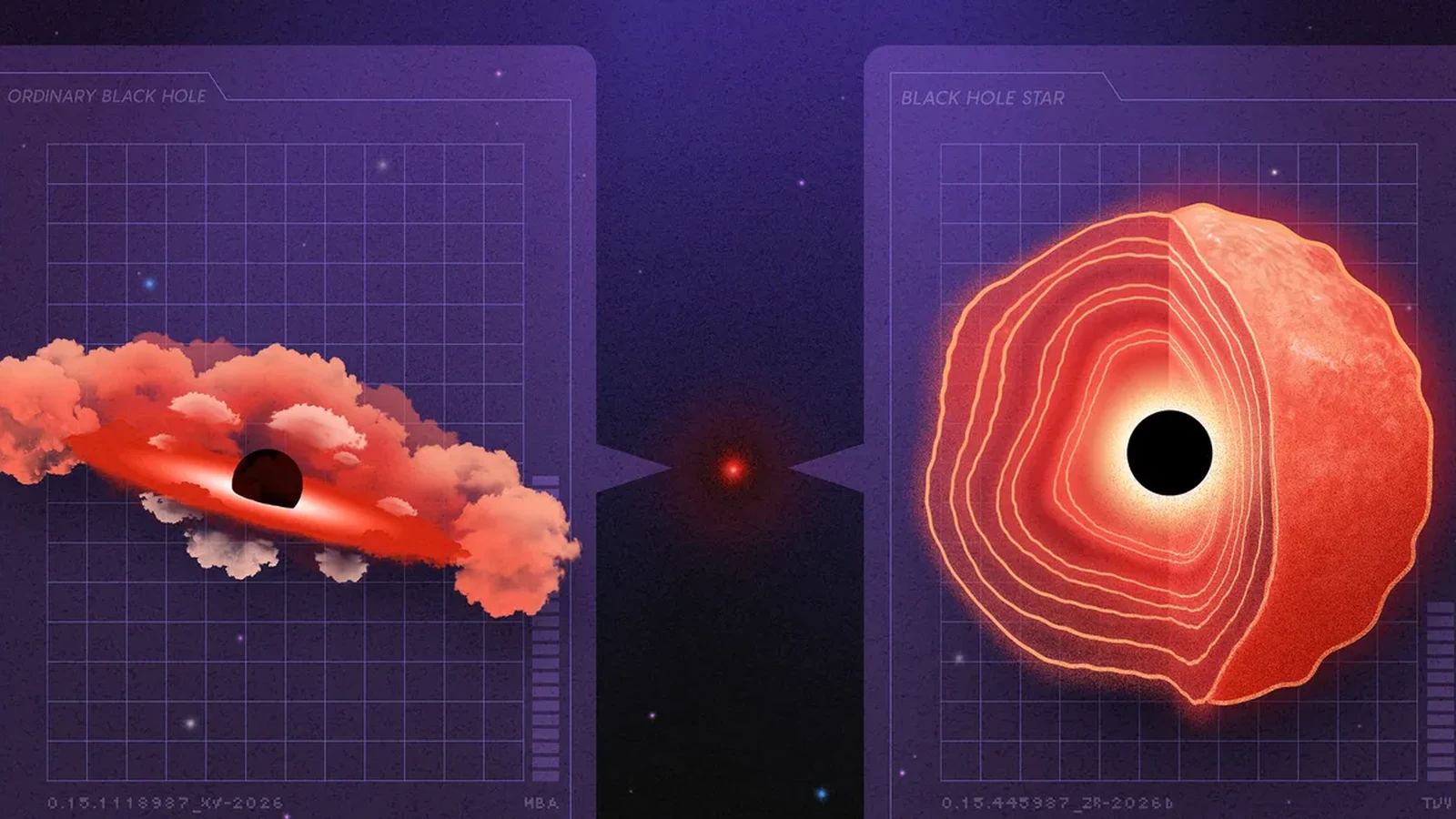
Because the new little red dots were too bright to literally be stars and did not look much like traditional black holes, Naidu and de Graaff concluded they were looking at a new astronomical object. They proposed that these sources combine the vigor of a black hole with the outward appearance of a star, dubbing them a black hole star.
According to the researchers, a black hole star would appear from the outside as a huge agglomeration of hydrogen gas hiding a black hole deep in its core. While some experts find compelling evidence that the telescope is witnessing the births of supermassive black holes inside colossal stars, the broader scientific community remains deeply divided on the interpretation.
A Polarized Field and Continuing Research
The bold interpretation has sparked a flurry of follow-up research and reignited a fierce debate over the nature of these peculiar pinpricks of light. Anna-Christina Eilers, an astrophysicist at the Massachusetts Institute of Technology, noted that the field has gotten very polarized as researchers continue to analyze incoming data.
As detailed in additional reports from outlets such as Quanta Magazine, scientists are continuing to spar over whether these sources truly represent a groundbreaking new phenomenon or an alternative configuration of early cosmic matter.
Sources
- WIREDInside the Supermassive Debate Over the James Webb Telescope’s ‘Little Red Dots’
Continue chronologically


Related stories
Webb Telescope Detects Galaxy Origin Of Farthest Fast Radio Burst
Astronomers utilized the Webb telescope to locate the galaxy origin of the farthest fast radio burst ever detected, offering new insights into deep space.
Chariklo’s Ring System Evolving Over Time
Astronomers using the James Webb Space Telescope have observed significant changes in the rings of the small object Chariklo, suggesting dynamic evolution.
OpenAI argues execution, not just insight, drives progress
OpenAI's new essay suggests advanced AI's greatest value lies in routine execution, addressing the rising cost of turning brilliant ideas into reality.

Scientists Discover Pink and Green White Dwarf Stars
Astronomers discover that dying white dwarf stars can display vibrant pink, green, and purple hues due to extreme density and absorbed planetary material.