Mobile Carriers Store Years of Call Logs and Metadata
Major mobile carriers can retain years of call and text metadata, exposing sensitive personal routines, locations, and relationships when systems are compromised.
 Radwan AbdulhadiEditor and technology writer

The Risks of Long-Term Telecom Data Retention
Every call, text message, and data session handled by a mobile network generates records within a carrier's system. Carriers typically rely on Session Initiation Protocol (SIP) messages to manage calls and texts, and Call Detail Records (CDRs) to summarize who was involved, when the communication occurred, how long it lasted, and which cell site was utilized. While these logs serve administrative functions such as billing and troubleshooting dropped connections, they also create vast archives of sensitive information.
The potential dangers of long-term telecom data retention were highlighted during a massive data breach involving AT&T, which exposed communication logs for 109 million customers.
Because carriers frequently keep records for years—sometimes retaining geolocation data for up to five years—these repositories become high-value targets for attackers. Carrier infrastructure has been frequently breached through credential-based thefts and targeted campaigns, putting accumulated call metadata within reach of unauthorized parties.
What Call Metadata Reveals About Users
Even without access to actual audio content, customer names, or social security numbers, call logs and metadata can expose intricate patterns about an individual's daily life. Anyone with access to these records can identify close relationships, pinpoint home and workplace locations, and reconstruct complex daily routines. Historical logs can show if a subscriber previously contacted specific medical professionals, legal counsel, or personal contacts, details that can be correlated with public information to derive full identities.
The depth of personal profiling possible through telecom data was famously demonstrated by Malte Spitz, who sued his telecom provider in 2011 to obtain the data held on him. By analyzing roughly 35,000 records, Spitz successfully reconstructed a detailed replay of several years of his personal activities and movements.

Monetization and Surveillance Pressures
Telecom companies often store communication logs far longer than what basic phone service requires. In addition to technical troubleshooting and billing dispute resolution, retained logs are frequently used to build comprehensive behavioral profiles. These profiles can be monetized through advertising networks and data brokers, or in certain instances, accessed by government authorities.
Privacy advocates argue that the sheer existence of these large, centralized databases makes security incidents inevitable. When logs are preserved for years, a single network compromise can expose vast historical archives of customer activity.
Alternative Approaches to Minimizing Retention
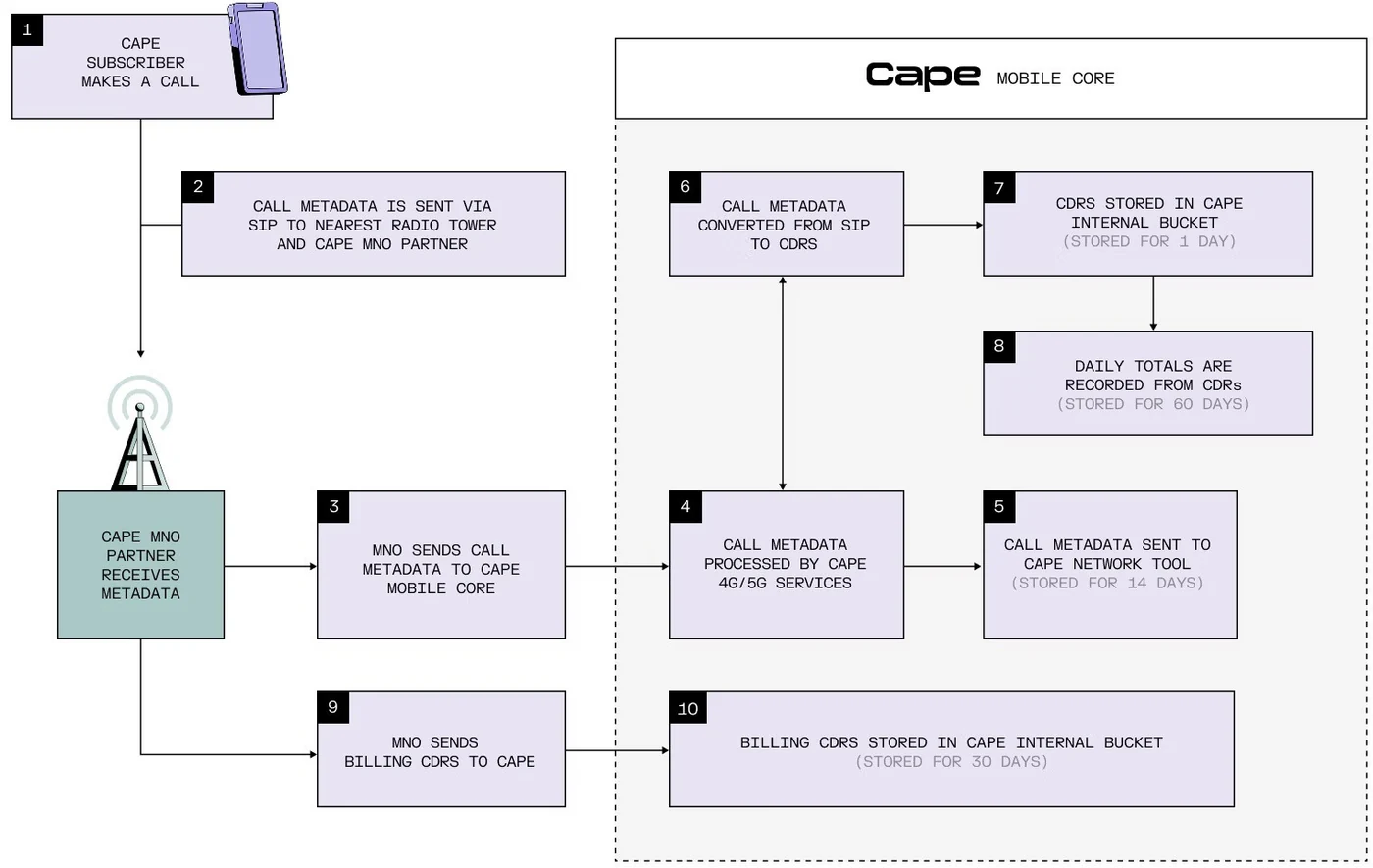
To address the privacy risks associated with long-term telecom data storage, alternative mobile providers are introducing services designed to minimize data exposure. Cape operates as a privacy-first mobile carrier that builds its own mobile core, allowing the company to control log generation and enforce strict data deletion policies.
Under its retention framework, Cape utilizes a Disappearing Call Logs feature designed to purge call and text metadata within days rather than years. SIP messages kept for network troubleshooting are converted into internal CDRs and deleted quickly, while daily usage totals are retained temporarily for billing purposes before being permanently erased.
Additionally, to prevent external tower operators and partner networks from linking network logs to individual subscribers, the service regularly rotates the unique identifiers visible to cell towers.
Auditing and Verifying Data Deletion
Because privacy claims require verifiable proof, providers utilizing shortened data retention windows often subject their systems to independent security reviews. For instance, third-party auditors like Trail of Bits have evaluated specific log retention features to confirm that call detail records and consumer metadata are actively purged in accordance with stated company policies.
Security experts note that while carrier security practices remain important, the most reliable defense against extensive metadata theft is simply collecting and holding less data. Records that are deleted days after a call takes place cannot be compromised in a future database breach.
Sources
- BleepingComputerYour Mobile Carrier Stores Your Call Logs for Years
Continue chronologically


Related stories
SpaceX Moves to Challenge AT&T, Verizon, and T-Mobile
SpaceX is advancing an ambitious mobile carrier strategy, securing spectrum assets and regulatory approvals to build a competitive wireless network.

SS7 and Diameter Flaws Expose Mobile Networks
Explore how vulnerabilities in SS7 and Diameter signaling protocols allow attackers to track phone locations, intercept calls, and bypass 2FA.
Carrier Deals Offer Up to $1,200 Off the iPhone Duo
T-Mobile, AT&T, and Verizon are offering savings of up to $1,200 on the iPhone Duo, but customers must commit to a 36-month plan.

Military Explores Commercial 5G Networks for Drone Defense
Military and defense organizations are exploring the use of commercial 5G networks and AI agents to sense, track, and defend against enemy drones.