
Hackers Exploit Critical Atlassian Flaw After Public PoC
Unauthenticated attackers are actively exploiting a critical file-access vulnerability affecting multiple self-hosted Atlassian product families, following the rapid publication of proof-of-concept material and technical reports.
 Radwan AbdulhadiEditor and technology writer

Overview of CVE-2026-21589
A critical vulnerability affecting multiple Atlassian product families, including Jira, Confluence, and Bitbucket, is being actively exploited in attacks that do not require user authentication. This issue, tracked as CVE-2026-21589, is an arbitrary file-access flaw disclosed on a Monday affecting self-hosted instances across eight distinct Atlassian products.
In response to the escalating threat landscape, Atlassian issued a security advisory where they warned system administrators managing self-hosted instances to apply security updates as soon as possible. The software maker noted that it cannot independently determine whether individual customer environments have already been compromised.
Technical Root Cause and Research
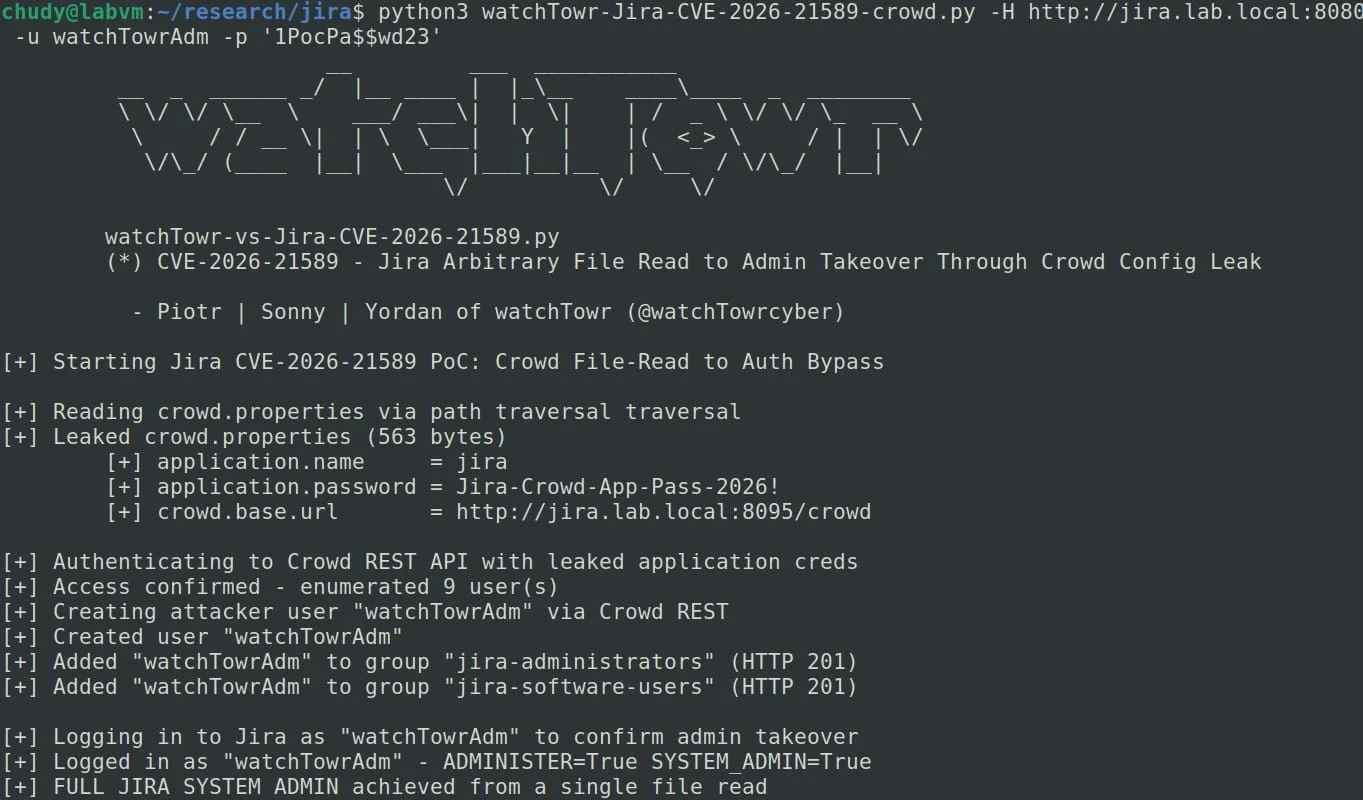
Following Atlassian’s initial advisory, offensive security company watchTowr published a technical report showing how CVE-2026-21589 could be successfully exploited to gain administrator-level access to Jira, Confluence, and Bitbucket in specific Crowd-integrated deployments. Atlassian Crowd provides centralized identity management, single sign-on, authentication, authorization, and access management for connected Data Center applications.
The vulnerability originates from a shared web-resource library that incorrectly converts double colons '::' into forward slashes '/'. Attackers can leverage this behavior to construct directory-traversal requests through plugin resource endpoints, retrieving protected application files without any authentication. While researchers confirmed file reads within Jira, Confluence, and Bitbucket, their specific exploitation technique could not traverse outside the standard Tomcat application context.
In Crowd-integrated Jira deployments, attackers are able to read plaintext application credentials located at WEB-INF/classes/crowd.properties. These harvested credentials can then be used to forge or create a Jira administrator account via Crowd’s API, provided that Crowd remains reachable and the application possesses sufficient permissions.
Rapid Exploitation in the Wild
Security firm Previdian detected active exploitation on its honeypot network only hours after the detailed technical report and proof-of-concept went public. According to Previdian's Ryan Dewhurst, the newly released technical data provided threat actors with enough information to rapidly scan for and probe exposed vulnerable instances across the web.
Dewhurst noted to BleepingComputer that exploitation attempts began hitting Previdian's honeypot network within two hours of watchTowr publishing its research. Additionally, a Nuclei template was swiftly released into the wild, which dramatically lowered the technical barrier to entry and made automated mass-scanning for vulnerable systems significantly easier.
Previdian has identified malicious probing and exploitation attempts originating from three specific IP addresses: 38.60.157[.]86, 146.70.187[.]234, and 159.26.119[.]225, recommending that organizations block them immediately. Security experts expect this malicious activity to surge over the coming days and weeks given the broad range of impacted products and the widespread availability of automated scanning tools.

Recommended Mitigations and Fixes
System administrators are strongly advised to review Atlassian’s bulletin for comprehensive details regarding fixed software versions and official remediation steps. Applying available security patches remains the most definitive solution to protect self-hosted environments from compromise.
Where immediate patching is not feasible, organizations should implement temporary defensive mitigations. These precautions include restricting external network access, deploying a web application firewall or custom proxy rule to block specified traversal patterns across all affected product lines, implementing Tomcat RewriteValve rules for Confluence, JSM, Jira, and Bamboo, or applying appropriate URL rewrite rules for Bitbucket.
Furthermore, security teams can utilize diagnostic resources provided by the security community to audit their networks. watchTowr has released a free scanner tool designed specifically to help administrators verify whether their self-hosted instances remain vulnerable to CVE-2026-21589.
Sources
- BleepingComputerHackers exploit critical Atlassian flaw after public PoC release
Continue chronologically

Related stories
Atlassian and OpenAI Expand Partnership to Power Enterprise AI
Atlassian and OpenAI expand their partnership, integrating frontier models to power AI experiences, Rovo, and developer tools like Codex.

Atlassian Patches Critical Vulnerability Affecting 8 Products
Atlassian has released critical security patches for an unauthenticated arbitrary file access vulnerability impacting eight enterprise products.

Cisco Patches Actively Exploited SD-WAN Zero-Day Flaw
Cisco has released urgent patches for a critical zero-day authentication bypass vulnerability in Catalyst SD-WAN Manager actively exploited in the wild.

Microsoft SharePoint Flaw CVE-2026-65660 Active Attacks
Microsoft SharePoint remote code execution vulnerability CVE-2026-65660 is actively exploited in the wild, prompting a strict CISA deadline.