Kali Linux 2026.3 Released With Six New Tools and KDE Plasma 6.7
The third Kali Linux release of the year brings upgraded kernels, new penetration testing utilities, and refreshed build scripts supporting Docker and Podman.
 Radwan AbdulhadiEditor and technology writer

Overview of Kali Linux 2026.3
The development team behind Kali Linux has announced the release of version 2026.3, marking the third major update for the platform this year. Designed specifically for ethical hackers, penetration testers, red-teaming professionals, and network security researchers, the distribution supports a wide array of hardware. Users can deploy the system as an installable operating system, run it as a live environment, or operate it on hardware ranging from Raspberry Pi devices to Android phones via Kali NetHunter.
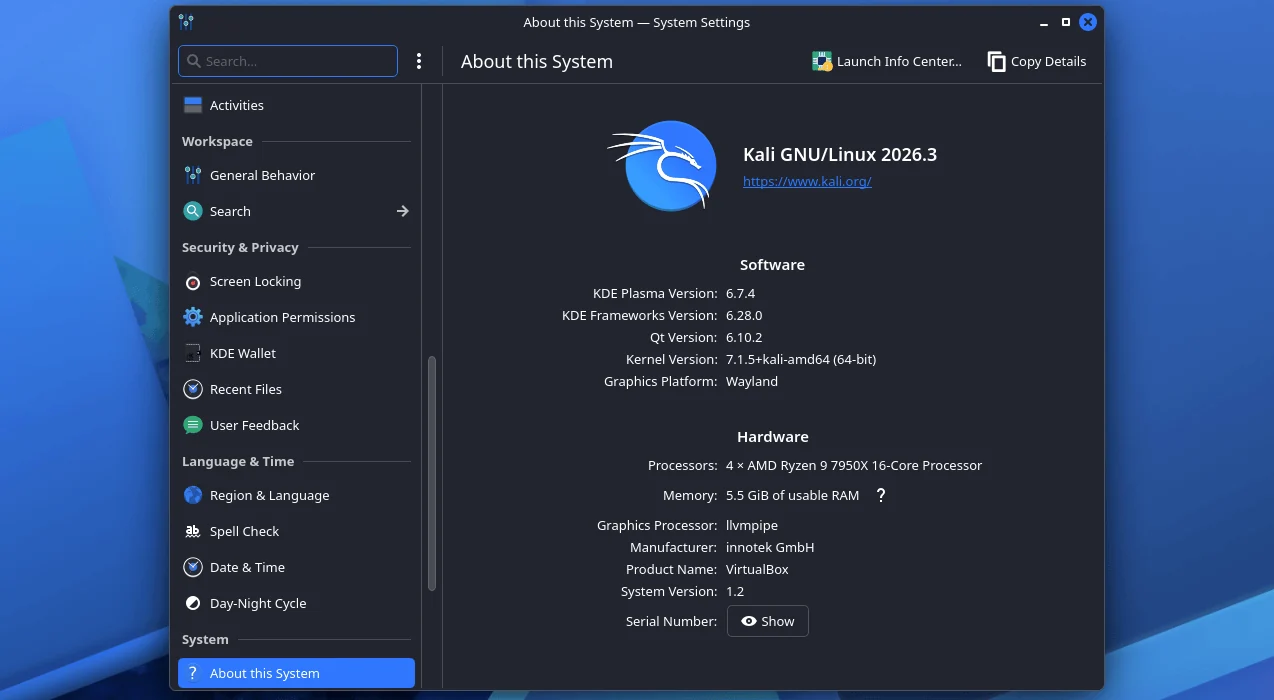
Alongside general system maintenance, the distribution update includes 126 package updates, the introduction of new libraries, and a major upgrade to the Linux kernel, moving it from version 6.19 up to 7.1.5. These changes ensure that security professionals working with modern hardware architectures and updated system components retain full compatibility during their assessments.
Six New Hacking Tools Added
As with traditional quarterly updates, version 2026.3 introduces several new utilities designed to aid security testing and vulnerability assessment workflows. Among the additions is dalfox, which functions as a powerful open-source XSS scanner and utility focused heavily on automation during web application testing.
Another prominent utility added to the software repositories is katana, serving as a next-generation crawling and spidering framework for web reconnaissance. Testers can also utilize qsreplace, a command-line tool that accepts URLs on standard input and replaces all query string values with a user-supplied string.
The release further expands capabilities by incorporating sdrangel, a Qt-based software-defined radio front-end for interacting with various hardware devices. Network and credential assessments are supported by snaffler-ng, an SMB share credential and sensitive data scanner, alongside rustscan, which provides modern port scanning functionality.
Desktop Environment and KDE Plasma 6.7 Updates
The graphical user experience has also received significant attention in this release, highlighted by the integration of KDE Plasma 6.7 alongside fresh icon designs. The updated desktop environment introduces performance enhancements, integrated Intel GPU power-usage optimizations, and layout workflow improvements.
Key workflow additions include per-screen virtual desktops that allow users to establish separate workspaces on a single display for web browsing, terminal sessions, and technical documentation. Navigation between these isolated workspaces has been accelerated directly from the Overview interface.
Furthermore, the Kali devs explained that support for additional Wayland protocols and portals continues to refine the user experience on modern Linux environments. Additional usability upgrades include the ability to duplicate network connections to save configuration time, as well as distinct refinements made to the System Monitor.
Refreshed Build Scripts and Container Support
Version 2026.3 brings a comprehensive overhaul to the build scripts utilized for generating official distribution images. The project has standardized script structures, command-line arguments, layouts, and overall visual aesthetics across multiple host platforms.
A notable addition to the build process is native container support. Developers can now perform builds inside containerized environments using either Docker or Podman. Each updated build script now incorporates a dedicated execution script that detects the available container engine, provisions the appropriate build container, and executes the compilation process internally.
While not every individual script has been fully migrated prior to this cycle, the project team plans to complete the transition by the subsequent Kali 2026.4 release, with future phases aiming toward complete build automation.
Availability and Installation Guidance
Security practitioners wishing to utilize the latest features can select a platform of choice, upgrade their current operating system deployment, or directly download ISO images for fresh installations and live environments.
For instances running on the Windows Subsystem for Linux, users are advised to transition to WSL 2 to secure proper graphics application compatibility, which can be verified via command prompts. Verification of a successful upgrade to version 2026.3 can subsequently be performed by querying the system release identification files.
Sources
- BleepingComputerKali Linux 2026.3 released with 6 new tools, desktop updates
Continue chronologically


Related stories
Kali Linux 2026.3 Released With New Tools and KDE Plasma 6.7
Kali Linux version 2026.3 has been released as the third update of the year, featuring six new hacking tools, kernel upgrades, and desktop improvements.
Microsoft October 2026 Patch Tuesday fixes 1,411 flaws
Microsoft's October 2026 Patch Tuesday addresses a record-breaking 1,411 flaws, featuring three zero-day vulnerabilities and new risk cohorts.

Germany Arrests Alleged Core Qilin Ransomware Member
Germany has arrested a Russian national suspected of being a leading member of the Qilin ransomware group following an extradition from Japan.

ASOS Confirms Cyberattack After Rogue In-App Notifications
British online retailer ASOS confirms a data breach following unauthorized push notifications sent to users via a compromised third-party platform.