Migrating PHP to Java with Kiro and AWS Transform
Migrating mature PHP codebases to Java can now be handled through a measurable, repeatable process using Kiro and a parity-first workflow.
 Radwan AbdulhadiEditor and technology writer
Moving from PHP to Java with Confidence
When engineering teams decide to move a mature PHP application to Java, they typically do so to gain stronger type safety, broader library support, and more predictable scaling. However, a PHP codebase built over the years using frameworks like Laravel, Symfony, or Doctrine often embeds business rules in less obvious places, ranging from Eloquent traits to XML mapping files. As a result, a structurally similar Java port can compile cleanly yet still behave differently.
To address these challenges, developers can utilize <a href="https://kiro.dev/">Kiro</a>, an AI integrated development environment (IDE) that pairs an AI agent directly with a codebase to execute multi-step engineering tasks while keeping the developer in the loop. This methodology transforms a PHP-to-Java migration from a one-time leap of faith into a structured, measurable process built on a reusable engine.
Core Architecture and Workspace Layout
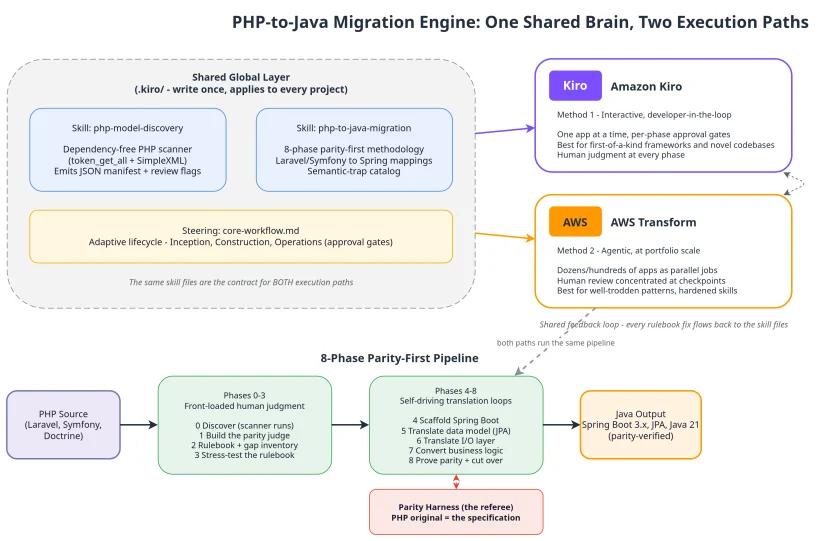
The migration engine operates on a shared-brain architecture where a global methodology layer informs multiple individual projects. Everything the engine relies on is packaged into versioned Markdown capability packages known as <a href="https://kiro.dev/docs/skills/">Skills</a>, alongside core workflow configuration rules located in <a href="https://kiro.dev/docs/steering/">Steering</a> files.
In a configured workspace, a global .kiro/ layer contains the discovery scanner and migration playbook. Beneath this global layer reside per-project folders containing individual PHP sources, generated Java outputs, and specification sub-folders. This ensures that any improvement made to the methodology benefits all subsequent migration projects.
Mechanical Discovery Scanner
The single most important rule of the engine is that developers should never read, guess at, or hand-translate a model or entity file before running the scanner. The scanner tool, discover-models.php, is a single-file, dependency-free command-line utility that inspects source text as tokens without executing the target code.
By applying three distinct discovery strategies—Eloquent model discovery across class inheritance chains, Doctrine attribute detection, and external ORM XML mapping file evaluation—the scanner emits a unified JSON manifest. Any ambiguity encountered during this pass is routed to a review-flag queue rather than left to guesswork, allowing human engineers to resolve potential discrepancies.
Dual Execution Paths: Interactive Kiro and AWS Transform
Because the migration knowledge is encapsulated entirely within versioned skill files rather than hardcoded into a single tool, teams can execute the same methodology through two distinct paths depending on their project scale and scope.
The first method utilizes <a href="https://kiro.dev/">Kiro</a> for interactive, developer-in-the-loop migrations. Operating one application at a time, the AI agent walks through an eight-phase workflow featuring explicit approval gates, allowing developers to review discovery manifests, rulebooks, and phase sign-offs interactively.
The second method leverages <a href="https://aws.amazon.com/transform/">AWS Transform</a>, an agentic AI service designed for large-scale migration and modernization that now integrates natively with Kiro. Through this integration, organizations can apply the exact same skill files to run autonomous migrations across multiple applications simultaneously at portfolio scale.
Parity Harness and Eight-Phase Workflow
The migration engine follows an eight-phase, parity-first workflow. Phase 0 prepares the inventory using the discovery scanner, while Phase 1 constructs a parity harness before any Java code is written. This harness replays request and response pairs against both the original PHP application and the generated Java port to verify equivalence.
By treating the original PHP application as the authoritative specification, the workflow refuses to declare the Java output correct until the parity harness successfully verifies it. Teams interested in exploring the complete workflow can examine <a href="https://github.com/aws-samples/sample-php-to-java-migration">the sample PHP-to-Java migration repository</a> provided for hands-on evaluation.
Sources
- AWS Machine Learning BlogBuild a repeatable PHP-to-Java migration engine with Kiro
Continue chronologically


Related entity coverage
Related stories
Workflow context for AI agents with Smartsheet MCP on AWS
Discover how the Smartsheet Model Context Protocol Server lets AI agents read, update, and act on live project data via Amazon Quick and Kiro.
Smartsheet Launches MCP Server to Connect AI Agents on AWS
Smartsheet introduces its general-available Model Context Protocol Server on AWS, enabling AI agents in Amazon Quick and Kiro to manage live work data.
IskayPet Unifies Corporate Knowledge with Amazon Bedrock
IskayPet built a multilingual corporate knowledge assistant using Amazon Bedrock Managed Knowledge Bases to streamline employee operations across Iberia.
AWS Introduces Trust in Depth to Safely Scale AI Agents
Enterprise leaders want AI agents to take on more work but struggle with trust. AWS details a layered approach to safely scale autonomous agents.