
Hugging Face Transformers Now Supports llama.cpp GGUF Models
The Transformers library can now load GGUF checkpoints directly, bridging the gap between efficient local inference and the standard PyTorch-based ecosystem.
 Radwan AbdulhadiEditor and technology writer
Democratizing Local Inference
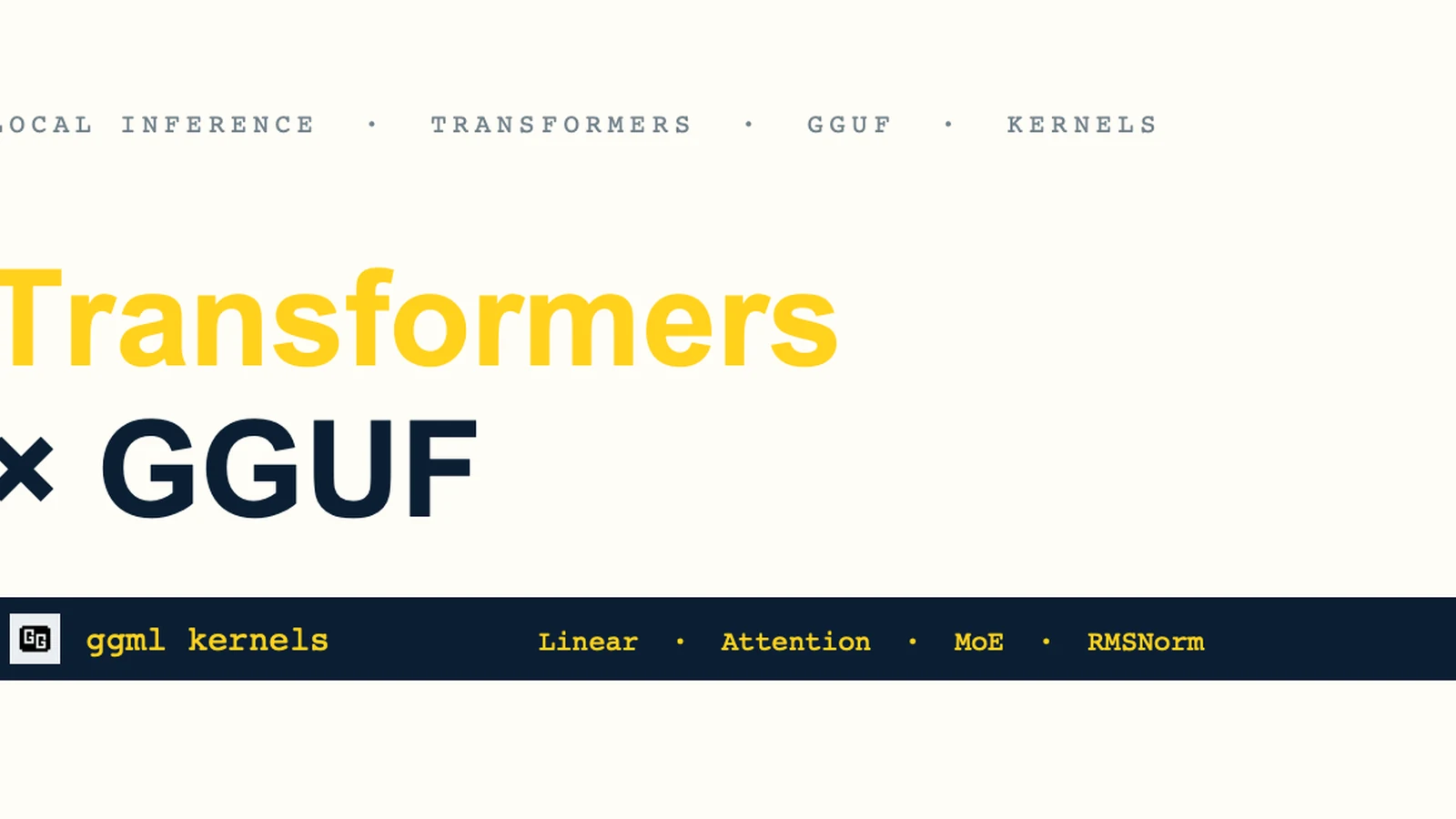
Hugging Face has announced a major update to its Transformers library, introducing support for running GGUF models. By enabling the loading of checkpoints specifically sized for local hardware, the company aims to make powerful artificial intelligence models accessible on standard consumer laptops. This development builds upon the success of [llama.cpp](https://github.com/ggml-org/llama.cpp), which has become a cornerstone of the local AI ecosystem, powering widely used tools such as Ollama, LM Studio, and Jan.
The GGUF format, developed by the team behind llama.cpp, is designed for efficiency and ease of use, packaging model weights, metadata, and tokenizer information into a single file. By supporting various quantization levels, it allows users to trade off model precision for a smaller memory footprint. According to the [Hugging Face Blog](https://huggingface.co/blog/transformers-llama-cpp-quants), this integration allows users to pick a GGUF file from the Hub and load it directly using the standard Transformers API.

Bridging Transformers and GGUF
To achieve performance competitive with dedicated inference engines, the Transformers library now reuses the underlying ggml kernels through the kernels library. This approach reduces generation overhead, with an initial focus on supporting the Qwen3.5 architecture for users running Apple Silicon devices. The integration is designed to be seamless; when weights remain packed on the Metal backend, Transformers automatically detects and loads the compatible layer kernels.
If a compatible kernel is unavailable, the system is designed to gracefully fall back to the standard dequantization process. For those looking for further details or wishing to view the technical implementation, an [Update on GitHub](https://github.com/huggingface/blog/blob/main/transformers-llama-cpp-quants.md) provides comprehensive insights into the codebase updates and requirements for developers, such as utilizing the latest versions of PyTorch.
Expanding Development Workflows
While llama.cpp remains the recommended engine for production-grade, highly efficient local inference due to its specialized memory management and broader hardware support, this new integration offers significant advantages for researchers and developers. By working with GGUF checkpoints inside the Transformers environment, developers can now inspect intermediate activations with hooks, modify a model's forward pass, or prototype custom layers using the familiar PyTorch toolset.
This compatibility also simplifies model validation and fine-tuning. Users can now load original checkpoints alongside their quantized GGUF versions to measure quantization error, or they can dequantize weights to resume standard fine-tuning workflows. Furthermore, the library supports the use of Transformers serve to expose an OpenAI-compatible API, allowing developers to connect local model instances to various client interfaces, including Jan or custom AI agents.

Quantization and Future Outlook
The GGUF ecosystem offers several quantization variants, such as Q4_K_M, which balances performance and precision by mixing tensor precisions. Hugging Face suggests that users start with these balanced profiles before experimenting with more aggressive quantization, which may be necessary to fit larger models into limited system memory. Because the quality trade-offs are highly dependent on the specific model and target task, the company emphasizes the importance of evaluating performance based on actual use cases.
Looking ahead, the integration highlights the complementary roles of [MLX](https://github.com/ml-explore/mlx) and the broader Hugging Face ecosystem. By bringing the performance benefits of ggml to a wider array of model architectures, the development team hopes to accelerate operations that were previously unsupported. For developers interested in tracking the latest discussions or contributing to this ongoing effort, [Upvote -](https://huggingface.io/login?next=%2Fblog%2Ftransformers-llama-cpp-quants) remains an option for authenticated users on the platform.
Sources
- Hugging Face BlogTransformers now runs llama.cpp quants