Southeast Asia’s Digital Economy to Hit $368 Billion
The 11th annual e-Conomy SEA report reveals that Southeast Asia's digital economy is growing 17% year-on-year, propelled by widespread generative AI usage and increasing consumer trust in digital tools.
 Radwan AbdulhadiEditor and technology writer
Surging Growth in Southeast Asia
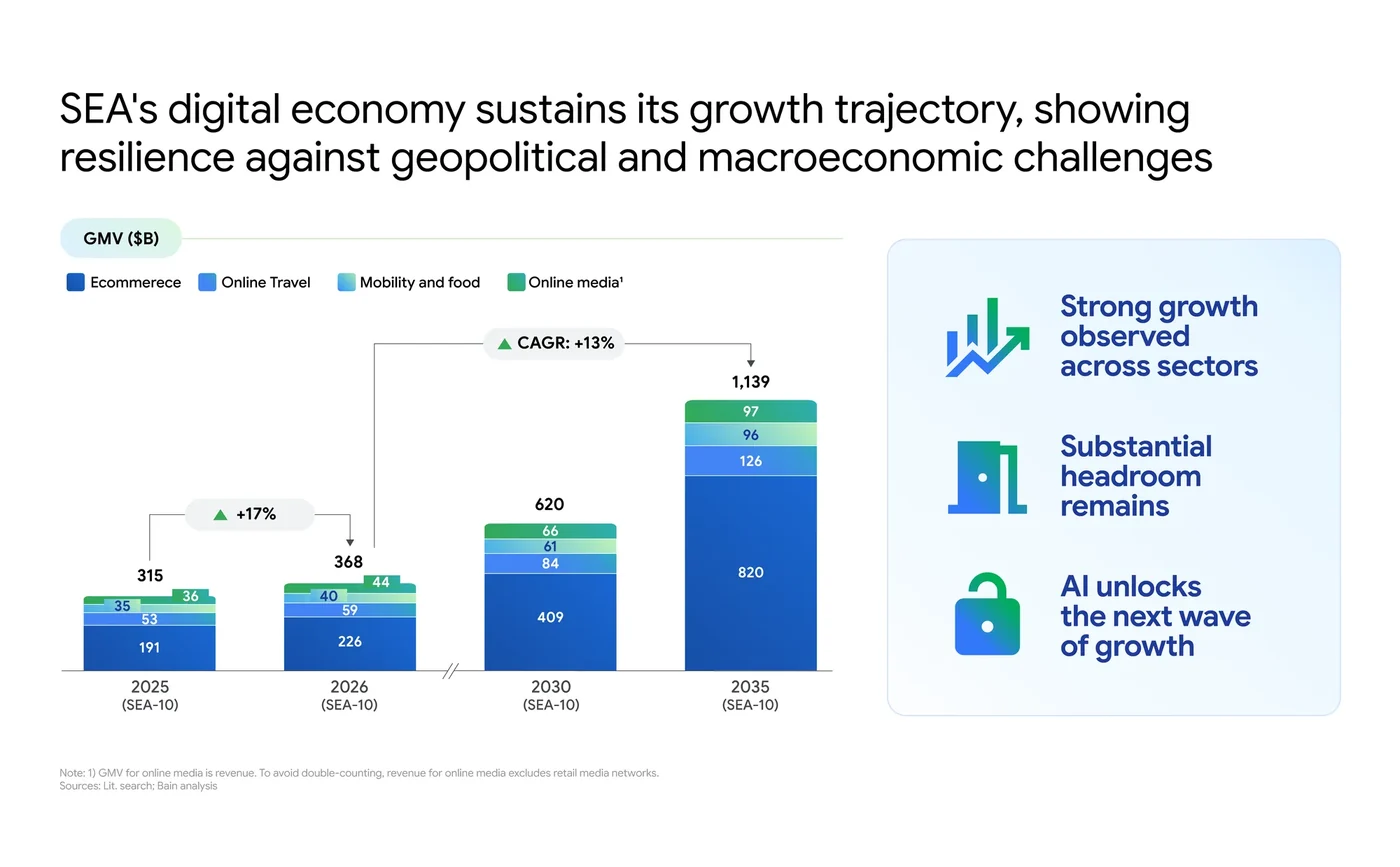
Southeast Asia’s digital economy is surging forward, with generative AI acting as a primary catalyst pushing the region toward a projected $1 trillion valuation by 2035. According to the 11th edition of the annual e-Conomy SEA report, widespread AI implementation is driving the region's digital economy to grow 17% year-on-year to reach $368 billion in Gross Merchandise Value in 2026. You can explore the full findings in the official e-Conomy SEA report. Further details are available from Google AI in the original source material.
Generative AI has quickly become an essential part of daily life for 243 million people across the region, which accounts for 58% of the working population. The technology is scaling four times faster than the rollout of the mobile internet, fundamentally reshaping how consumers live, shop, and move across five mainstay digital sectors.
Sector Breakdown and AI Integration
E-commerce anchors this regional shift with $226 billion in Gross Merchandise Value, marking an 18% year-on-year increase. Shoppers increasingly use multimodal discovery and in-app assistants to navigate complex purchases, which organically drives a 10% higher conversion rate and order volume uplifts as high as 75%.
In online travel, which reached $59 billion in Gross Merchandise Value with 10% year-on-year growth, traditional search engines remain the top platform for planning trips. However, generative AI has overtaken social media to become the second-most used tool for organizing complex itineraries. Meanwhile, online media generated $44 billion in revenue with a 22% year-on-year increase, personalizing content feeds and connecting audiences with more relevant ads.
Mobility and food delivery contributed $40 billion in Gross Merchandise Value, growing 15% year-on-year by saving consumers time through predictive suggestions, smarter routing, and AI-powered offerings like pooled rides. Digital financial services also saw robust expansion, hitting $1,650 billion in Gross Transaction Value with a 16% year-on-year increase, supported by real-time fraud detection and broader credit access.
Consumer Trust and Agentic Commerce
Digital automation is already well established in the region, where 72% of users rely on everyday features such as price tracking. This familiarity is clearing the runway for agentic commerce, with 75% of users expressing a willingness to let AI agents autonomously compare prices and complete transactions on their behalf.
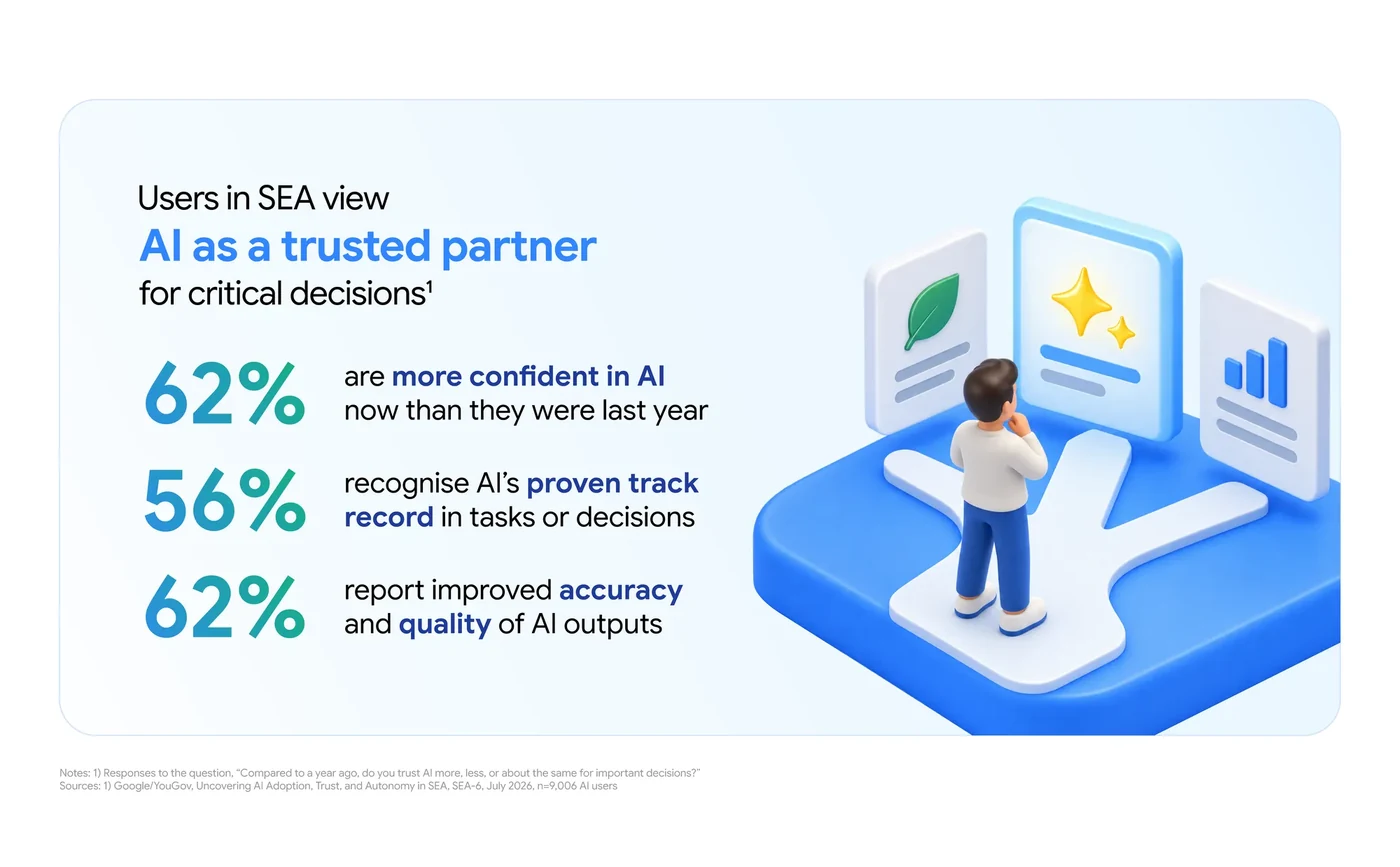
This momentum is rooted in regional optimism, as people in Southeast Asia view AI as a net benefit to society. In fact, 62% of respondents report greater trust in AI tools today than they did a year ago. Driven by proven track records, rising familiarity, and output accuracy, this trust signals a clear runway for deeper platform integration.
To feel fully comfortable using new agentic capabilities, users expect clear guardrails. These include robust privacy safeguards, transparent information regarding what AI can and cannot do, and the ability to easily reverse agentic transactions.
Infrastructure and Adaptation Requirements
To support a projected 60-fold increase in regional AI usage by 2030, the broader digital ecosystem must systematically evolve across four critical conditions. Businesses need to move beyond single-question AI interactions and adopt multi-step task automation backed by strong privacy safeguards and clear safety rules.
Physical expansion must also rapidly keep pace with soaring compute demand. Meeting this trajectory requires roughly a three-fold expansion in data center capacity over the next five years. Additionally, national frameworks and expanded clean energy access must guide next-generation facilities to ensure strict model and energy efficiency.
Finally, unified regional governance will anchor this trajectory. The upcoming ASEAN Digital Economy Framework Agreement will establish a region-wide digital trade pact designed to unlock further growth across the Southeast Asian digital economy.
Sources
- Google AISoutheast Asia’s digital economy to hit $368 billion
Continue chronologically


Related entity coverage
Related stories
Google expands AI & Economy research team
Google is adding economists and researchers to study AI adoption, productivity, labor-market change and the technology’s wider economic impact.

YouTube Music Introduces AI Labels for Streaming Content
YouTube Music rolls out new player page labels to identify fully or partially AI-generated tracks as AI music floods streaming platforms.

Researchers Say OpenAI and Google AI Models Tricked Into Nudes
Safety researchers reveal a novel attack method that easily bypasses safety guardrails on leading AI models from OpenAI and Google to generate explicit content.

When You Should—and Shouldn’t—Use AI to Search the Web
Discover when AI chatbots excel at web searches and when traditional search engines still deliver better, more trustworthy results.