NVIDIA Expands Advanced Tech Access for European Science
NVIDIA is expanding access to advanced technology for Europe's scientific community through open learning resources, strategic collaborations, and specialized compute initiatives.
 Radwan AbdulhadiEditor and technology writer
Joining the AI in Science Enablers Initiative
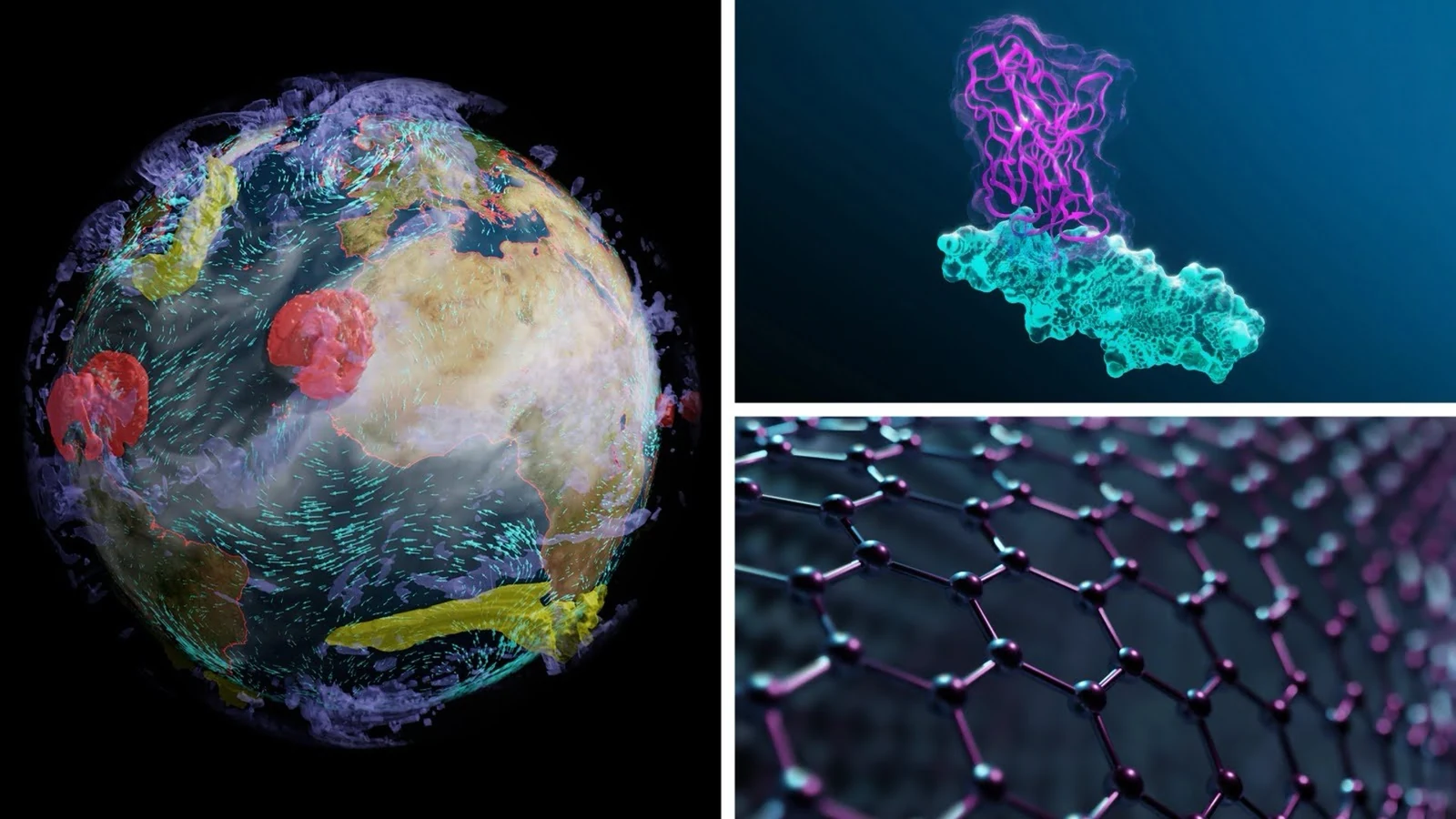
Much of today’s scientific progress begins with computation, but turning accelerated computing's potential into actual research breakthroughs—such as modeling climate systems, designing molecules, and simulating materials—often involves significant hurdles. Especially for smaller labs, early-career scientists, and science-based startups, assembling tools, finding compute, and building expertise can be challenging.
At the AI in Science Summit in Dublin, the European Commission launched the AI in Science Enablers Initiative, a shared framework connected to RAISE—the Resource for AI Science in Europe—that brings private-sector support closer to the continent's research community. By [joining the campaign], NVIDIA is deepening its commitment to supporting scientific progress across the region.
Ekaterina Zaharieva, European Commissioner for Startups, Research and Innovation, noted that Europe’s ambition in AI for science relies on uniting the strengths of the research community, industry, and other partners to provide researchers with essential tools, expertise, and resources.
Open Source Models, Datasets, and Scientific Software
NVIDIA's participation begins with open source technology. The company has released more than 250 open models, 250 open datasets, and over 1,400 open source software projects spanning large language models, healthcare, robotics, climate science, physical AI, autonomous vehicles, and scientific research. These models and datasets are hosted on Hugging Face and GitHub.
Building upon this open ecosystem, researchers can construct agentic reasoning capabilities using [NVIDIA Nemotron], a family of architectures, open weights, open source models, training data, and recipes. Furthermore, specialized scientific software such as the [NVIDIA BioNeMo Agent Toolkit] helps accelerate research across biology, chemistry, and molecular design.
The ecosystem is further supported by additional developer tools and microservices, including [NVIDIA PhysicsNeMo] libraries, [NVIDIA Earth-2] models, and [NVIDIA ALCHEMI NIM microservices] designed to assist researchers in fields ranging from weather and climate to energy, engineering, physics, and material sciences.
Open Learning Resources and Deep Learning Training
To build advanced intelligence capabilities across Europe, knowledge must travel as freely as compute. Addressing this requirement, the NVIDIA Deep Learning Institute has launched an [open source courseware hub] featuring hands-on course materials covering accelerated computing and deep learning.
These materials are freely downloadable and openly licensed with no enrollment requirements, fees, or deadlines. Modular by design, the courses can be adapted for university curricula, supercomputing center bootcamps, or developer community events, while serving as a direct bridge to NVIDIA's broader [training and certification programs].
Collaborations with European AI Factories and Startups
NVIDIA is also collaborating with cloud infrastructure partners and European national AI factories to open new routes for startups and small- and medium-sized enterprises (SMEs) to access sovereign European compute and services.
For instance, NVIDIA is working closely with national initiatives in [France], Spain, and Sweden. The NVIDIA Inception program for startups provides access to compute resources and technical support, lowering entry barriers for early-stage companies seeking high-performance infrastructure.
In France, AI2F became the first AI factory to collaborate with the Inception program for a four-month period, yielding positive results. Meanwhile, the BSC AI Factory in Spain ran a pilot initiative and is rolling out its full accelerator program, with other European national AI factories looking to replicate the model by 2027 to build self-sustaining AI ventures.
Supercomputing Infrastructure and Hackathons
EuroHPC supercomputing centers, including CINECA and JSC, provide academia and startups with free access to NVIDIA GPU infrastructure and services for open research. NVIDIA complements this access with office hours, bootcamps, and hackathons designed to help researchers fine-tune models on their own datasets.
As part of these collaborative efforts, NVIDIA is co-organizing a European AI hackathon alongside Austrian Scientific Computing, the Leibniz Supercomputing Centre, the High-Performance Computing Center Stuttgart, and The Cyprus Institute for Pharos-CY.
Furthermore, NVIDIA is powering Europe's largest single-year buildout of supercomputing capacity to date, with 35 supercomputers currently in development across the continent. Together, these systems aim to equip over 3 million researchers with next-generation infrastructure to accelerate discoveries across climate science, drug development, materials research, and beyond.
Sources
- NVIDIA BlogNVIDIA Expands Advanced Technology Access for Europe’s Scientific Community Through Open Learning Resources, Collaborations and Compute
Continue chronologically


Related entity coverage
Related stories
NVIDIA Expands Agent Toolkit to Ground Enterprise AI
NVIDIA expands its open-source Agent Toolkit with the Agent Knowledge Foundation, integrating company data to build trustworthy enterprise agents.
C-BRAIN and NVIDIA Deploy Open Source AI Tools for Dementia
Discover how C-BRAIN is collaborating with NVIDIA to deploy open source AI tools and accelerate research for millions living with dementia.

NVIDIA: Security Requires Engineering for AI Agents
NVIDIA emphasizes a rigorous engineering approach to AI security, advocating for enforceable controls, agent identity, and standardized testing across the stack.
AWS Launches Open-Source Physical AI Toolchain for Robotics
Amazon Web Services has launched an open-source Physical AI Toolchain to help roboticists streamline training, simulation, and edge deployment.