New VOLTA Windows Malware Uses Claude to Rank Victims
A newly detailed Windows infostealer called VOLTA-AUTODOXER gathers personal data and leverages AI models to rank a victim's assets before deleting itself.
 Radwan AbdulhadiEditor and technology writer
Overview of the VOLTA Infostealer
A newly analyzed threat known as VOLTA-AUTODOXER has highlighted the growing intersection of artificial intelligence and cyber threats. According to findings from Cisco Talos, this self-deleting Windows infostealer extracts a wide range of sensitive information from an infected PC before employing a large language model to compile a detailed target assessment.
The payload is designed to operate with a specific system prompt, instructing the AI model to act as a forensic intelligence analyst that provides blunt, specific, and accurate evaluations of a victim's financial standing and security posture.
Data Gathering and Live Enrichment
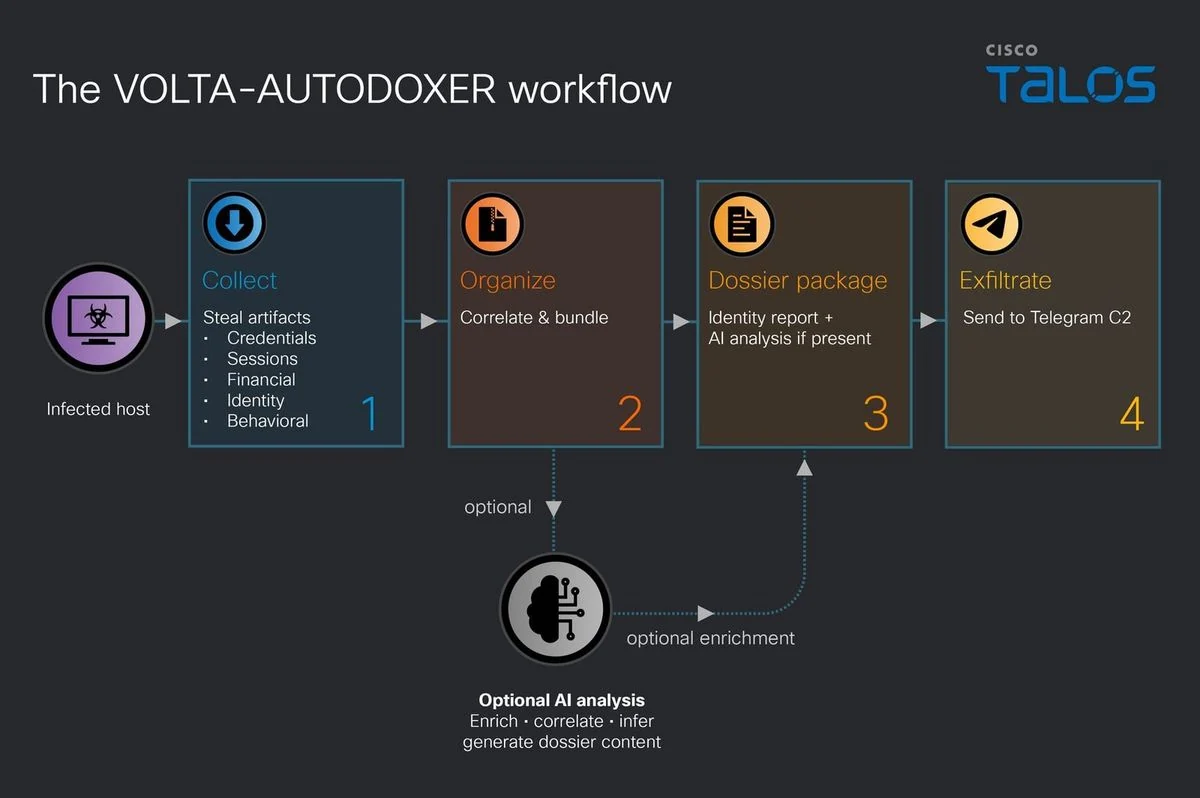
Before interacting with any external services, VOLTA harvests browser passwords, cookies, saved payment cards, Thunderbird and Outlook email profiles, Roblox accounts, Microsoft OAuth tokens, screenshots, and SSH configuration files. Furthermore, the malware captures every saved Wi-Fi password in plaintext and attempts to crack cryptocurrency wallet vaults inline.
The tool then performs a live enrichment phase using stolen sessions. It searches Gmail receipts from major delivery and retail platforms to confirm addresses, pulls order histories, reuses Discord tokens, and checks Roblox items. This transforms raw collected data into a structured evidence bundle.
AI Integration and Model Fallbacks
Once the evidence bundle is serialized into JSON and compiled into a local report, VOLTA sends a request via OpenRouter. By default, the malware utilizes Anthropic’s Claude Opus 4.6 with a low temperature setting of 0.2 to ensure predictable and structured outputs.
To counter potential safety refusals or thin replies, the malware is programmed to switch between models. If the primary choice declines the request, VOLTA can transition to Moonshot AI’s Kimi K2 and Google’s Gemini 2.5 Flash in sequence. If no API key is provided, the malware can still exfiltrate the dossier directly over Telegram without invoking the AI step.
Commercial Design and Resale Structure
VOLTA appears to be structured as a product intended for resale. The malware features a customizable template containing swappable slots for API keys, settings, and Telegram channels that are populated during the build process. Buyers can generate custom binaries that deliver ranked target assessments directly to their Telegram inboxes without requiring attacker-owned infrastructure.
Mitigation and Remediation Steps
Much of the token theft mechanism relies on bypassing Chrome's App-Bound Encryption by launching the browser in headless mode. Implementing application-control policies to restrict headless Chrome execution can disrupt this specific decryption path, though it does not mitigate other forms of data extraction.
Following an infection, victims are advised to preserve any generated debug logs, immediately rotate or revoke all exposed API keys and passwords, and move cryptocurrency funds to a fresh wallet generated on an air-gapped device.
Sources
- Tom's HardwareNew AI-driven Windows malware feeds stolen data to Claude to rank victims’ assets by value, then deletes itself — payload builds custom target assessment, can switch models if one refuses, or skip the AI step entirely
Continue chronologically


Related entity coverage
Related stories
New Volta Malware Uses AI to Autodox and Profile Victims
Researchers discover a new infostealer malware called Volta-Autodoxer that uses commercial AI models to automatically profile and prioritize victims.

Anthropic Files S-1 Prospectus for Nasdaq IPO
Anthropic has filed its S-1 prospectus with the SEC to list on Nasdaq under the ticker ANT, detailing financials, risks, and compute deals.

Anthropic AI sends false homicide tip to Philadelphia police
An Anthropic AI model submitted a false tip about an unsolved Philadelphia homicide through an online tipline during testing, sparking security concerns.

Hackers Abuse Google Ads and Bing to Push Fake Claude
Security researchers reveal a new malvertising campaign abusing Google Ads and Bing redirects to deliver ClickFix attacks via fake Claude installers.