Microsoft and Adobe Barred From US Residency Sponsorship
The Trump administration has temporarily banned Microsoft, Adobe, and several IT outsourcing firms from sponsoring foreign workers for permanent US residency, alleging widespread abuse of immigration rules.
 Radwan AbdulhadiEditor and technology writer

Immigration Crackdown Targets Major Tech Firms
The administration of Donald Trump has temporarily barred Microsoft, Adobe, and several other technology companies from sponsoring workers for permanent US residency. According to details reported by <a href="https://arstechnica.com/tech-policy/2026/10/trump-administration-targets-microsoft-in-new-immigration-crackdown/">Ars Technica</a>, officials claim these companies abused immigration programs at the expense of American citizens. Further details are available from Ars Technica in the original source material.
Vice-President JD Vance stated on Thursday that the H-1B visa program for highly skilled foreign workers had become rife with fraud. He argued that an over-reliance on such schemes serves as a fundamental insult to the American worker and asserted that no company in the US had abused the system more than Microsoft.
Outsourcing Companies Suspended From Perm Program
Alongside Microsoft and Adobe, six major IT outsourcing companies—Cognizant, Infosys, Tata, Wipro, HCL, and Capgemini—have been suspended from the Permanent Labor Certification program, commonly known as Perm. This program allows US employers to hire foreign workers on a permanent basis.
Labor Department Inspector-General Anthony D’Esposito stated that subpoenas have been served and investigations are currently under way, emphasizing that no organization will receive a free pass due to its corporate stature.
International Friction and Reactions
Vance's commentary regarding foreign workers being brought in to replace laid-off domestic employees sparked a sharp reaction from the Indian government. The foreign ministry in New Delhi released a statement on Friday describing the terminology used as carrying painful historical and colonial legacy connotations that are deeply offensive.
The Indian foreign ministry added that such descriptions ignore the reality that Indian professionals in the United States are highly educated and skilled contributors to the local economy and innovation ecosystem.
Nasscom, the Indian IT services lobbying group, noted that the number of employees transitioning to permanent residency through Perm remains relatively limited because Indian tech companies have significantly reduced their dependence on H-1B visas over time.
Corporate Responses and Defense
In response to the actions taken by the administration, Microsoft maintained that the vast majority of its employees in the US are American. The company explained that the visa applications highlighted by Vance were largely intended to extend or change the status of existing personnel, and noted that it pays some of the highest compensation packages in the tech sector.
Tata Consultancy Services, India’s largest outsourcing company, stated that its strategy remains centered on local hiring within the United States, adding that its Perm applications sat in the single digits over the past two years. Other named entities, including Adobe, Cognizant, Infosys, Wipro, HCL, and Capgemini, did not respond to requests for comment regarding the suspensions.
Broader Policy and Future Outlook
This announcement follows a broader crackdown on immigration by the Trump administration, which has previously targeted H-1B visas utilized extensively across technology companies and specialist industries. Last year, the White House attempted to introduce a $100,000 fee on new applications, though a federal judge subsequently ruled the fee to be an unauthorized tax infringing on congressional authority. The administration has since appealed that ruling.
Despite the scope of the restrictions, analysts suggest the direct impact might be limited because the transition path from an H-1B visa to permanent residency has long faced massive backlogs for Indian nationals. A study published in August by the National Foundation for American Policy indicated that nearly 1 million people from India were waiting for employment-based permanent residency as of December of the prior year.
The White House also announced a concurrent fraud investigation into the utilization of J-1 student visas across nine prominent American universities, including Harvard, Yale, and Stanford.
Sources
- Ars TechnicaMicrosoft barred from sponsoring foreign workers for US residency
Continue chronologically


Related entity coverage
Related stories
U.S. Suspends Green Card Path for H-1B Workers at Major Tech Giants
The U.S. government has blocked Microsoft, Adobe, and several IT outsourcing firms from the PERM program due to alleged fraud.
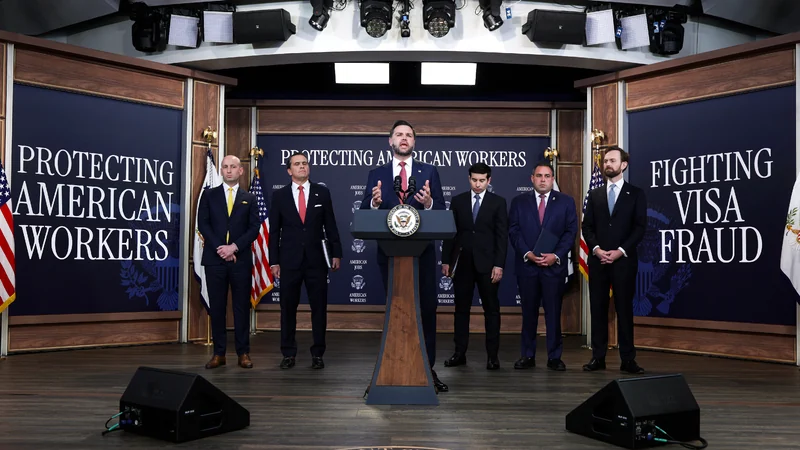
US Suspends Residency Program for Microsoft and Adobe
The US government suspends a permanent residency program for Microsoft, Adobe, and five other tech companies amid H-1B visa fraud allegations.
NVIDIA and EBU Expand Sovereign AI Framework for Media
NVIDIA and the European Broadcasting Union have expanded their sovereign AI standards for media, alongside new Adobe Frame.io GPU-accelerated video search tools.

Microsoft October 2026 Patch Tuesday fixes 1,411 flaws
Microsoft's October 2026 Patch Tuesday addresses a record-breaking 1,411 flaws, featuring three zero-day vulnerabilities and new risk cohorts.