Managing Amazon Bedrock Costs: A FinOps Playbook
A newly detailed five-stage operating model helps FinOps and platform engineering teams track, govern, and optimize spending on Amazon Bedrock generative AI workloads.
 Radwan AbdulhadiEditor and technology writer
The Generative AI Cost Challenge
Managing expenses for generative AI applications represents a shared responsibility between development teams and cloud finance stakeholders. While early cost-saving tactics often focus on comparing per-model token rates or shortening prompts, these methods rarely answer critical financial questions as usage scales across an enterprise.
Agentic workflows introduce additional complexity because they issue multiple model invocations and maintain larger contexts per task compared to standard conversational assistants. Consequently, token consumption scales with workflow autonomy rather than simple user interactions, making cost management an essential architectural discipline. Teams can model rates using the AWS Pricing Calculator and review official details via the Amazon Bedrock pricing page to better understand their workload requirements.
A Five-Stage Operating Loop for FinOps
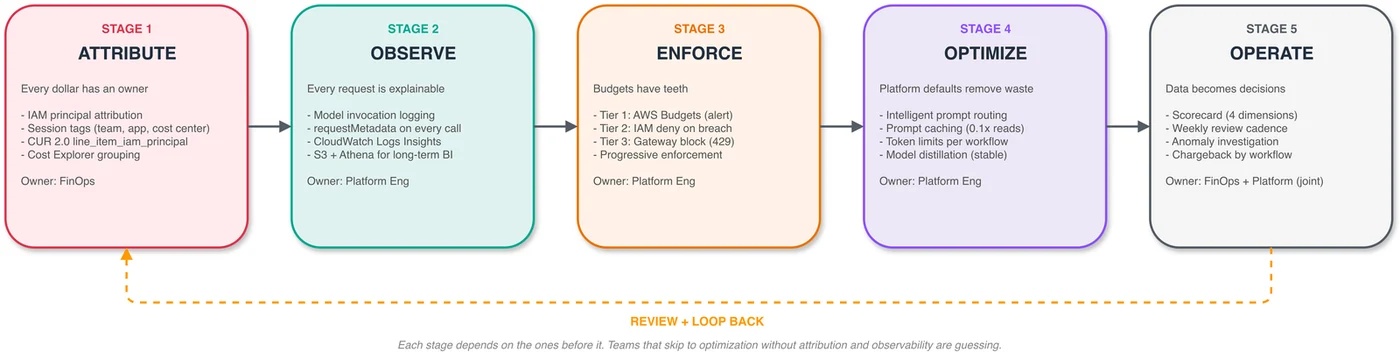
To move beyond simple guesswork, organizations are adopting a repeatable, five-stage operating model for Amazon Bedrock. The framework divides responsibilities clearly between FinOps practitioners and platform engineering teams to maintain accountability without stifling innovation.
The continuous loop begins with attribution, ensuring every dollar maps directly to an identity, team, and application. The second stage focuses on observability so that every request includes descriptive metadata. Subsequent stages enforce budgets, optimize platform defaults centrally, and establish a review cadence to turn metrics into actionable financial decisions.
Granular Cost Attribution and IAM Principles
Effective cost management relies entirely on accurate attribution. Amazon Bedrock automatically attributes inference costs to the AWS Identity and Access Management (IAM) principal that executed the API call across all available models.
By activating IAM principal data in AWS Cost and Usage Report (CUR) 2.0 and tagging IAM principals with business dimensions, organizations achieve invoice-grade visibility. These tagged entries appear inside AWS Cost Explorer within 24 to 48 hours for streamlined filtering by team, application, or cost center, as detailed in reports on introducing granular cost attribution for Amazon Bedrock.
Resolving the Shared-Role Problem
A common challenge in enterprise deployments is the shared-role problem, where a centralized large language model gateway invokes Amazon Bedrock using a single IAM role. This architecture can completely eliminate per-user visibility if not configured properly.
To restore per-user and per-tenant attribution, platforms can implement per-user session management. By having the gateway assume the invocation role once per user, passing user attributes as session tags, and caching credentials safely for up to an hour, organizations maintain detailed tracking behind a shared access point.
Alternative Attribution Paths and Workloads
In addition to core IAM principal attribution, Amazon Bedrock provides application inference profiles and workspace projects to accommodate various infrastructure patterns. Application inference profiles allow teams with stable application sets to pre-create per-application resources on the runtime endpoint.
Alternatively, projects and workspaces support OpenAI-compatible workloads across the bedrock-mantle endpoint. Developers can explore further guidance on managing AI costs with Amazon Bedrock Projects to determine the optimal attribution strategy for their specific architectural requirements.
Sources
- AWS Machine Learning BlogManaging Amazon Bedrock costs end to end: A playbook for FinOps and platform teams
Continue chronologically


Related entity coverage
Related stories
Build Multi-Agent Pipelines with Amazon Bedrock AgentCore
Learn how to build a multi-agent music production pipeline on Amazon Bedrock AgentCore Runtime Instances using shared sessions and GPU infrastructure.
Building Agentic Retrieval on Amazon Bedrock with AWS CDK
Learn how to build enterprise agentic retrieval on a Managed Amazon Bedrock Knowledge Base using the AWS CDK and Amazon Bedrock AgentCore.
Circle K Cuts DevOps Incident Triage Times With Amazon Bedrock
Circle K's DevOps team accelerated incident triage from up to 60 minutes down to under 15 minutes by implementing an agentic AI system on Amazon Bedrock.
OpenAI GPT Models Arrive on Amazon Bedrock in Canada
Canadian organizations can now access OpenAI GPT models on Amazon Bedrock from Canada (Central) and Canada West (Calgary) using cross-Region inference.